Some links on this site are affiliate links. If you book through one, Tokyo Trailhead earns a commission at no extra cost to you. It never decides what appears here.
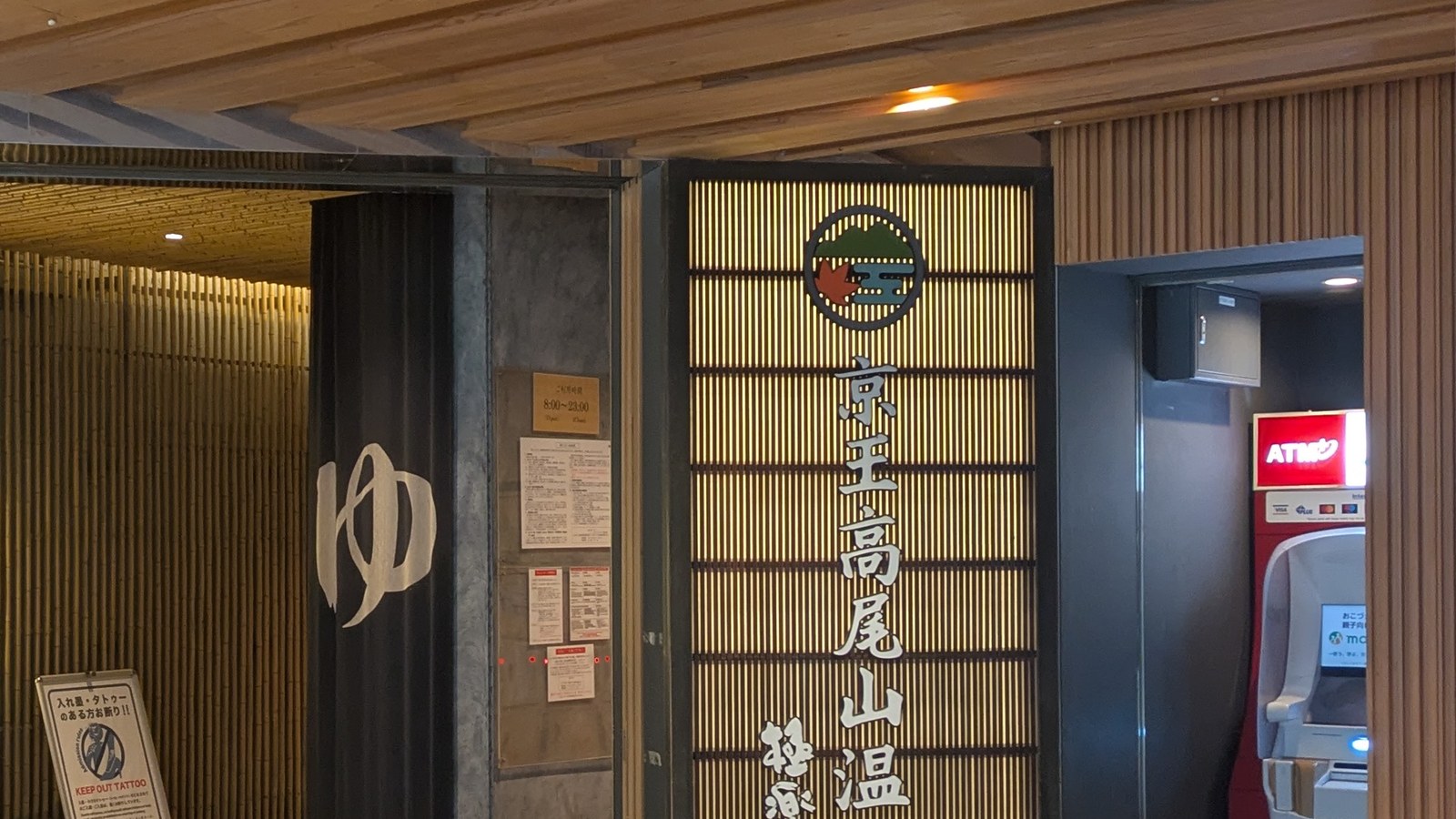
You come down off the mountain and walk back to the station. The hot spring is already there — built into the same block as the ticket gate. No taxi, no bus, no onward journey to arrange. You have arrived.
It is the best available ending to a day on Mount Takao, and almost everyone gets almost all the way to using it. What catches people out is the last thirty metres: the stretch between the curtain over the doorway and the front desk, where a rule nobody mentioned turns them around.
Keio Takaosan Onsen is unusually well served in English. There is a proper English website, and a printed English pamphlet by the door with prices, a floor plan and a description of every bath. So this guide will not repeat what they already do well. It covers what they leave out — which lives entirely in the Japanese-language pages, and which, as it happens, is mostly the part that matters to somebody who has just walked down a mountain.
The essentials
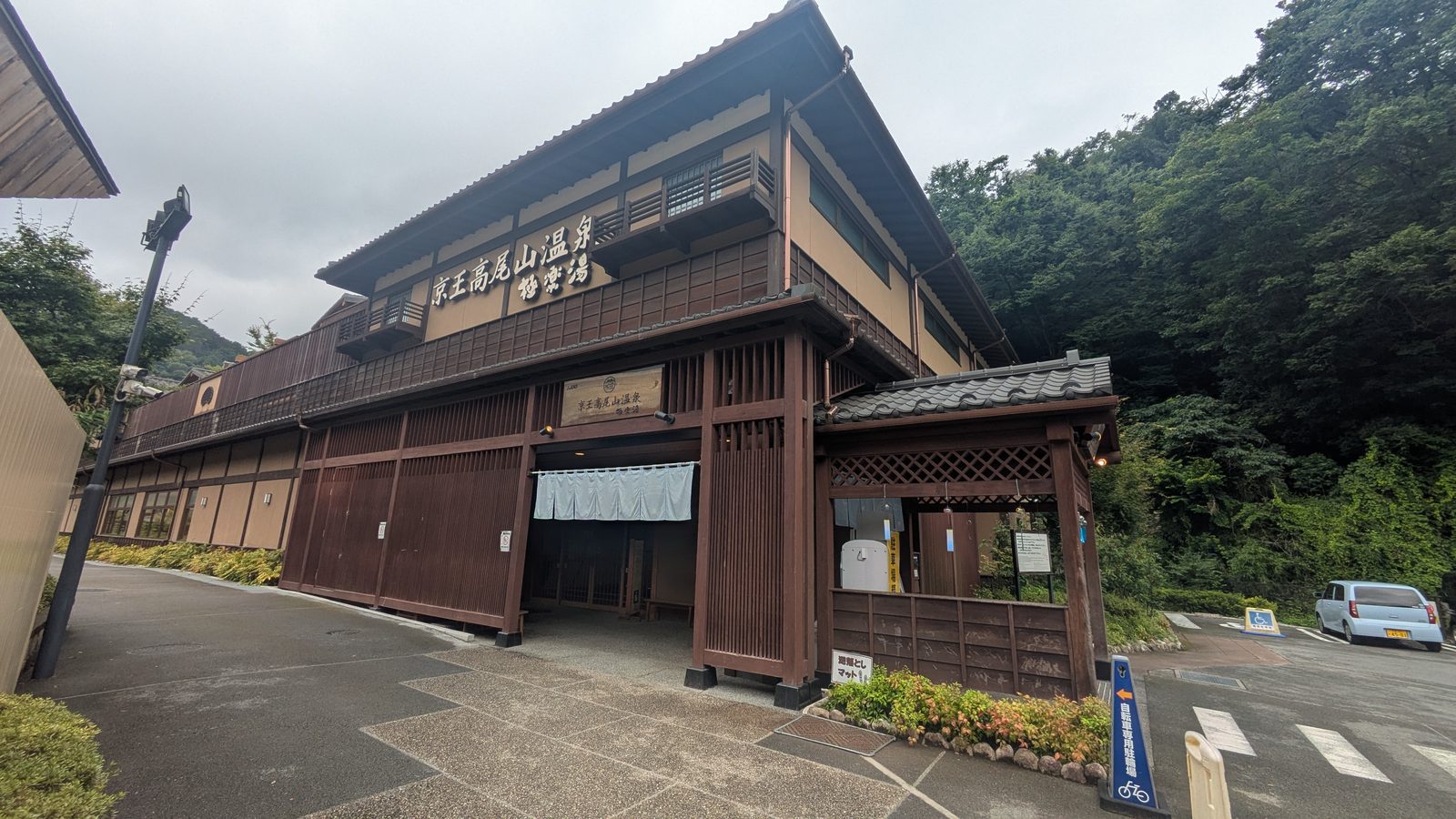
| Where | Beside the ticket gate at Takaosanguchi Station, on the Keio Line. The pamphlet describes it as adjacent to the station. That is not marketing |
|---|---|
| Adult (13 and up) | ¥1,100 on weekdays. ¥1,300 at weekends, on public holidays and in peak season |
| Child (4 to 12) | ¥550 on weekdays, ¥650 otherwise. Under 3 free |
| Peak season | The operator lists 29 December to 3 January, Golden Week, the mid-August Obon period, the autumn foliage season, plus other unspecified dates. The English pamphlet spells the autumn one out as 1 to 30 November |
| Hours | 8:00 to 22:30. Last entry 21:45 |
| The baths | On the second floor. There is a lift |
| The water | Simple alkaline hot spring. The source is 26.2°C (79.2°F); the pamphlet lists the outdoor rock baths as warm and hot |
| Provided | Shampoo, conditioner, body soap, hairdryer, toner and lotion |
| Not included | Towels — but you can buy a face towel and rent a bath towel from the ticket machine, which has an English option |
| Payment | Cash and IC cards (Suica, PASMO) work at the ticket machine. Six credit card brands are also accepted, though we could not confirm where. No IC top-up on site |
| Re-entry | None. Step outside and you pay the entrance fee again |
First things first: can you get in?
Four rules decide whether you get through the door. Two of them are printed in English. Two are not, and one of those is the most useful thing on this page.
Tattoos: no, and there is no workaround
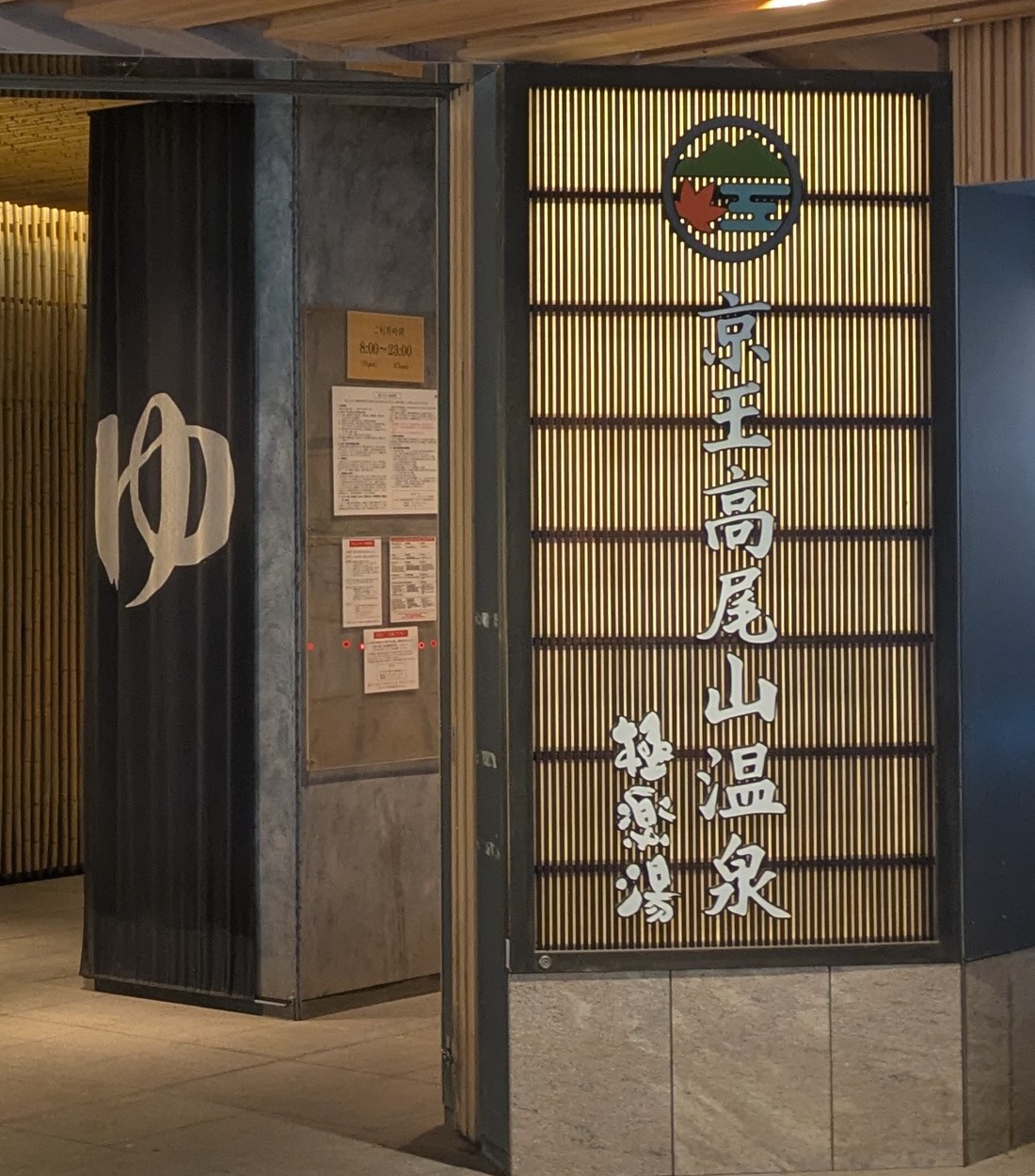
A free-standing folding sign is set up just inside the entrance, with a crossed-out pictogram and, in red capitals, `KEEP OUT TATTOO`. It is the largest piece of English at the door.
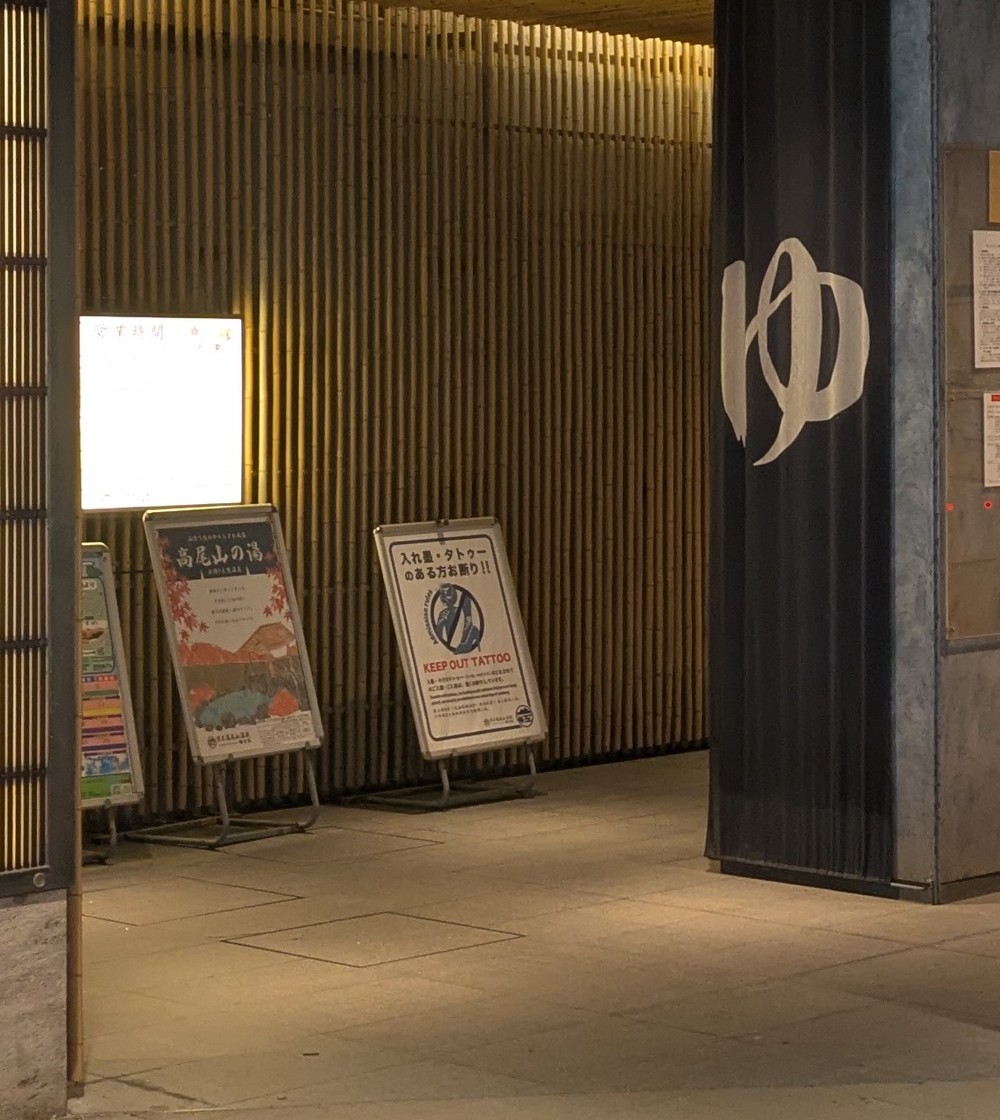
What the English does not tell you is how absolute the rule is. From the operator’s Japanese FAQ:
- Size makes no difference. A small tattoo is still a refusal.
- Stickers, paint and temporary tattoos count.
- Covering it does not work. Taping over a tattoo, or putting a sticker on it, is refused in its own right — on hygiene grounds as well as policy.
- It is not only the baths. The restaurant and the other rooms inside are closed to you too.
- It applies after you have paid. If staff notice a tattoo once you are inside, you will be asked to leave.
Plenty of bathhouses in Japan have softened this over the last decade. This one has not. That is worth knowing while you are still in Tokyo rather than at a doorway in Takao — and if it rules you out, the shopping street between the onsen and the trailhead has soba, ice cream and beer, and no such policy.
If this rules you out, there is a separate guide to what your remaining options actually are: a private shower three minutes from this station, a cover sticker policy one valley away, plus the single guided day that will drive you to a hot spring that accepts tattoos. It is here: Mount Takao with tattoos. To look at that guided day on its own, it is listed on GetYourGuide, an affiliate link that earns this site a commission at no extra cost to you.
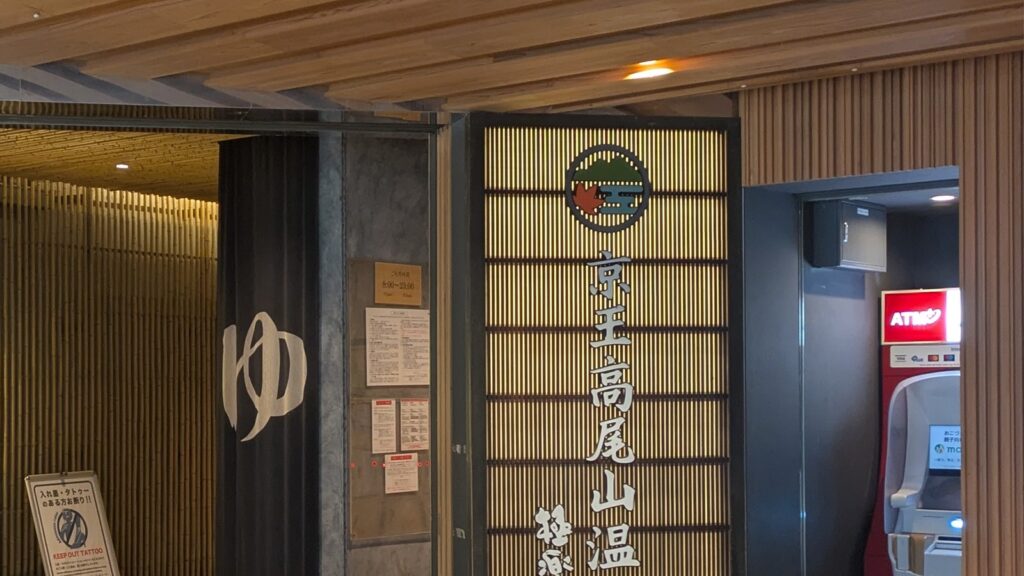
Affiliate link. This site earns a commission if you book through it, at no extra cost to you. Photo from our own walk.
Plasters and blister tape: also no
This is the one that catches hikers, and we have not found it stated in English anywhere.
You cannot get into the water wearing a plaster (band-aid) or a medicated compress. The operator refuses it on hygiene grounds. A graze is fine, as long as it has stopped bleeding.
Now think about what that means at the end of a hike. Four hundred metres of climbing in shoes you do not wear every day is precisely how blisters happen, and the reflex is to cover the sore spot as soon as you feel it. If you patch a heel at the summit and then come here, the patch has to come off before you get in.
So deal with your feet after the bath, not before. Keep the plasters in your bag until you are dressed again.
Children
- Mixed bathing is not allowed from the age of seven — a change in Japanese law that took effect on 1 April 2022. Above that age, a parent and child of different sexes cannot bathe together.
- The onsen adds a rule of its own: a child under seven who is 120 cm or taller may also be turned away from mixed bathing.
- Children cannot bathe unaccompanied. An adult has to be with them.
Alcohol
If you have been drinking, you will not be admitted, and bathing after a drink is refused inside as well. The summit sells beer and so does the shopping street. Have the bath first; the restaurant on the ground floor sells beer afterwards, which is the correct order anyway.
The right order for the last hour
There is a correct sequence to this, and it is not obvious. Getting it right costs you about five minutes and saves you from doing things twice.
1. Wash your boots first, outside, at the station
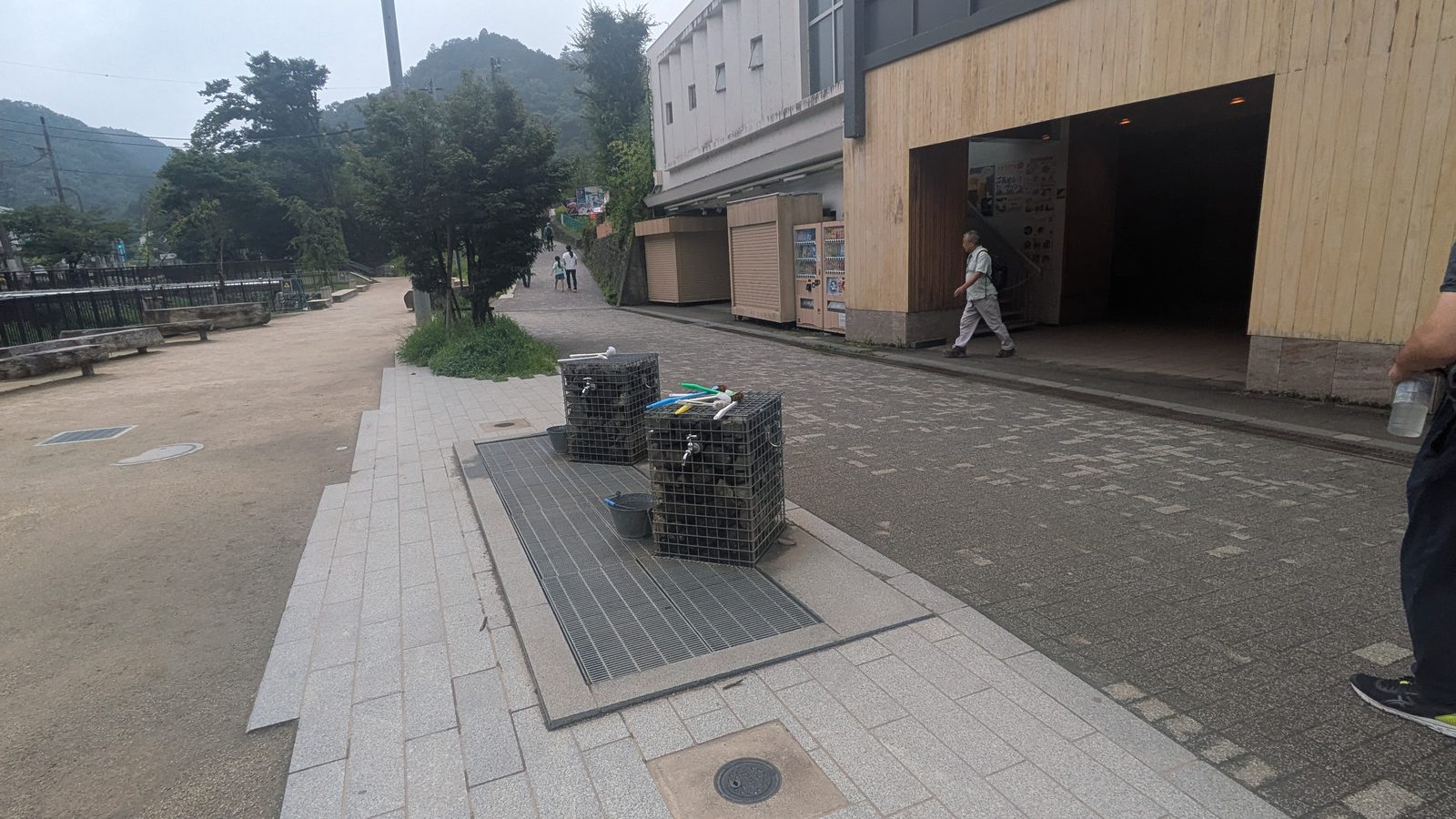
There are boot-washing taps outside Takaosanguchi Station, with brushes and buckets, free to use. The route guide covers them as a courtesy to the train you are about to board.
There is a second reason, and it comes before the train. The onsen has shoe lockers immediately inside the entrance. Your boots come off at the door and go into a wooden box, and whatever is on the soles goes in there with them.
We came down with mud on ours and washed them at the taps before going in. It takes two minutes, and the taps are on your way.
2. Your bag: what fits where
A day pack goes upstairs with you. It fits in a changing-room locker as it is; we put a full day pack into one without any trouble.
Anything larger stays on the ground floor. The floor plan in the English pamphlet shows a bank of lockers down there, near the entrance and the tatami area.
A suitcase belongs at the station, because of a rule that catches people out:
The onsen does not hold luggage. Not after you arrive, and — the part worth knowing — not before either.
You cannot leave a bag at the front desk in the morning, climb the mountain, and collect it on your way to the bath. The operator says so plainly and points you at the station coin lockers instead. Those are:
- Two banks, both outside the ticket gate. One sits under the elevated tracks on the Shinjuku side and is available at any hour. The other is inside the passage that leads to the onsen, available from 8:00 to 23:00.
- ¥600 standard, ¥700 medium. This station has no large or oversized lockers, so a big suitcase is not guaranteed a home.
- They take PASMO and Suica, so you do not have to hunt for coins.
3. Shoes off, front desk, then upstairs
Shoe lockers and the front desk are on the ground floor. The baths and the changing rooms are on the second floor, and there is a lift — worth knowing if your knees have just come down four hundred metres.
4. Afterwards, come back down to eat
The restaurant is on the ground floor, open 9:00 to 22:15 with last orders at 21:45. The house dish is tororo soba: buckwheat noodles under grated mountain yam. It is the dish Mount Takao is famous for.
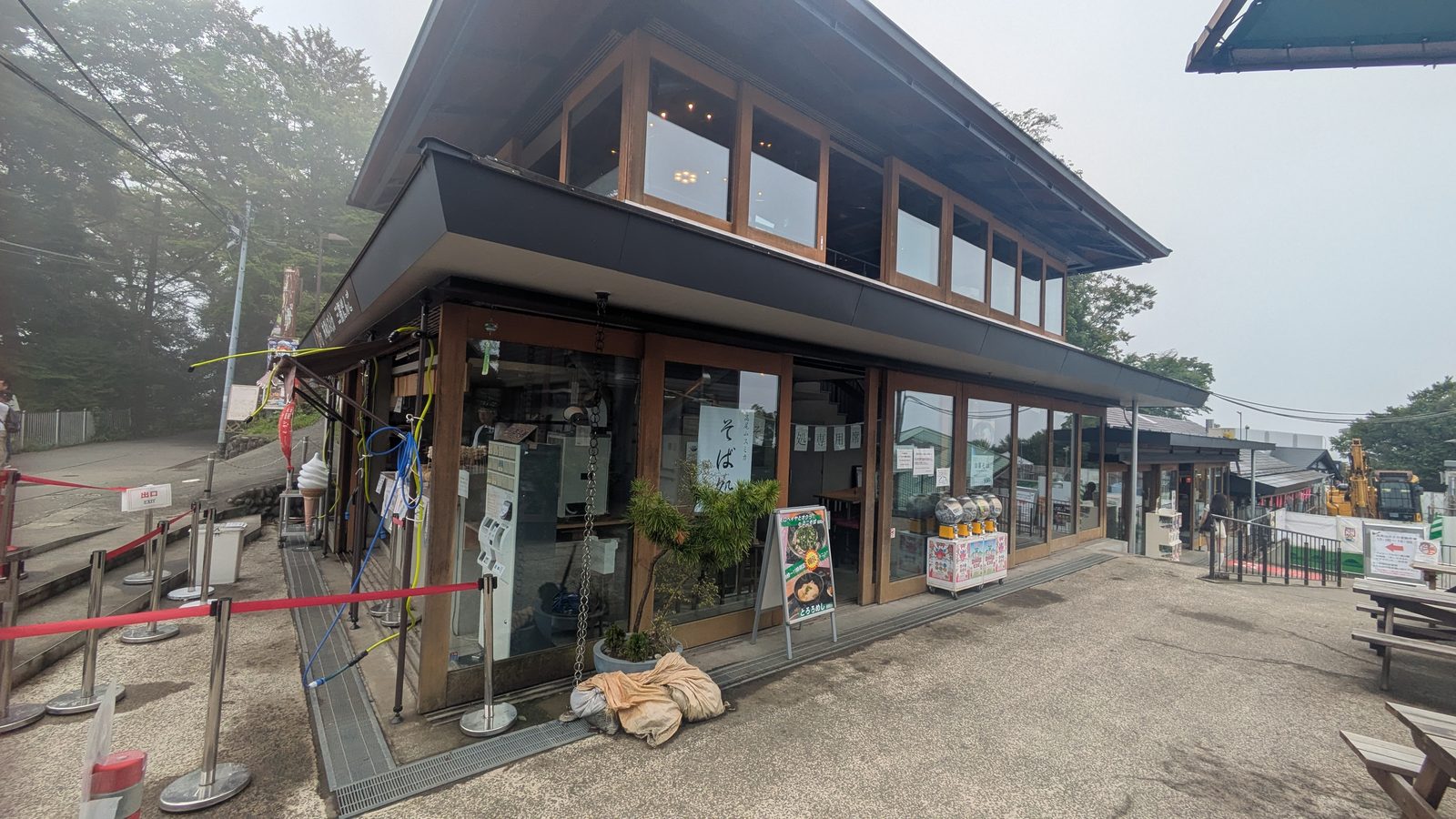
There is also a tatami area, a room for lying down, and massage until 22:00 with the last appointment at 21:00.
Then the ticket gate is a minute away, and you get on a train with clean boots and nothing left to arrange.
What it costs, and when it is quiet
The price list is a crowding calendar
You do not need crowd data for this place. The operator has published its own, in the form of a price list.
Adults pay ¥1,100 on a weekday and ¥1,300 at weekends, on public holidays and in peak season. That ¥200 is not arbitrary. A business raises its price on the days more people turn up, which means the fee table doubles as a list of the days to avoid.
The pattern matches what happens on the ground. Weekends fill up through the afternoon and into the evening — everybody comes off the mountain at roughly the same time, and there is one bathhouse at the bottom of it. Weekdays stay comparatively quiet. We went in at around midday on a weekday and there was no queue at all.
Which gives you the ideal day
Three things line up in the same direction, and this is not a theory. It is a day we actually had.
- Pick a weekday. Cheaper by ¥200 and quieter, both at once.
- Start walking before eight. The trails are empty then, which is the advice in the route guide for entirely separate reasons.
- Be in the water by lunchtime. You get the bath before the afternoon fills it.
You then have a whole afternoon left over, and you have paid less than the person arriving at four o’clock on a Sunday.
One thing to get right: there is no re-entry
Once you have paid, stay in. Step outside and your ticket is spent; going back in means paying the entrance fee a second time. Inside, you can get into the baths as often as you like.
This matters more than it sounds. If something is still in a station locker, or you want to visit the shop across the way, do it before you pay.
Paying
You buy the entrance ticket from a ticket machine, and the machine takes cash or an IC card — a tap with Suica or PASMO is enough.
That is a quietly satisfying place for this mountain to finish. The vending machines at the summit take coins and nothing else, and so do the shops up there. By the time you are back at the bottom, the travel card in your pocket is doing the work again.
The operator also lists six credit card brands: Visa, JCB, UnionPay, Diners Club, Discover and Mastercard. We could not confirm whether those work at the machine itself or only at the front desk, so if a card is your only way of paying, expect to deal with the desk.
One catch with the IC cards. You cannot top them up here. If your Suica is nearly empty, deal with that before you walk in.
One guided option ends at a different bath. The small-group guided day on Mount Takao finishes the day at a hot spring on another mountain that accepts tattoos, not at this one. The listing does not name which hot spring it uses.
Affiliate link · Small group of up to 7 · About 8 hours · Free cancellation up to 24 hours before
What to bring
Towels: not included, and not a problem
Shampoo, conditioner and body soap are provided in the bathing area. So are hairdryers, and toner and lotion in the changing room.
Towels are not included in the entrance fee. That is worth knowing, but it is not the obstacle some guides make it sound like, because you can sort it out on the spot: a face towel to buy, a bath towel to rent. In July 2026 the set was ¥350. The operator does not publish that price, so treat it as an indication rather than a promise.
The part nobody tells you is how little there is to it. The entrance ticket and the towel rental both come out of a ticket machine, and the machine has an English option. You take the ticket to the front desk and hand it over. There is no conversation to negotiate and nothing to explain.
Bringing your own towel still makes sense if you have one with you — it weighs nothing and it saves the ¥350. But arriving without one is not a reason to skip the bath.
No bottles in the bathing area — but there is a water cooler
You cannot take a water bottle or a flask into the bathing area. It is refused on hygiene grounds, which sounds unhelpful for somebody who has just come down a mountain short of fluid.
It is not, because there is a water cooler inside the bathing area, installed on the recommendation of the public health authority. Use that.
Phones and cameras stay in the locker
No phones and no cameras in the bathing area or the changing room. This is normal for a Japanese bathhouse, and here it is stated as a firm rule rather than a request.
It also explains something about this page. There are no photographs of the baths on it, and the pictures you find elsewhere are all the operator’s own — because nobody bathing there is allowed to take any.
The baths themselves
Do not come for the view
The pamphlet lists seven baths, including natural hot spring rock baths outdoors, a carbonated outdoor bath, a cypress bath with micro-bubbles, a sauna and a cold bath.
The outdoor bath is the one everybody pictures, so here is the honest version. From the outdoor rock bath you can see a privacy fence and the sky. That is the whole view. There is no mountain panorama, no valley, no sight of the ridge you have just walked down.
We would rather tell you now. There is also a practical upside: since there is no scenery to catch, there is no best time of day to come for it. You can drop that variable entirely and choose your slot on price and crowds instead.
You are here for your legs, and the water suits that. The source is a simple alkaline spring at 26.2°C (79.2°F), and the operator’s own list of what it helps with reads like a description of the day you have just had: tired muscles, joint pain, stiff shoulders, recovery from exhaustion.
The manners, and where to read them properly
This is the part where the onsen’s English is genuinely good, so we are not going to rewrite it. Their manner guide walks through the whole sequence — undress fully, take the small towel in with you, wash before you get in, sit down to wash, keep your hair and towel out of the water, dry off before you go back to the changing room.
Two lines from it are worth pulling out, because they are the ones first-timers get wrong:
- You wash before you get in, not in the bath. The bathing water is shared and nobody cleans themselves in it.
- No swimsuits and no underwear in the water. You go in with nothing on. The small towel is for modesty on the way there, not for wearing in the bath.
Get those two right and nothing else you do will cause a problem.
Two things about the clock
Last entry is the number that matters
The onsen opens at 8:00 and closes at 22:30, and the last entry is 21:45. That is the figure to hold on to. Arriving at 22:00 gets you nothing at all.
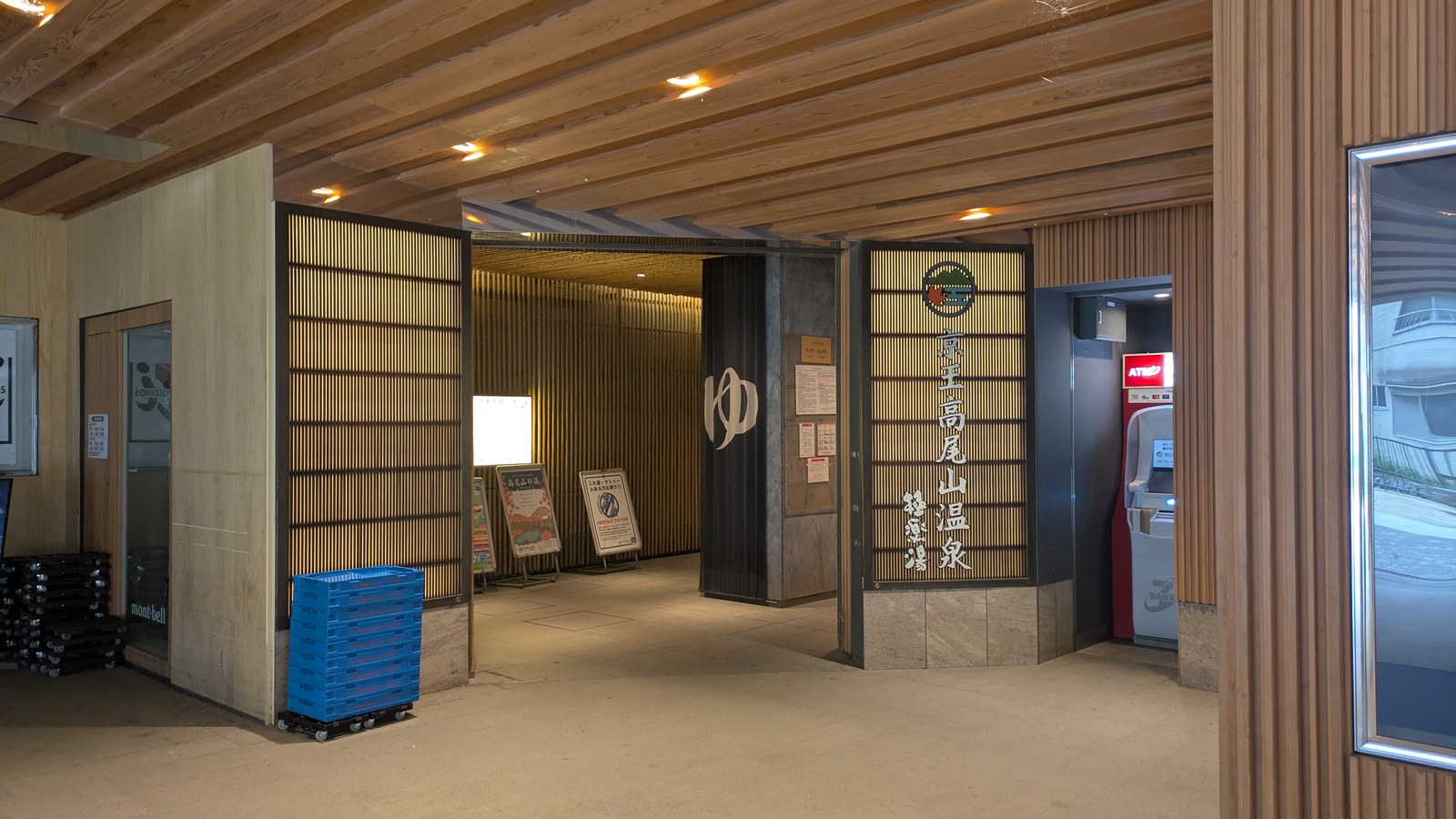
Other times are posted around the passage the entrance sits in. Several things share that passage, so if the hours matter to your plan, take them from the operator’s own page rather than from a sign on a pillar.
Open year round comes with an asterisk
The English website says the onsen is open year round and stops there. The pamphlet adds, in small print, that it may close temporarily for inspections. The Japanese pages are blunter: there are a few closure days a year, set irregularly, announced on the website and on posters inside the building, and hours can also change without notice for inspections, suspended trains or bad weather.
For most visitors this will never come up. But if the bath is the reason you chose this particular day, it costs nothing to look at the operator’s page the night before.
Questions people actually ask
Can I use the onsen if I have a tattoo?
No. The rule covers tattoos of any size, and stickers, paint and temporary designs count as well. Covering one with tape or a sticker is refused in its own right. It applies to the restaurant and the other rooms too, and it can be enforced after you have paid and gone in.
Can I get in the bath with a plaster or blister tape on?
No. Bathing with a plaster or a medicated compress on is refused on hygiene grounds. A graze is fine once it has stopped bleeding. If your heel has given up on the way down, patch it after the bath rather than before.
Do I have to bring a towel?
No. Towels are not included in the entrance fee, but you can buy a face towel and rent a bath towel from the ticket machine. The set was ¥350 in July 2026. Bringing your own saves that.
What does it cost?
Adults ¥1,100 on a weekday, ¥1,300 at weekends, on public holidays and in peak season. Children aged 4 to 12 pay ¥550 or ¥650. Under 3s are free.
How long should I allow?
One to two hours if you only want the bath. Two to three if you are going to eat as well. The restaurant, the tatami area and the room for lying down are all on the ground floor, so a long stop needs no planning — but remember that stepping outside ends your ticket.
Is November more expensive?
The English pamphlet lists 1 to 30 November among the peak season dates, so budget for the higher price if you are coming for the autumn colour.
Where do I put my rucksack?
A day pack fits in a changing-room locker upstairs as it is. The ground floor has lockers for larger bags. A big suitcase is better left in a coin locker at the station.
Can I leave my luggage there while I climb?
No. The onsen does not hold luggage at any point, before or after. Use the station coin lockers: one bank under the elevated tracks is available at any hour, and there is a smaller bank inside the passage to the onsen from 8:00 to 23:00. Standard lockers are ¥600, medium ¥700, and they take IC cards.
Can I pay by card?
The ticket machine takes cash and IC cards, so a tap with Suica or PASMO works. The operator also lists six credit card brands, though we could not confirm whether those work at the machine or only at the desk. You cannot top up an IC card on site.
Can I go out and come back in?
No. There is no re-entry. Once you step outside, going back in means paying the entrance fee again. Inside, you can use the baths as many times as you like.
Is there a view from the outdoor bath?
No. From the outdoor rock bath you can see a privacy fence and the sky. Come for the water, not the scenery.
Can I take photographs in the baths?
No. Phones and cameras are not allowed in the bathing area or the changing room.
Where to next
The onsen is the end of the day, so everything below is about the part before it.
- Which trail should you take up Mount Takao? — the six trails compared, and the one honest answer about the view of Mount Fuji.
- Trail 1: walk up or take the cable car? — the paved route, and why the cable car is not cheating.
- Yakuo-in Temple: what to do as you walk through — the temple sits directly on Trail 1, and nobody explains how to behave in it.
- The Inariyama Trail — the quiet route, and the view you will walk straight past.
- Cable car or chairlift? — they cost exactly the same, so the choice is about something else.
- Mount Takao Trail 6 — the route that guarantees you arrive here with wet boots.
- Mount Takao and Lake Sagami: the traverse — the five-hour day this hot spring was built for.
A hot spring beside the station is easy to take for granted. On Mount Fuji, reaching one means choosing your descent months in advance: Mount Takao or Mount Fuji.