Some links on this site are affiliate links. If you book through one, Tokyo Trailhead earns a commission at no extra cost to you. It never decides what appears here.
Mount Takao’s Trail 1 is paved from the station to the summit. There is a cable car running up the middle of it. Both of those facts make it sound like a stroll, and both of them are why people get caught out.
Here is the thing nobody tells you: the hard part of Trail 1 is not spread evenly. It is concentrated in one stretch — roughly the middle third — and it is the least pleasant walking on the whole mountain. A long concrete ramp, no shade, no rhythm, going up.
And the cable car? It starts below that stretch. It ends above it.
That is not a coincidence. It means the real question is not whether to walk or ride — that framing makes it sound like a test of character. The real question is “where do I want to start walking?” Once you see Trail 1 as three separate sections, that decision gets very easy.
| Official name | Trail #1 (the main approach route) |
| Surface | Paved, all the way to the summit |
| Time up on foot | About 2 hours from Takaosanguchi Station. Around 90 minutes if you walk quickly |
| Time up from the cable car | About 45 minutes on foot from the upper station |
| Start | Takaosanguchi Station, 190 m |
| Summit | 599 m |
| Height gained | Just over 400 m |
| Toilets | At intervals the whole way |
| Vending machines | At intervals the whole way |
| Escape option | Cable car, chairlift — both skip the steep section |
Heights used below: Takaosanguchi Station 190 m, Kompira-dai 387 m, cable car upper station 472 m, chairlift upper station 462 m, summit 599 m. Note what that means — by the time you reach the top of the cable car line you have done nearly 70% of the day’s climbing — and you have done it on the least enjoyable part of the trail.
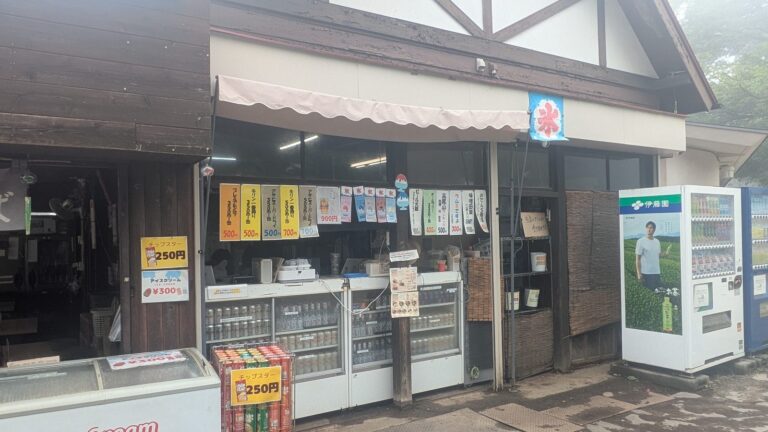
Affiliate link. This site earns a commission if you book through it, at no extra cost to you. Photo from our own walk.
What this guide covers7 sections
Trail 1 is really three walks stitched together
Most route descriptions treat Trail 1 as one thing. On the ground it is three, each with a completely different feel.
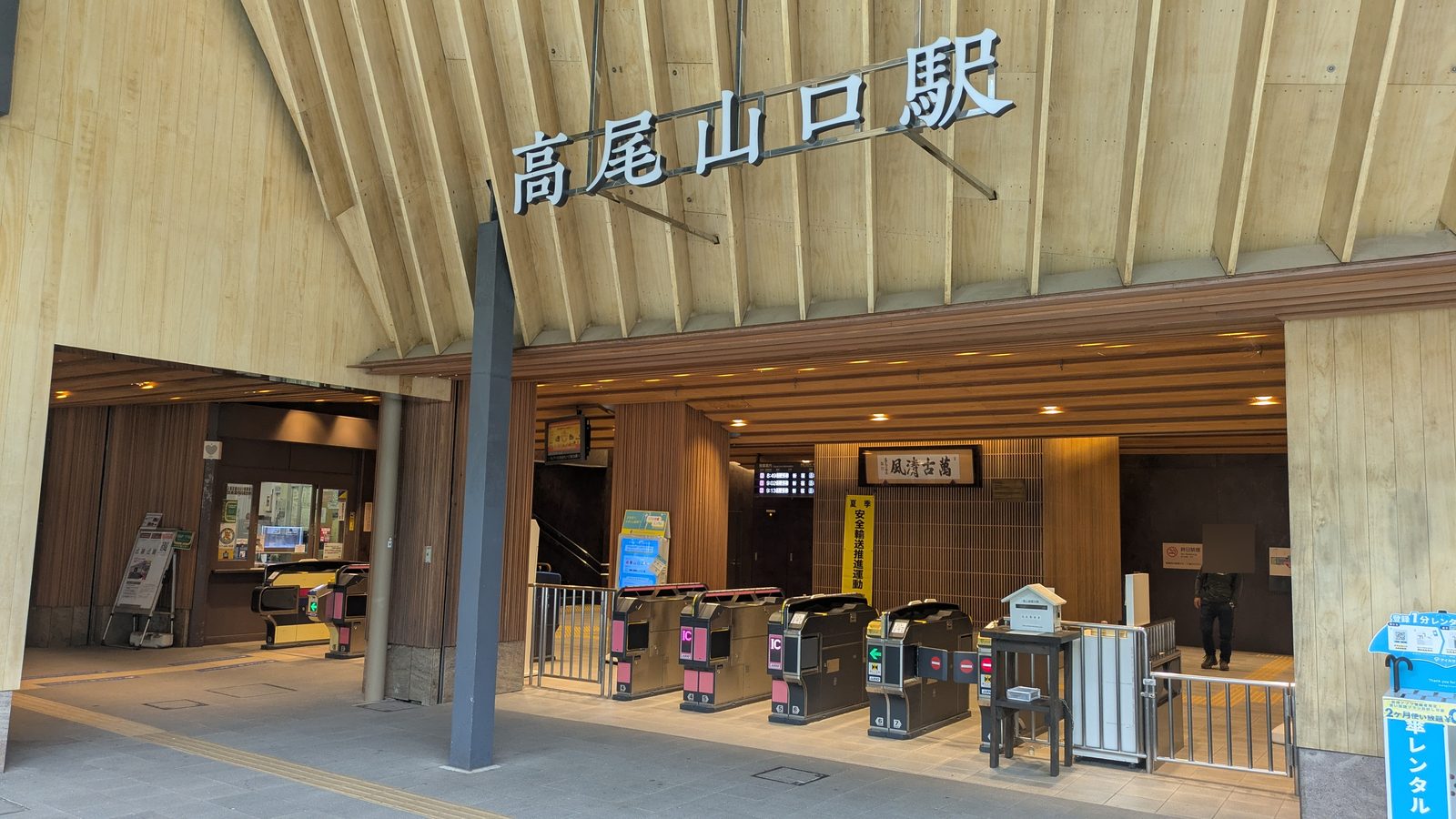
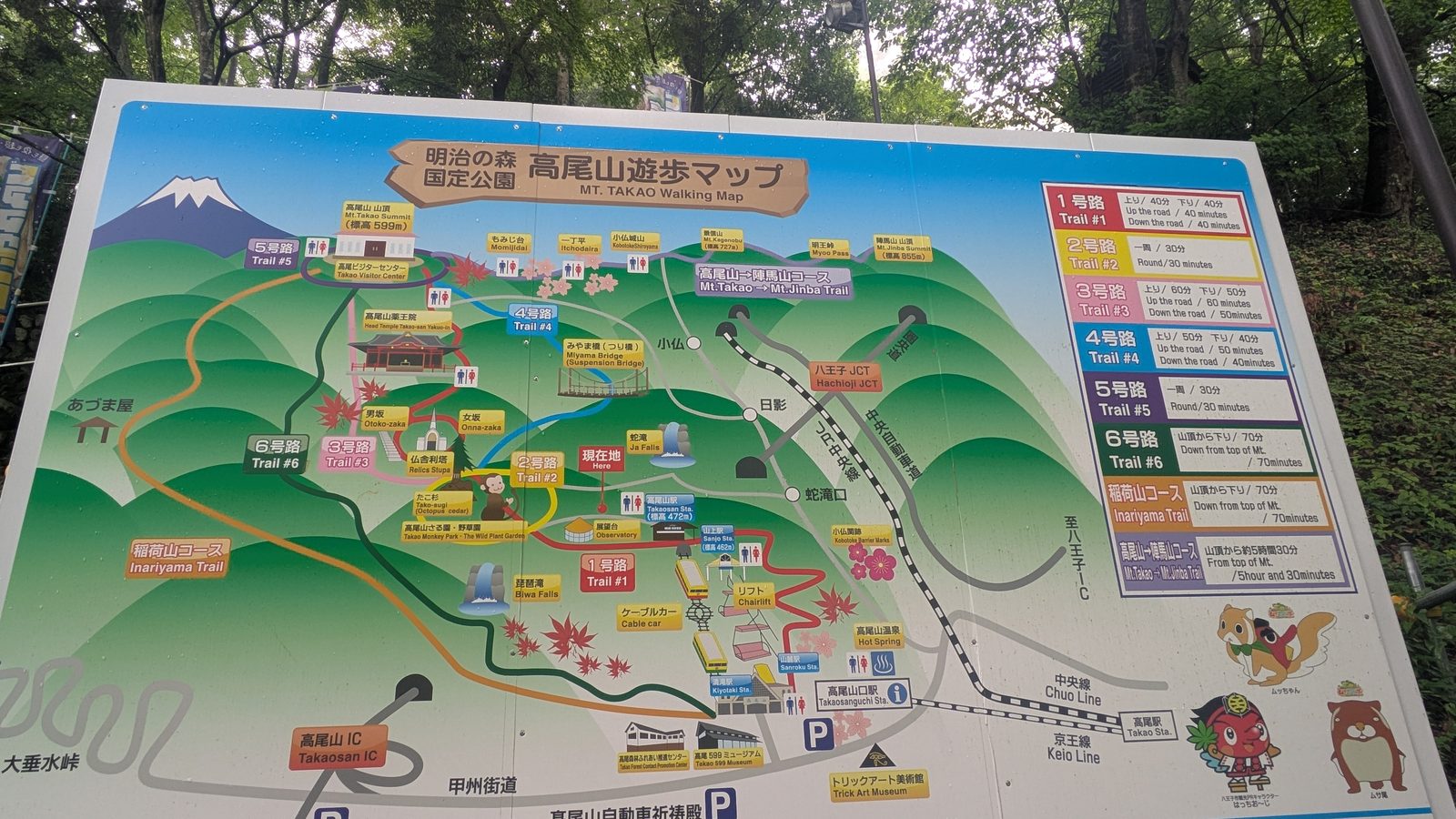
1. The station (190 m) to Kompira-dai (387 m) — the warm-up
Wide, paved, climbing steadily under trees. You gain height the whole time, but it never demands anything sudden. This is the part that fools people into thinking the rest will be like this.
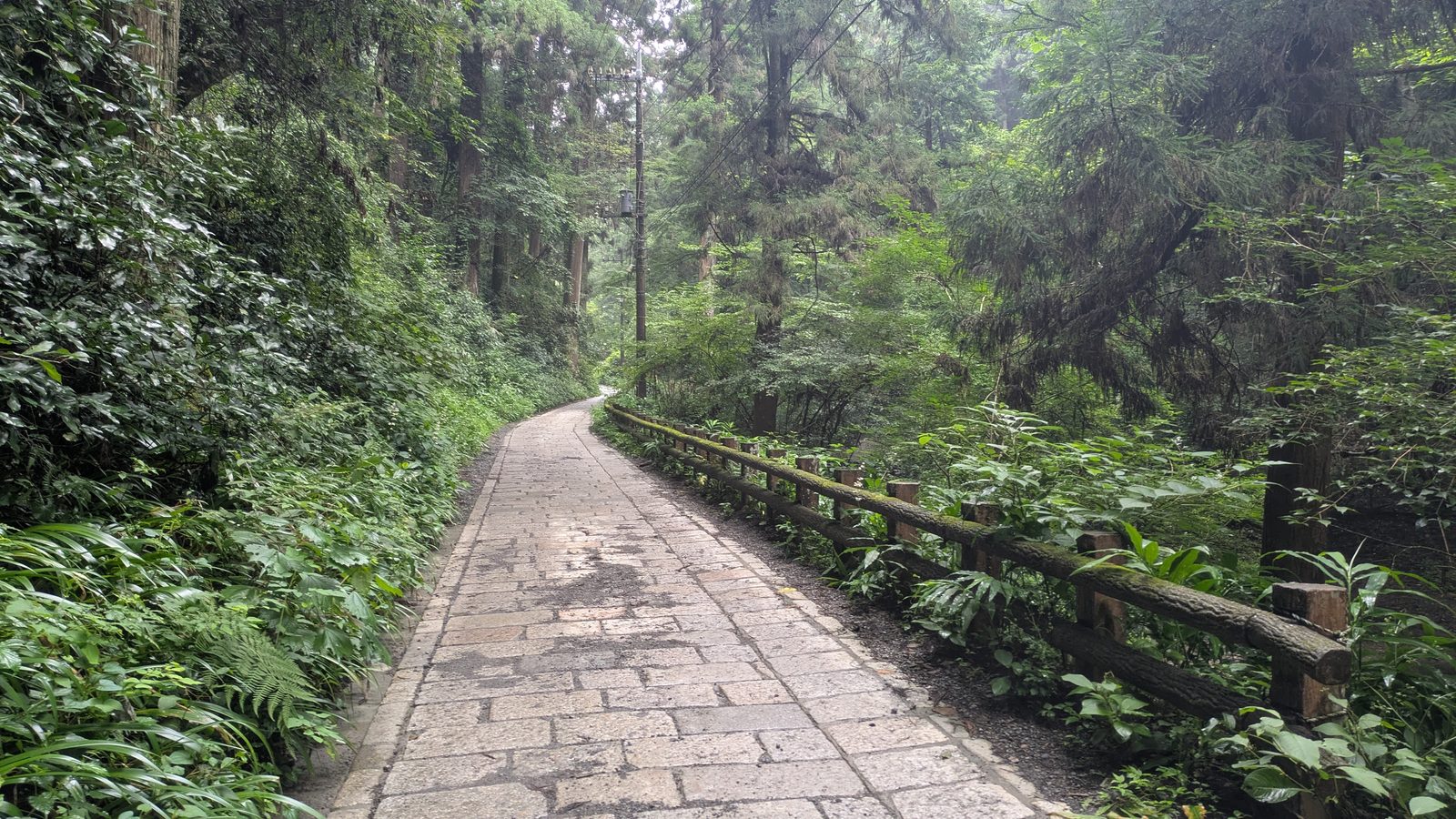
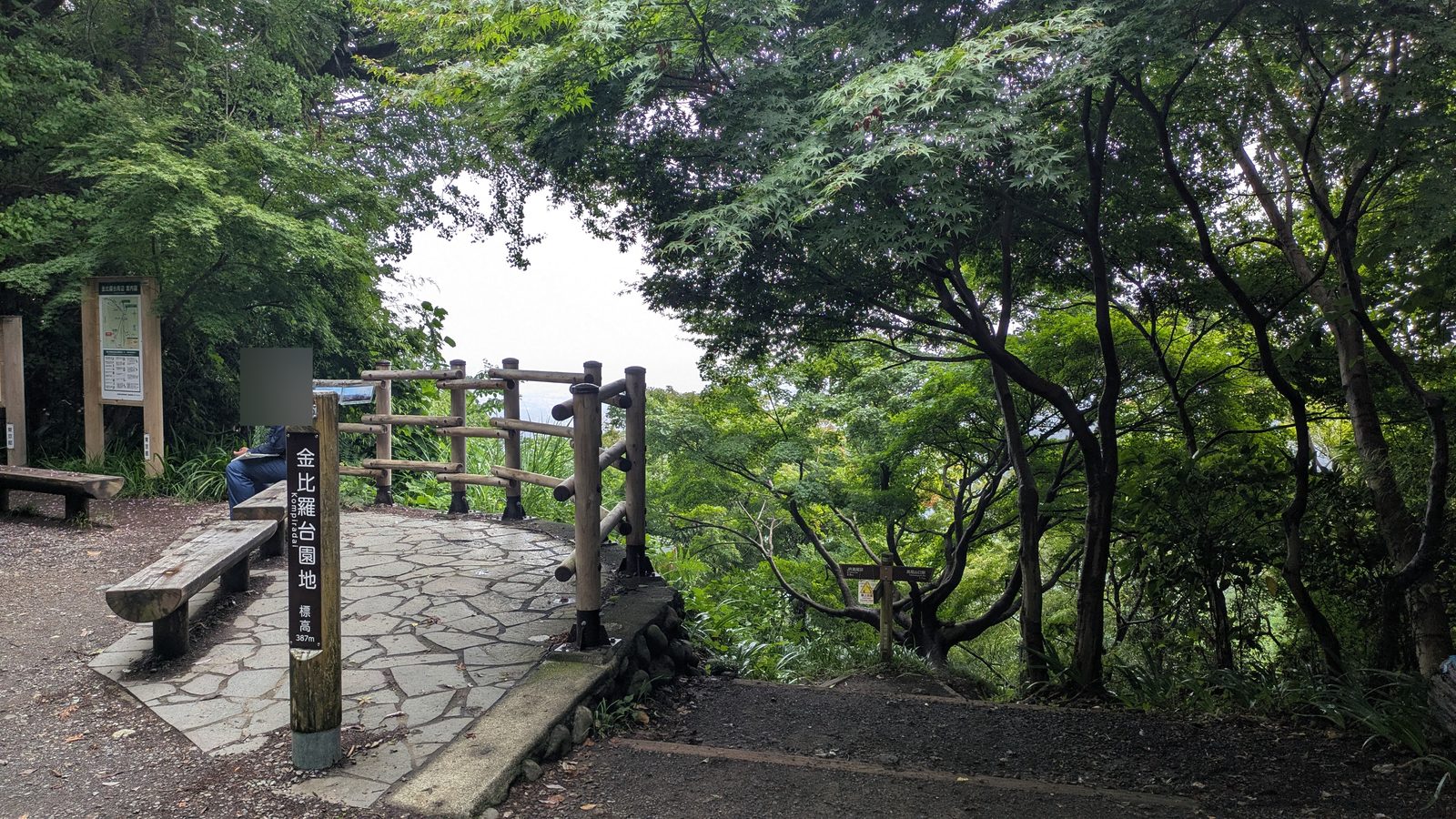
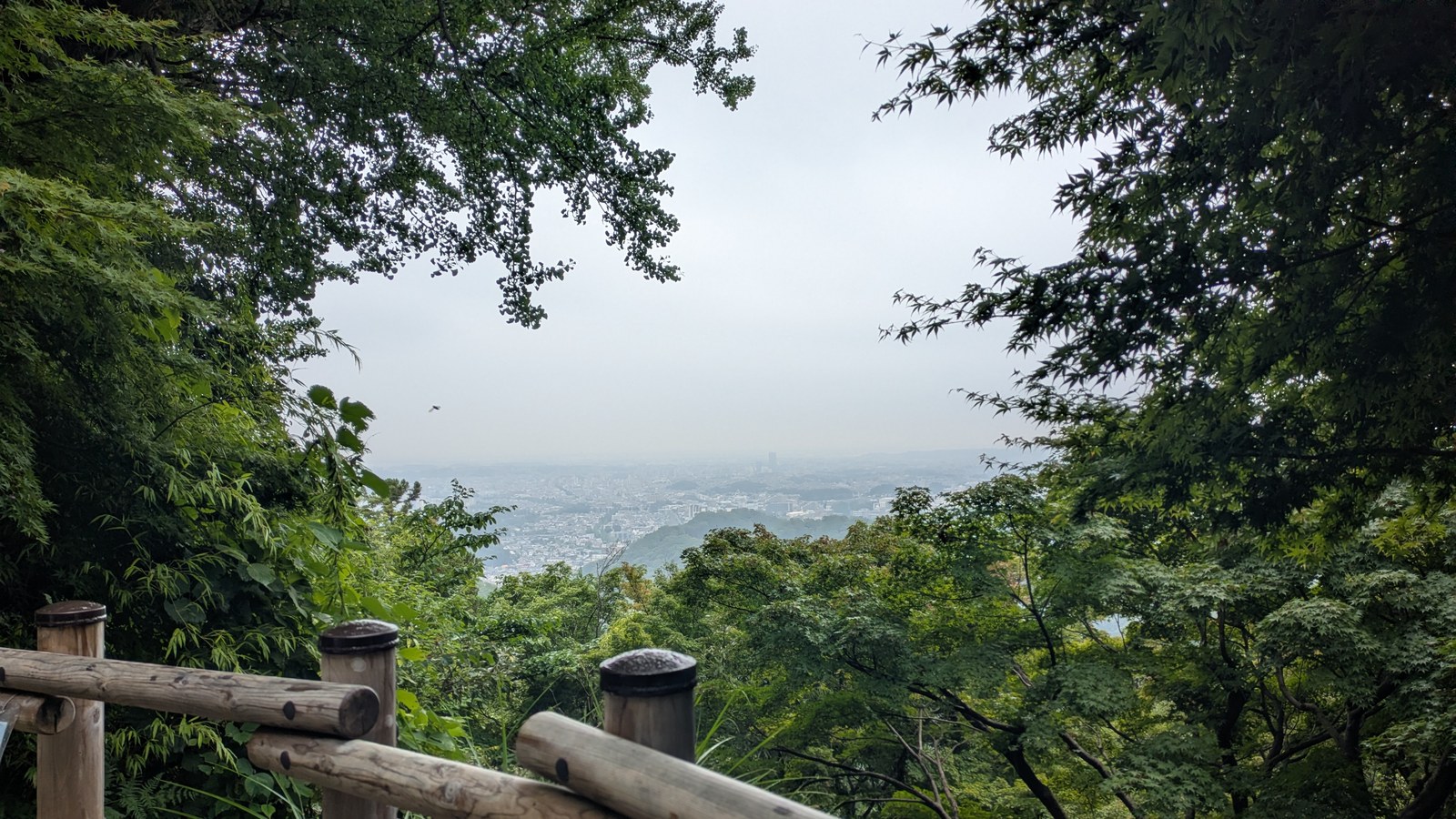
Kompira-dai is a small paved terrace with a bench, a signpost, and a gap in the trees looking out toward the city. It is the natural place to stop.
2. Kompira-dai to the cable car upper station (472 m) — the hard part
This is the stretch. About forty minutes into the walk, the trail tilts up and stays tilted, and it holds that angle until you reach the top of the cable car line.
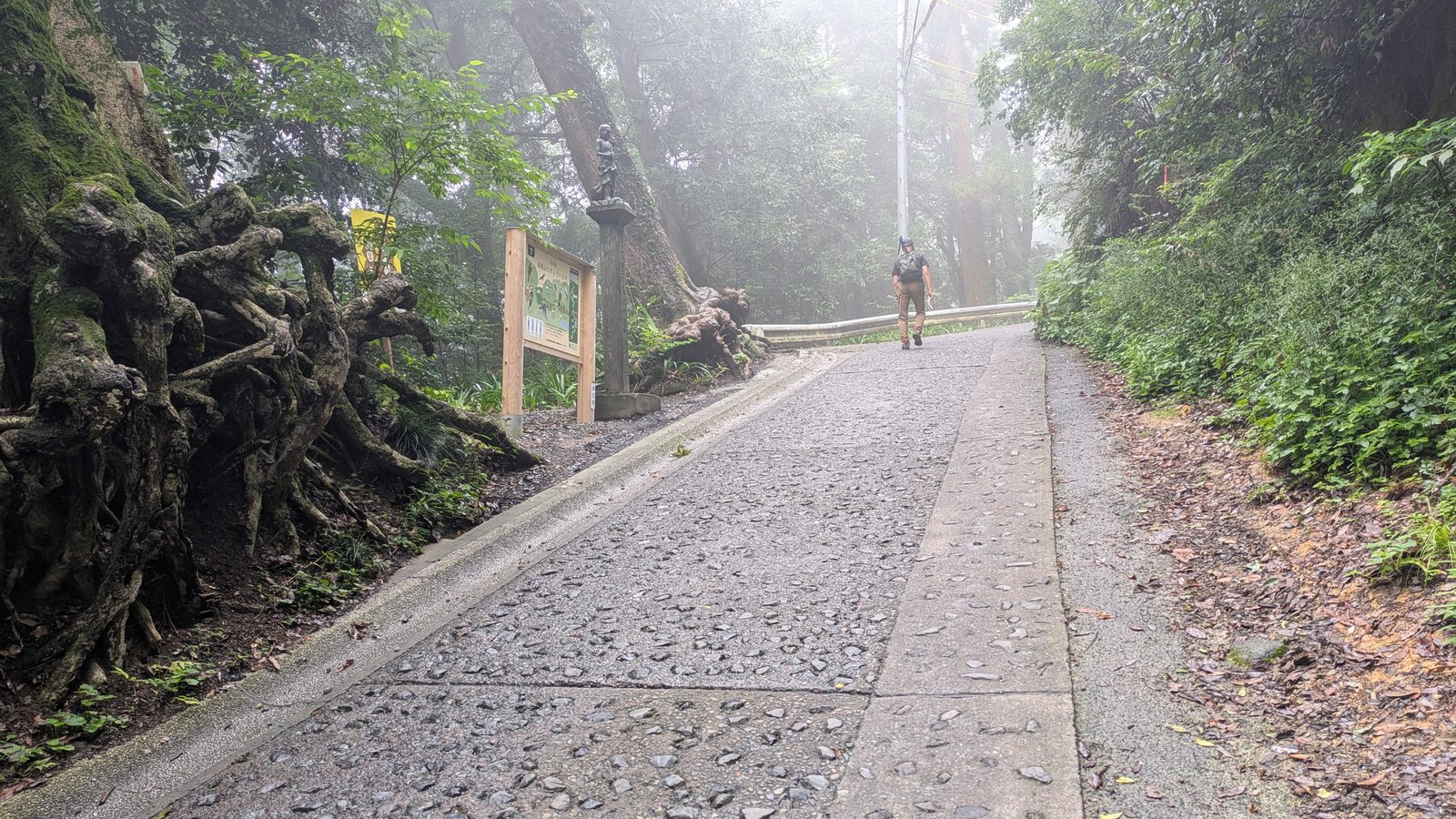
It is not dangerous. There is nothing technical about it. What makes it hard is that concrete gives you nothing back. On a dirt trail your feet find variety — a root to step over, a switchback that changes your rhythm, a bit of give in the ground. Here there is none of that. It is a ramp. You put your head down and grind up it, and the surface returns every step straight into your knees.
There is also very little shade on this stretch, which in summer is not a small detail.
Get to the top of it, and Trail 1 hands the mountain back to you.
3. The cable car upper station (472 m) to the summit (599 m) — the good part
The gradient eases. Souvenir shops appear. So do soba restaurants, a temple complex, cedar trees with names, and other people in ordinary clothes carrying ice creams.
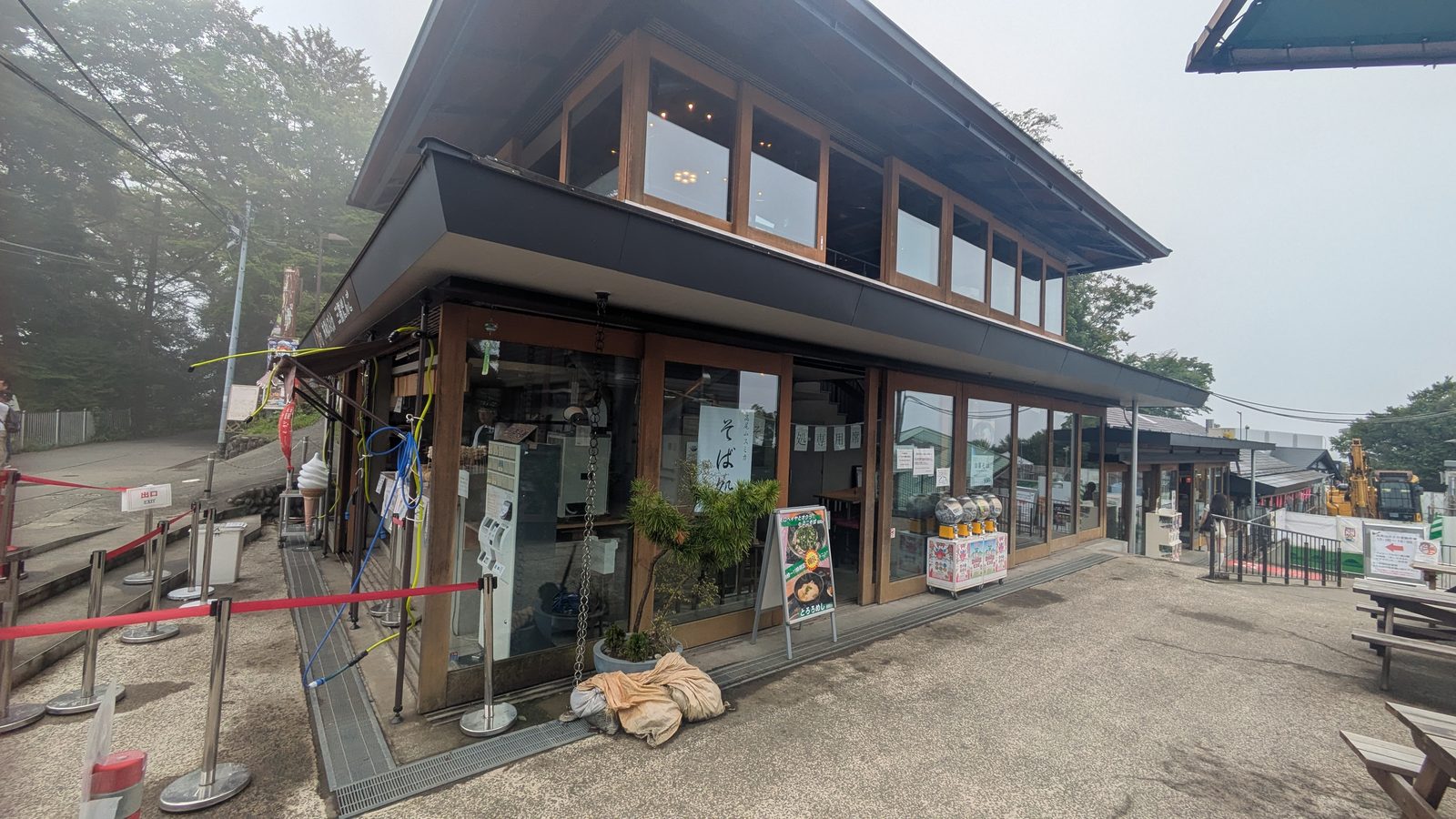
This section is genuinely pleasant, and it is why Trail 1 is the route that small children, grandparents, and people with no interest in hiking still get to the summit on. The climbing, in the sense of sustained uphill effort, is essentially finished.
What is left is not gradient. It is steps.
This is the part almost no English guide to Mount Takao spells out, so here it is plainly. The upper half of Trail 1 has three flights of steps, and only the first of them is optional.
1. Otoko-zaka — optional. Onna-zaka goes around it. See below.
2. The steps through Yakuo-in — not optional.
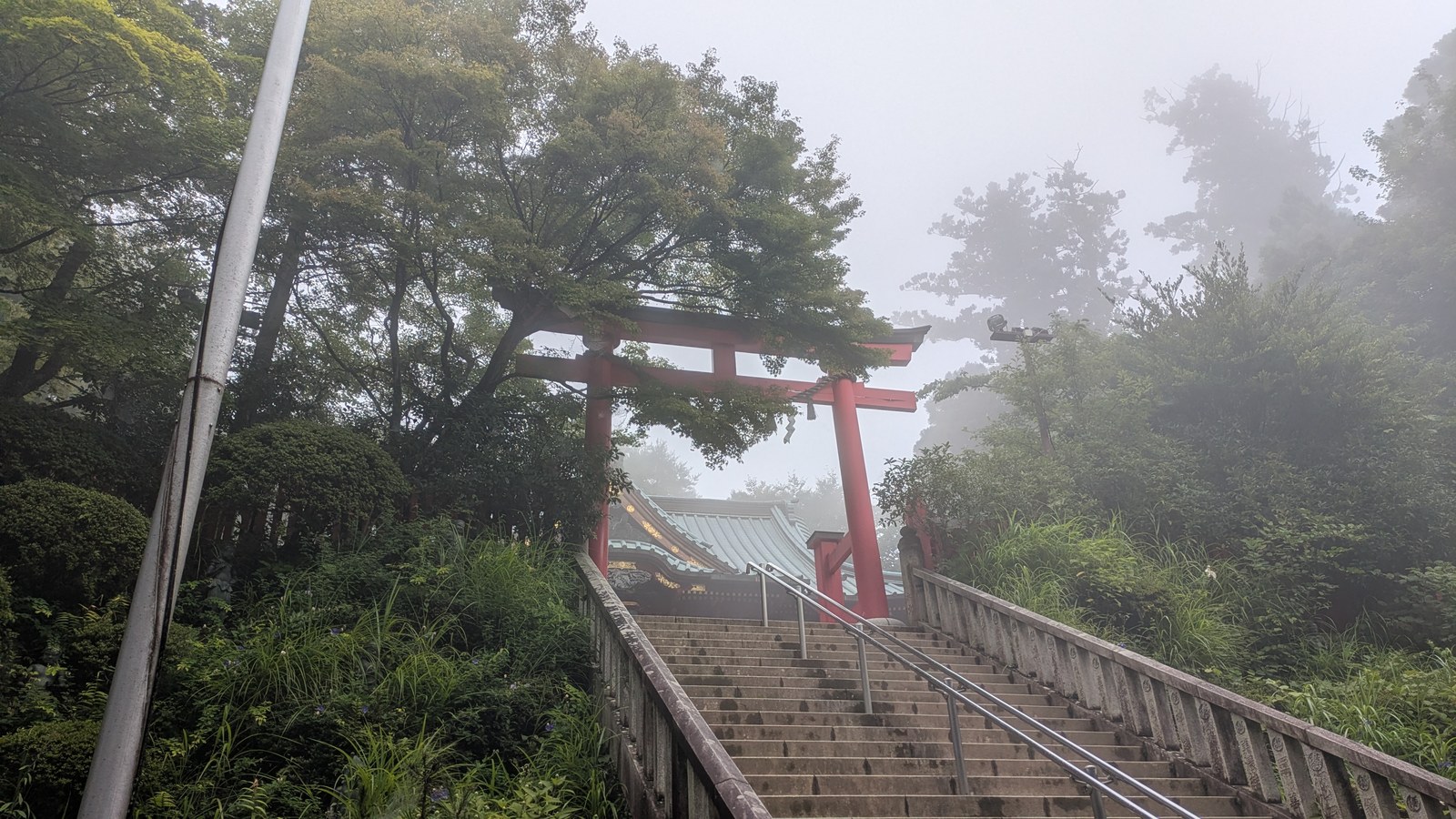
A proper flight of stone stairs with handrails, climbing through a red gate toward the halls above. Trail 1 runs through the temple grounds, so everyone going to the summit climbs them. There is no way round.
3. The final pull above the temple — not optional. Past Yakuo-in the road narrows, then becomes a staircase for the last stretch.
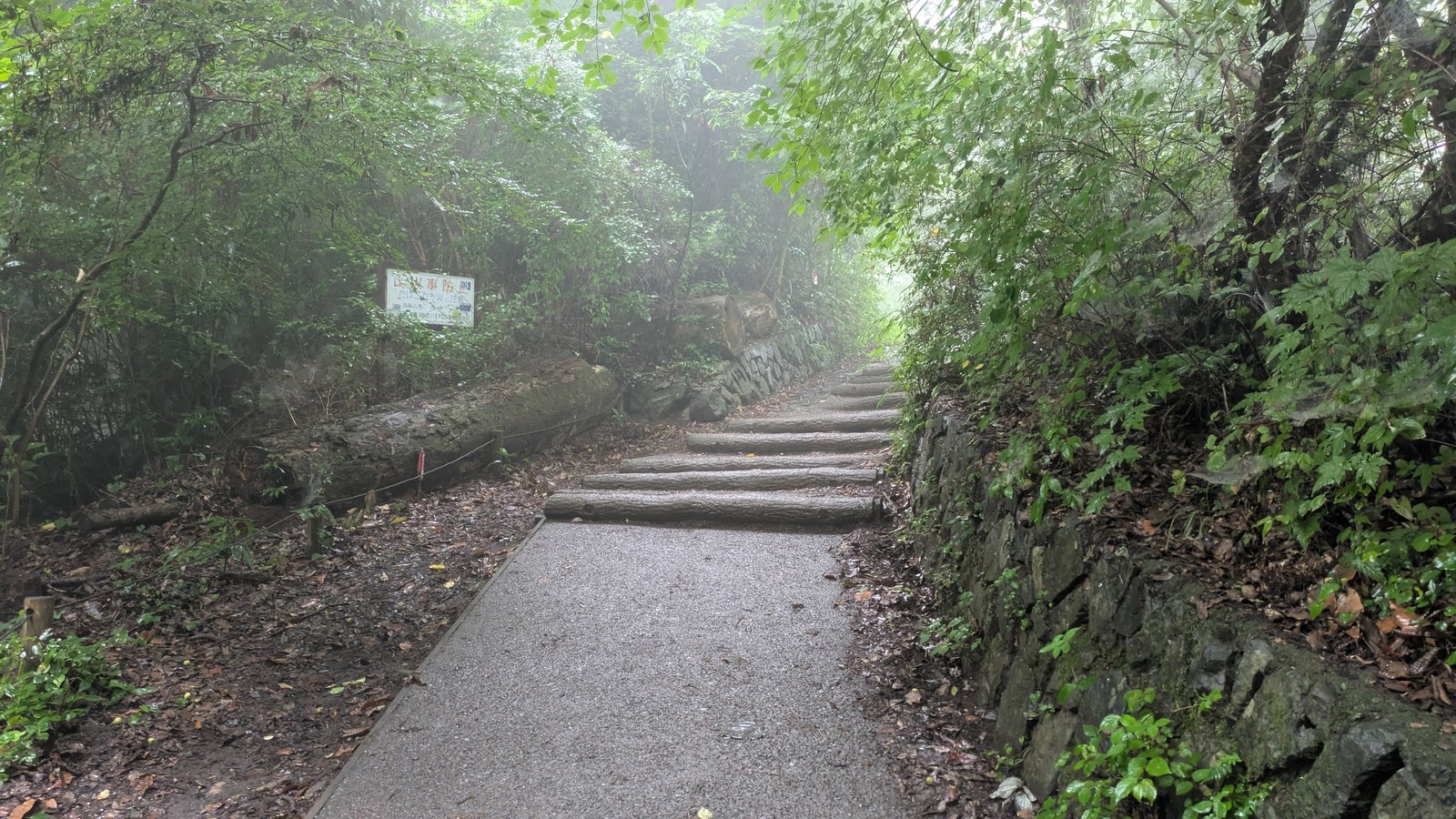
It is still paved. Those step edges that look like logs are concrete, moulded to resemble timber — a very Japanese piece of engineering — so there is no mud underfoot, nothing loose, nothing to slip on. But steps use your legs differently from a ramp, and this comes after 400 metres of climbing. If your knees would rather be given a gradient than a staircase, this is where you will feel it. It is short, and it is the last thing between you and the summit sign.
⚠️ If stairs are the barrier rather than distance, read this bit twice. Pushing a pushchair, using a wheelchair, walking with someone who cannot manage a flight of steps — Trail 1 will not get you to the summit. The cable car does not solve it either, because these steps are above its upper station, not below. What the cable car does buy you is the shops, the temple approach, the cedars, the terrace view over Tokyo. That is a genuinely good half-day. The summit sign is simply a separate question, so plan around it rather than discovering it at the bottom of the temple stairs.
So — where do you start walking?
Three sensible answers. None of them is cheating.
Option A: Walk all of it
Choose this if you want the mountain to have been a walk, start to finish, and you have the legs for a sustained forty-minute grind on concrete.
About two hours from the station. Ninety minutes if you are quick and you do not stop. You will have earned the summit, and you will also have spent a chunk of the day on the least interesting surface Mount Takao has.
Be honest with yourself about that last bit. If you have come to Japan to walk in forest, this stretch is not it.
Option B: Ride up, walk from the top station
Choose this if you want the temple, the cedars, the shops, the ridge, the summit — the whole character of Mount Takao — without the one section that is just work.
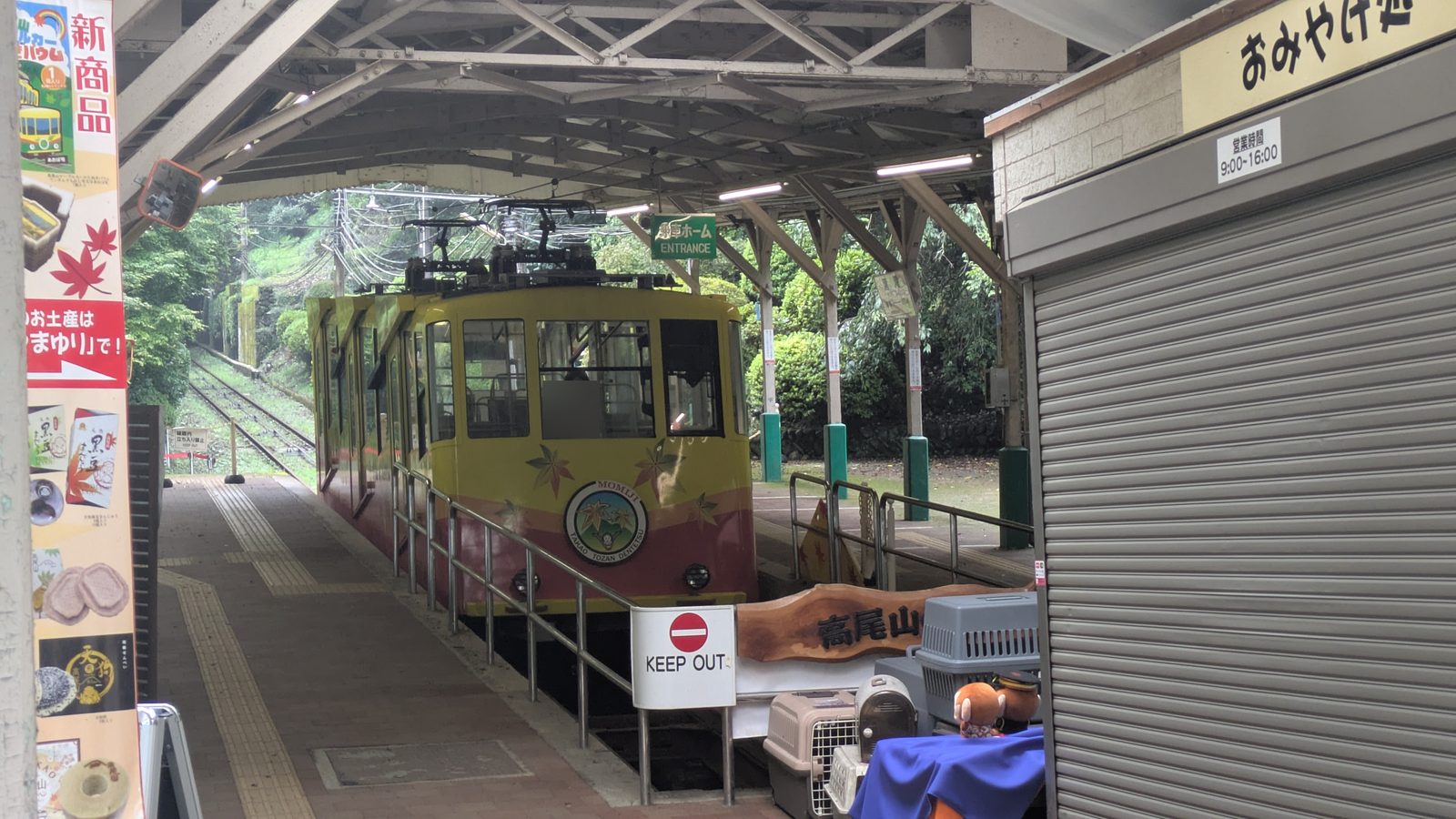
From the upper station it is about 45 minutes on foot to the summit, on gentle paved trail with things to look at the whole way. This is, for most visitors on a Tokyo itinerary, the best value on the mountain.
Look at the numbers and the case gets stronger. The station is at 190 m; the cable car’s upper station is at 472 m; the summit is 599 m. The cable car takes nearly 70% of the day’s ascent off your legs, and the part it takes is the part with no view, no shade, and no soft ground. What it leaves you is the last 130 m — the cedars, the temple, the ridge, the summit. You are not skipping the mountain. You are skipping the ramp.
Option C: Ride up, walk down
Choose this if your knees are fine going down but you would rather not spend your energy going up, or if you are short on time in the morning.
Walking down Trail 1 is genuinely nice: it is wide, it is paved, and — the part that matters — you can change your mind partway. If your legs give out, the cable car and the chairlift are right there, and you can get on.
A return ticket works on either one. You can go up on the cable car and come down on the chairlift, or the reverse.
The 8 a.m. problem nobody mentions
Two pieces of advice about Mount Takao are both correct, and they contradict each other.
The first: start before 8 a.m. to beat the crowds. This is true, and it is the single most effective thing you can do. From about 10 a.m. to 1 p.m. the mountain fills up, and on a spring weekend Trail 1 can back up to the point where you are queuing rather than walking.
The second: use the cable car to skip the steep section. Also true.
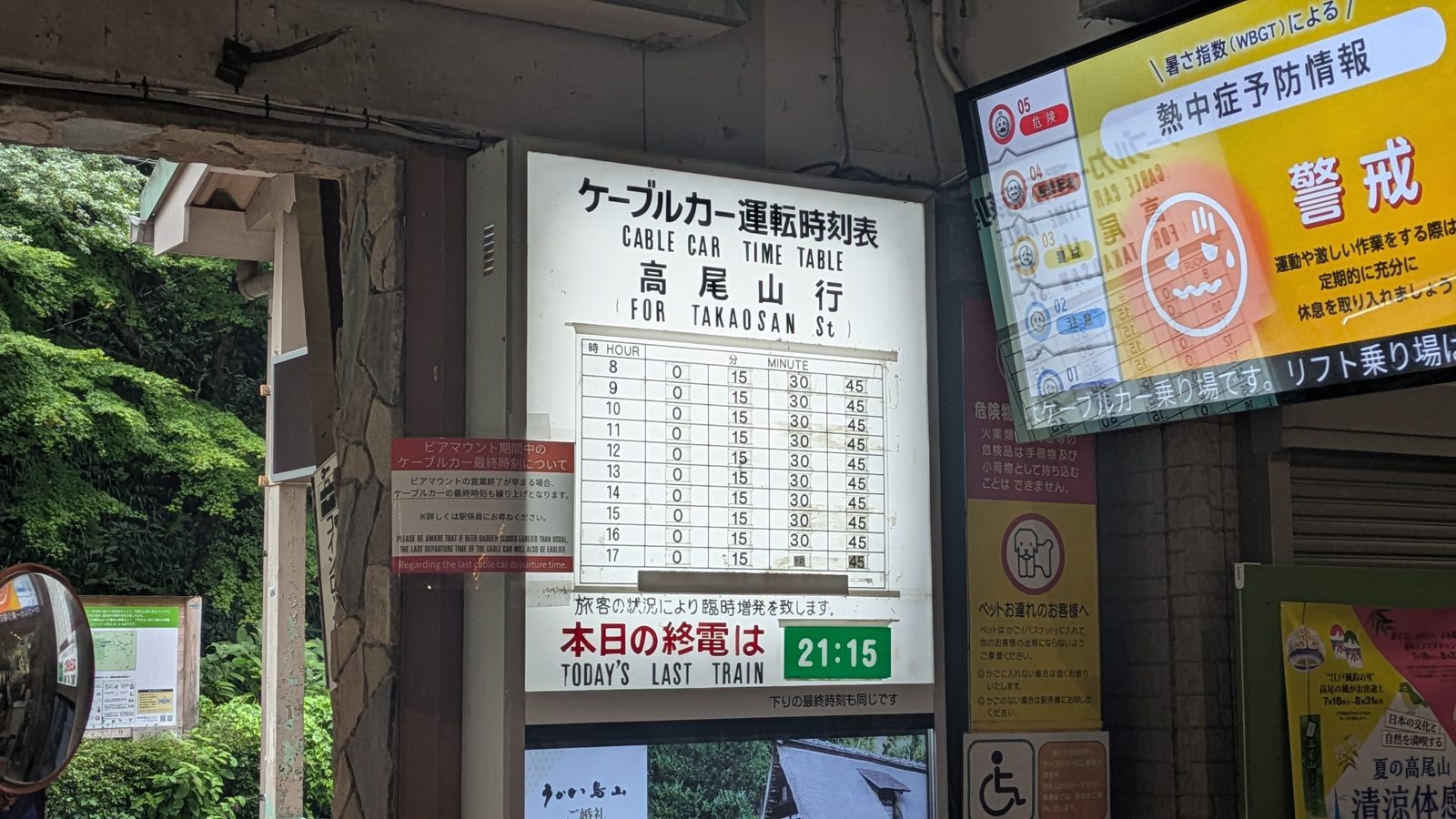
The problem: the first cable car of the day leaves at 8:00. The chairlift does not start until 9:00.
So you cannot have both. Either you start early and walk the hard section, or you wait for the cable car and accept more company on the trail. There is no version where you arrive at 7 a.m. and ride up.
If it were us: start early and walk it. The steep section is much less unpleasant in cool air on an empty trail than it is at eleven o’clock in July, and you will have the summit while it is still quiet.
There is also a version of this day where the decision is made for you. One small-group guided day on Mount Takao rides the cable car or chairlift halfway up, then walks the rest of the way to the summit through the temple, with an English-speaking guide.
Affiliate link · Small group of up to 7 · About 8 hours · Free cancellation up to 24 hours before
Before you plan around the chairlift: check you can ride it
The chairlift and the cable car are not interchangeable, and the difference is not price. We compare them properly in the cable car versus chairlift guide.
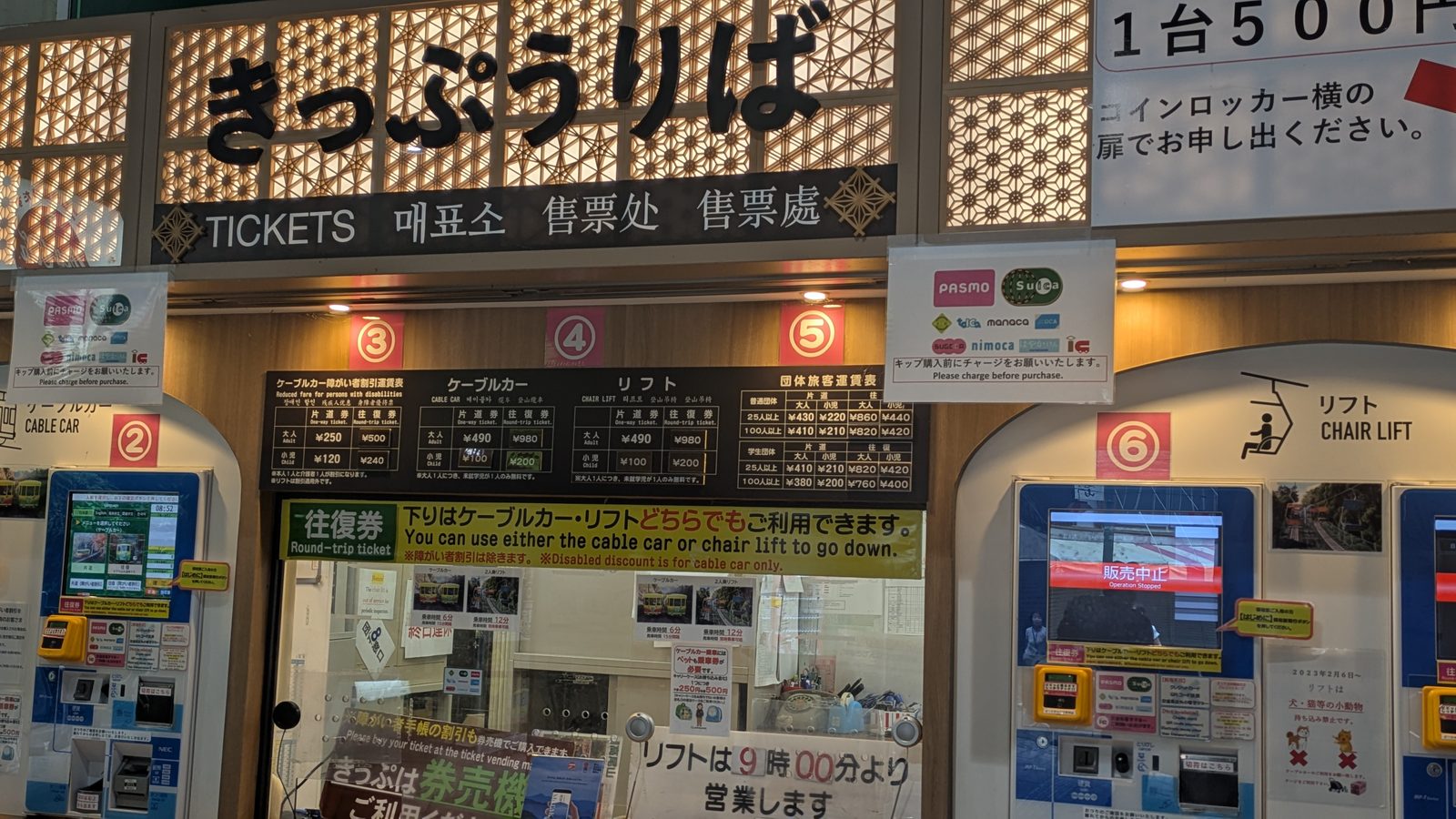
The notice at the chairlift boarding area rules out elderly passengers, anyone unsteady on their hands, legs, or back, anyone pregnant, anyone who has been drinking, anyone unwell or with a physical impairment. People afraid of heights, plus children riding alone, are asked to reconsider.
This matters because a lot of English-language advice treats the chairlift as the fun option and the cable car as the boring one. If you are travelling with an older parent, or you are pregnant, the cable car is not a preference — it is the one that will take you. It is fully enclosed and it carries everybody.
The chairlift does have a simple roof. It keeps the sun off. It will not keep rain or wind off.
What you actually pass on Trail 1
Trail 1 is the route with things on it. That is its other argument.
Kompira-dai (387 m)
The bench with a view, at the top of the easy first section. The view is a gap in the trees rather than a panorama — the city spreads out below, usually through a certain amount of haze. It is a place to sit, not a place to photograph.
Tako-sugi, the Octopus Cedar — the sign you cannot read
A cedar 37 metres tall, roughly 6 metres around the trunk, about 450 years old. It is a designated natural monument, it stands right beside Trail 1, and it is fenced.
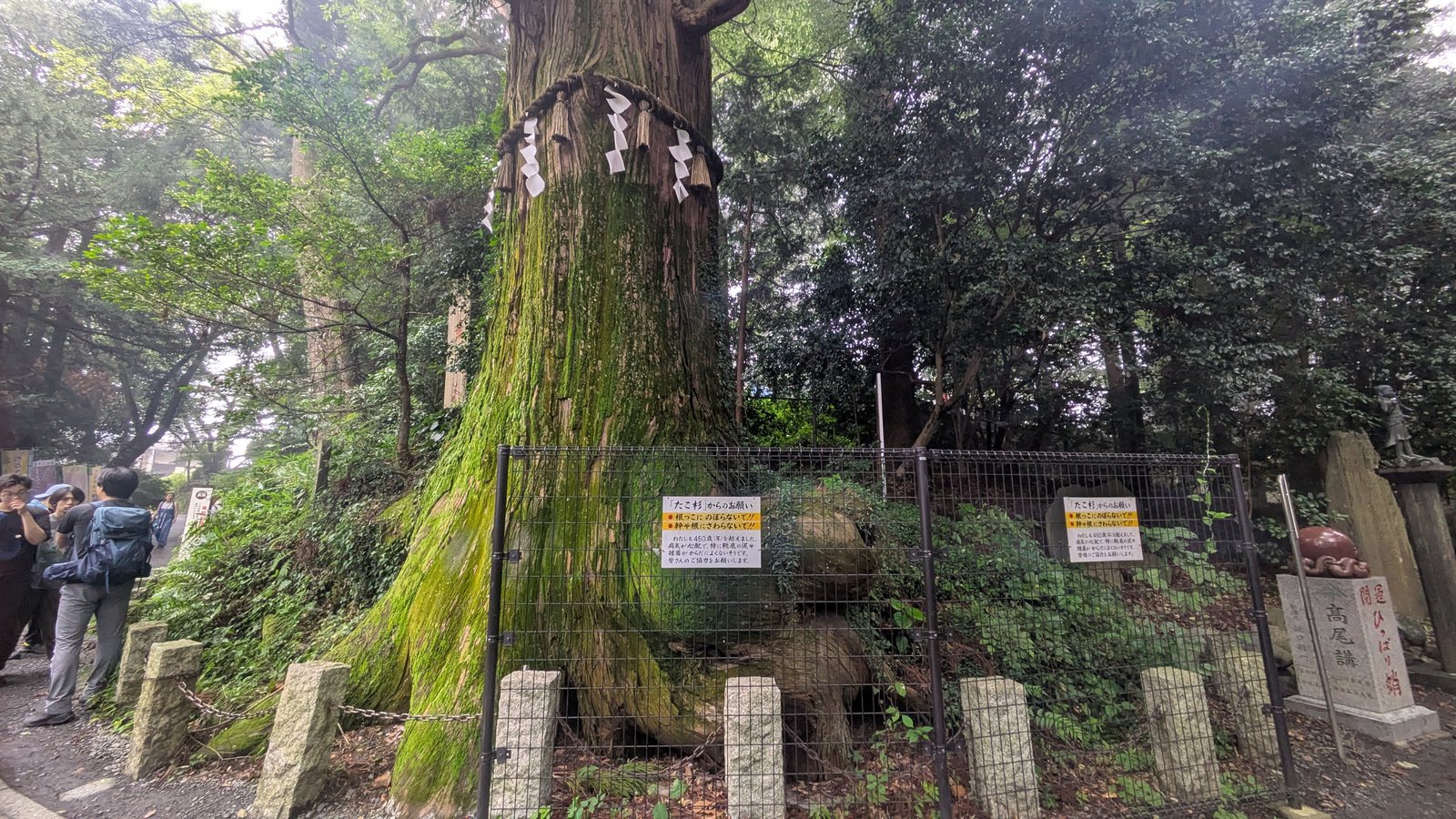
The name comes from a story, which the city’s information board tells. When the pilgrimage path up the mountain was first being cut, this tree’s sprawling roots were in the way of the work, so it was decided to fell it. Overnight, the roots bent themselves backwards, clear of the path. The tree was spared. The roots have looked like octopus legs ever since.
The notice on the fence is written in Japanese only, so almost no visitor from abroad knows what it asks. It is written in the tree’s own voice:
Please don’t climb on my roots. Please don’t touch my trunk, either.
I’m over 450 years old now. I’m worried about getting sick — apparently the mud, plus the germs from the soles of shoes, are especially bad for me. Thank you for your help.
That is the whole reason for the fence. It is not that the tree is fragile in some general way; it is that thousands of pairs of boots carrying soil from other places are very bad for a 450-year-old root system.
There is, however, something here you are meant to touch. On a granite plinth right beside the tree sits a polished red octopus — Kaiun Hippari-dako, the good-fortune pulling octopus. That one is for touching.
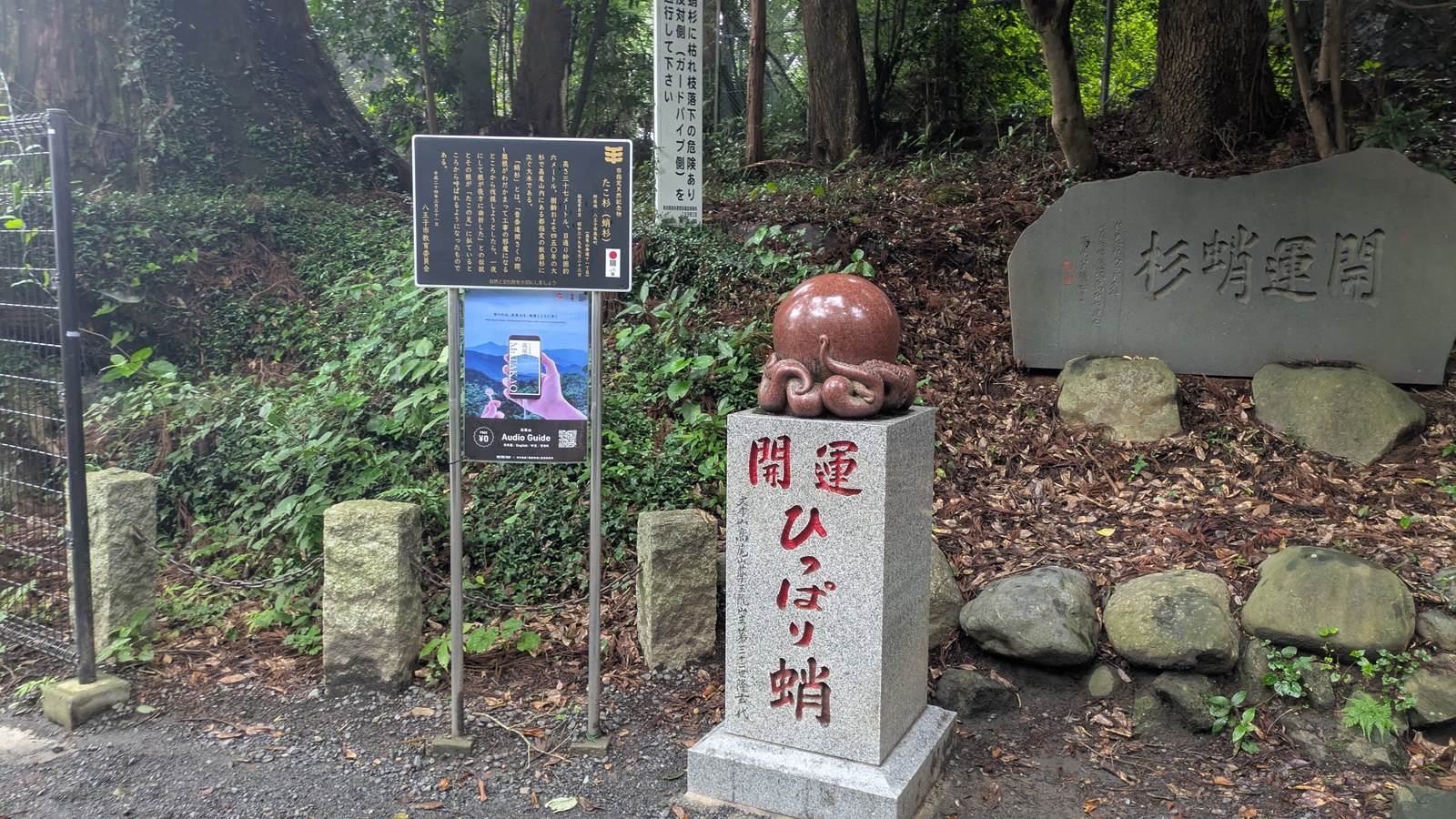
So the rule at this spot is neatly split: the 450-year-old tree is hands-off, the statue next to it is hands-on. If you have children with you, that is worth explaining before you reach the fence rather than after.
🎧 There is a free audio guide, in English. The poster beside Tako-sugi carries a QR code for Mount Takao’s official audio guide — ¥0, in English, Chinese, Korean, as well as Japanese. Almost no English-language guide to this mountain mentions that it exists.
Otoko-zaka and Onna-zaka: pick your poison, again
Shortly before the temple, Trail 1 splits in two.
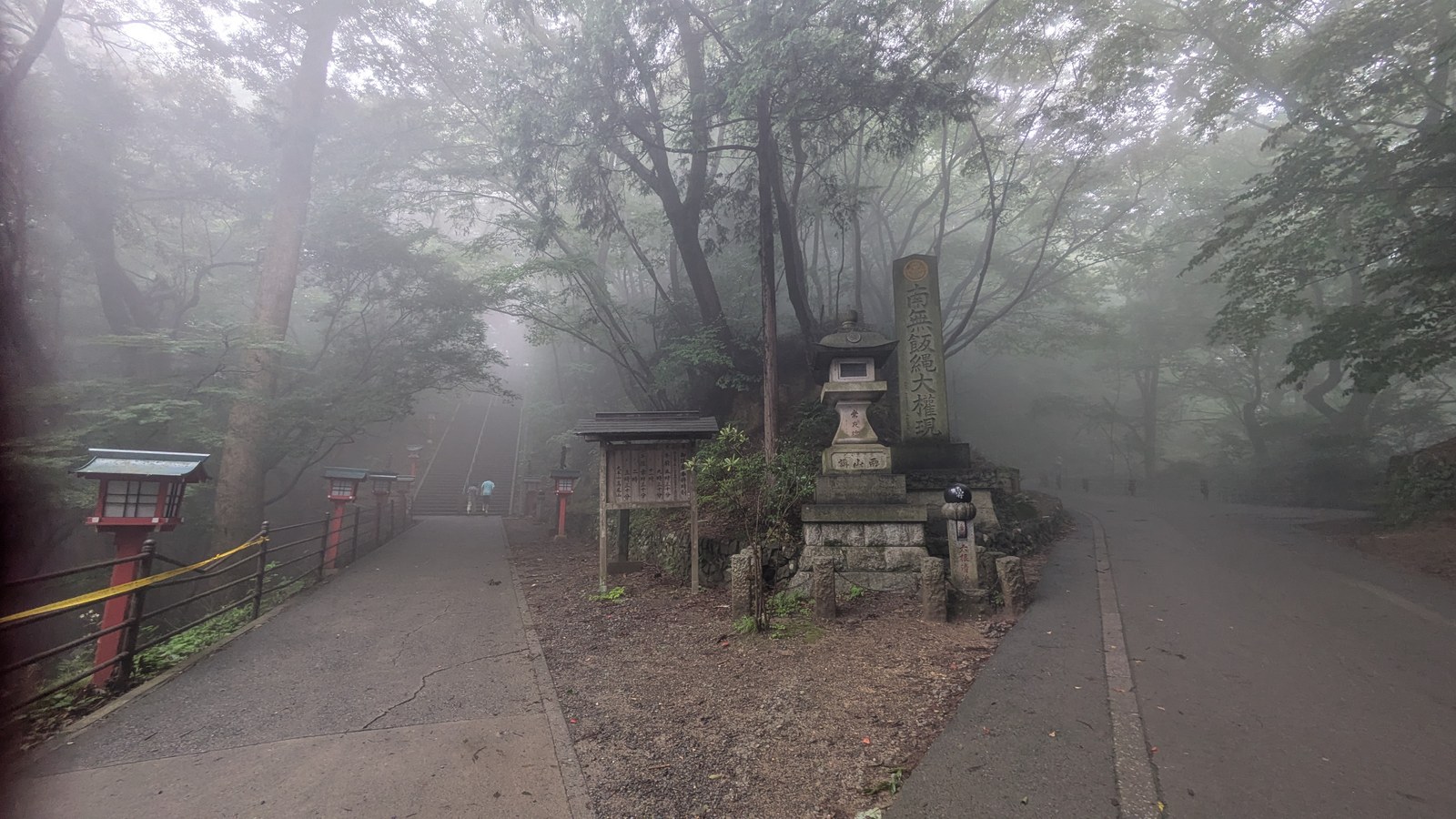
To the left, a stone staircase climbs straight up into the trees: Otoko-zaka, “the men’s slope.” To the right, the paved road curves away and works its way up more gradually: Onna-zaka, “the women’s slope.”
They rejoin a couple of minutes later at the same place, so nothing rides on this. The names are traditional, not a rule, and nobody will look at you strangely for taking either.
Practical guidance, since the naming is no help at all: if your knees prefer a steady gradient to a flight of steps, take Onna-zaka. If you would rather get the height over with quickly, take the stairs. It is the same choice as the one you made at the bottom of the mountain, in miniature.
Yakuo-in — the mountain temple, and the reason this trail is called the main approach route. It is a working temple, not a viewpoint, and there is a proper way to behave in it that most visitors are never told. Our walk-through guide to Yakuo-in sets it out in the order you meet it.
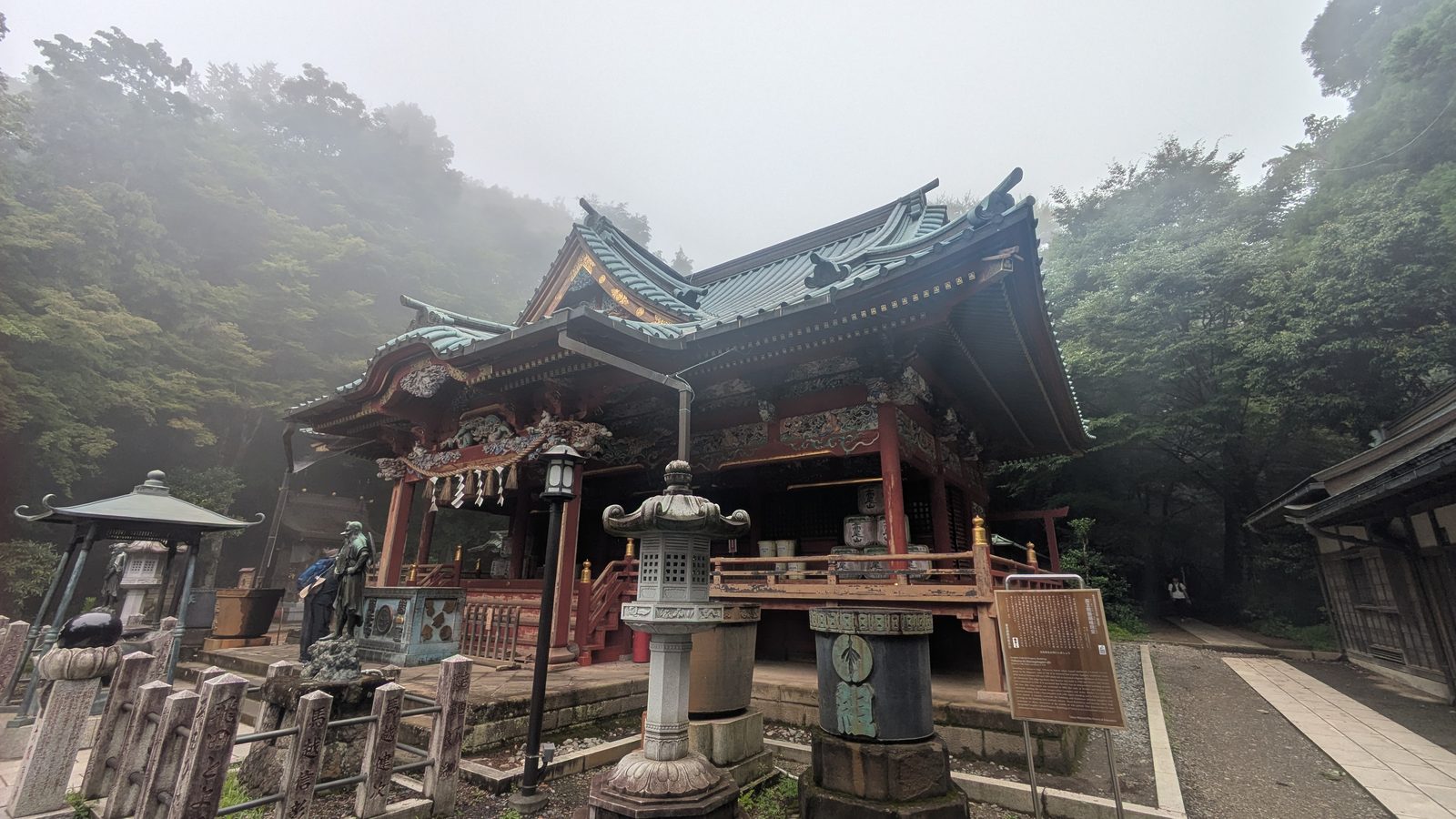
We cover Yakuo-in properly in its own guide — how to enter, what to do at the incense burner, what the tengu statues are doing there, and the one building where even the guidebooks disagree about how to pray.
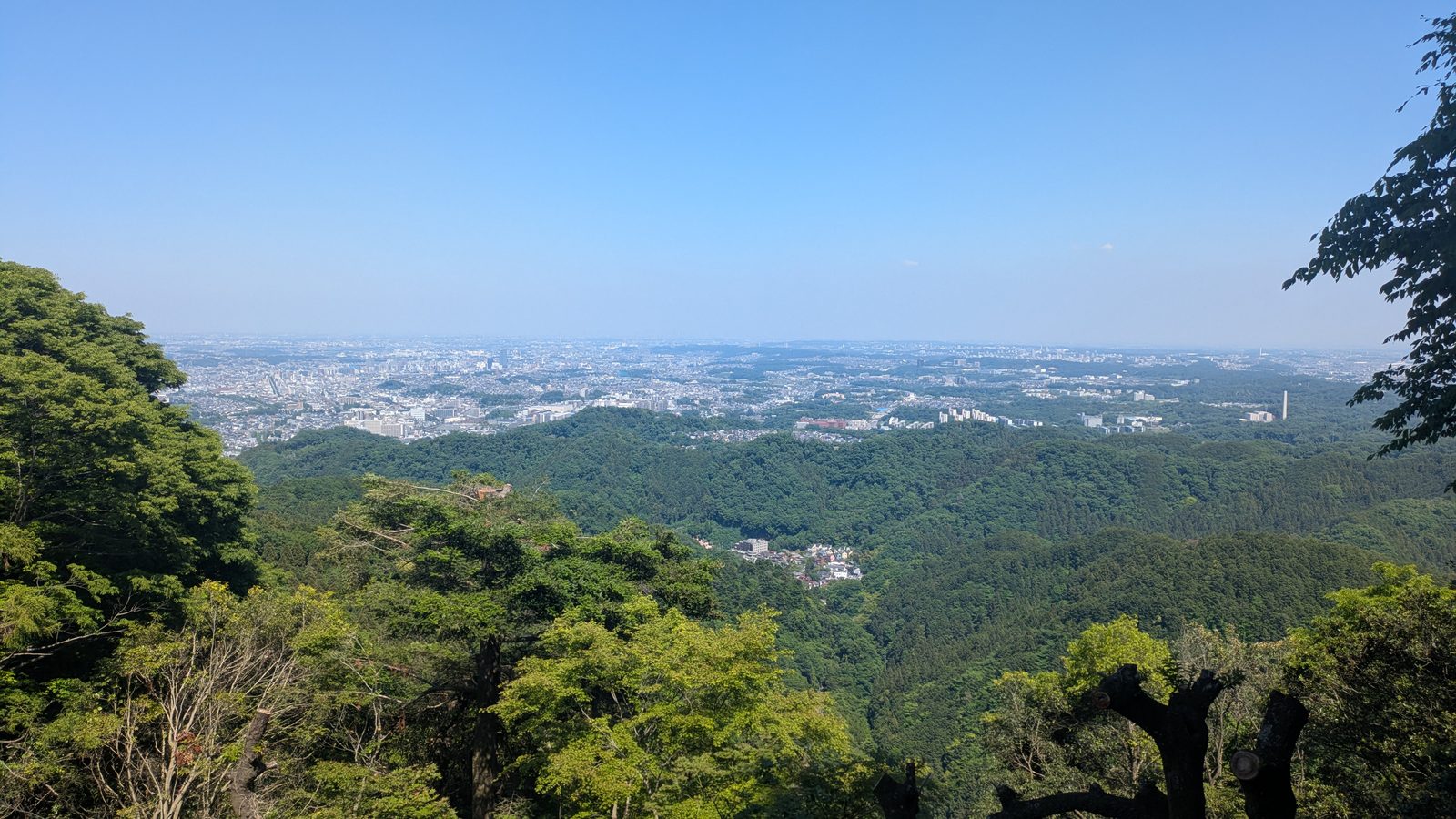
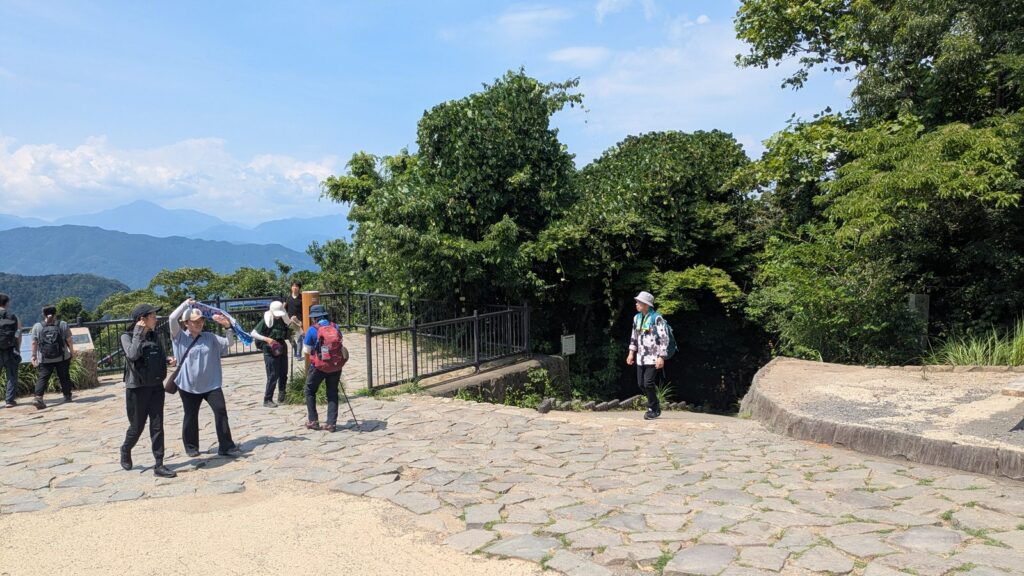
The terrace by the cable car station — the view over Tokyo. On a clear day you can pick out Skytree.
What Trail 1 gives you that the other routes do not
We cover water, cash, and footwear for the whole mountain in the route guide. Three things are specific to Trail 1:
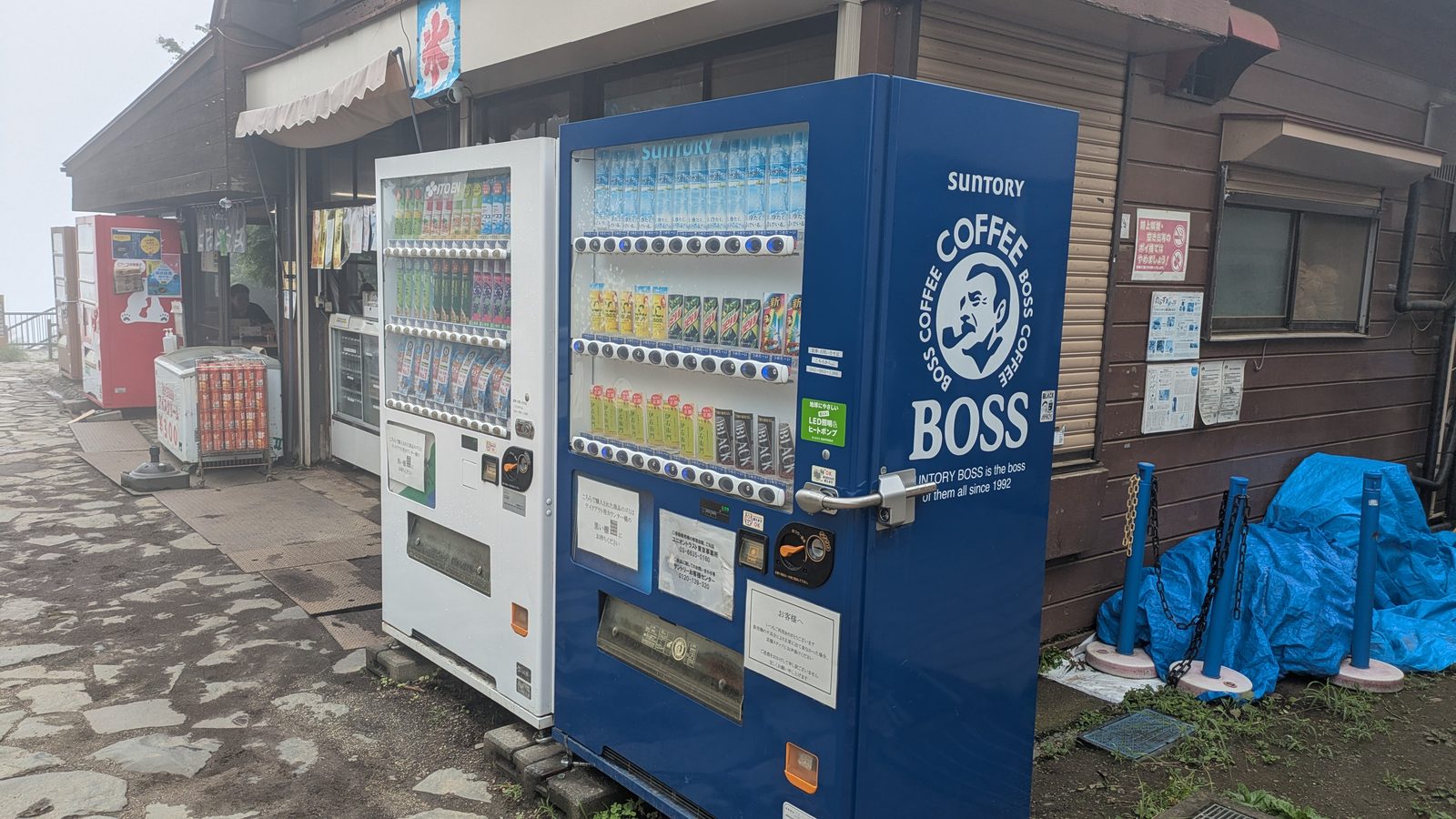
You are never far from a toilet or a vending machine. Trail 6 and the Inariyama Trail have neither, anywhere, between the trailhead and the summit. On Trail 1 there are both at intervals the whole way. If you are walking with children, that alone can decide your route.
It is the one trail where ordinary shoes genuinely work. Paved the whole way, no mud, no roots. That said — ordinary shoes does not mean anything at all. Heels, sandals, and flip-flops are still a bad idea on a 400 m climb, and we see them every time.
The summit vending machines take cash only. The ticket office at the base takes IC cards, credit cards, and QR payment; the machines at the top do not. Carry coins.
One more, which is not about Trail 1 but catches everybody: there are no public bins on the mountain. Whatever you open, you carry down.
The walk you will actually remember
Picture the version where nobody told you any of this. You buy no ticket, you set off in good spirits, and forty minutes in the road tips up and does not stop. You had no idea this was coming. You spend the next stretch head-down on hot concrete, wondering whether the whole mountain is like this, and by the time it eases you have stopped looking at anything.
Now the other version. You know the ramp is there. You have decided in advance — you are walking it before eight, in cool air, on an empty road, because you would rather have it behind you. Or you have a return ticket in your pocket and you are starting your walk at 472 m with a coffee. Either way, when the gradient eases and the cedars start, you have energy left to actually look at them.
That is the whole difference, and it costs nothing but knowing where the hard part is.
Take whichever option fits the legs you brought. Just don’t let the concrete surprise you.
When you come back down, the hot spring is built into the station.
Questions people actually ask
Is Mount Takao’s Trail 1 hard?
Most of it is not. One stretch is — roughly forty minutes in, from Kompira-dai up to the level of the cable car’s upper station. It is paved, it is sustained, and it has little shade. Above and below that stretch, Trail 1 is comfortable walking.
How long does Trail 1 take?
About two hours on foot from Takaosanguchi Station to the summit; around 90 minutes at a quick pace. From the cable car’s upper station it is about 45 minutes.
Should I take the cable car up Mount Takao?
If your priority is the temple, the forest, the summit, then yes — the cable car covers exactly the least rewarding part of the climb, and you still walk 45 minutes of good trail afterwards. If you want the full walk, skip it.
Can I walk up and take the cable car down?
Yes, and the reverse. A return ticket is valid on either the cable car or the chairlift, so you can go up one way and come down the other.
What time does the Mount Takao cable car start?
8:00, then every 15 minutes. The chairlift runs 9:00 to 16:30. If you are starting earlier than 8:00 to avoid crowds, you will be walking the steep section. Seasonal timetables are posted on the operator’s site.
Who cannot ride the chairlift?
The notice at the boarding area excludes elderly passengers or anyone unsteady, pregnant passengers, anyone who has been drinking, and anyone unwell or with a physical impairment. It also asks those afraid of heights, plus unaccompanied children, to reconsider. The cable car has no such restrictions.
Do I need hiking boots for Trail 1?
No. Trail 1 is paved from the station to the summit, so comfortable everyday shoes are fine. Heels, sandals, and flip-flops are not.
What are Otoko-zaka and Onna-zaka?
A short fork on the approach to Yakuo-in temple. Otoko-zaka is a staircase; Onna-zaka is a curving ramp. They rejoin within a couple of minutes. The names are traditional, not a rule — take either.
Can you touch the Tako-sugi cedar?
No. The tree is fenced, and the notice asks visitors not to climb on the roots nor touch the trunk. It is about 450 years old, and soil carried in on the soles of shoes is harmful to it. The sign is in Japanese only, which is why so many visitors do not realise. The octopus statue beside it, Kaiun Hippari-dako, is the opposite: that one is meant to be touched.
Can you reach the summit with a pushchair or a wheelchair?
Not on Trail 1. The trail runs through the grounds of Yakuo-in, where a flight of stone steps is unavoidable, and there is a second flight above the temple. The cable car does not get around this, because both flights are above its upper station. The cable car does still take you to the shops, the temple approach, plus the terrace view over Tokyo.
Is there an English audio guide for Mount Takao?
Yes, and it is free. A poster beside Tako-sugi on Trail 1 has a QR code for the official Mount Takao audio guide, which costs ¥0 and is available in English, Chinese, Korean, as well as Japanese.
Walking further? The ridge west of the summit carries on to Lake Sagami — a five-hour day described in Mount Takao and Lake Sagami: the traverse.
The same lesson, one mountain over. The cable car up Mount Mitake lifts you 424 metres, then sets you down at the foot of a stone staircase: Mount Mitake Rock Garden.
Getting to that cable car. A bus, a funicular, plus two waits nobody times for you: How to Get to Mount Mitake.
Affiliate link. This site earns a commission if you book through it, at no extra cost to you. Photo from our own walk.