Some links on this site are affiliate links. If you book through one, Tokyo Trailhead earns a commission at no extra cost to you. It never decides what appears here.
You did not come to Mount Takao to visit a temple. You came for a mountain.
But if you are walking up Trail 1 — the paved main route from Takaosanguchi Station — you will not reach the summit without passing through the middle of one.
Takao-san Yakuo-in does not sit beside the trail. The trail is its approach path. Somewhere past the Octopus Cedar, the route quietly stops being a hiking trail and becomes a temple pathway, and by the time you notice, you are already inside the grounds: incense smoke drifting across the steps, a stone basin of running water, people stopping to bow at buildings, a straw rope as thick as your leg slung above a doorway.
Every building here is labelled in English. Okunoin Fudodo Hall. Niomon Gate. Main Hall. Each nameplate carries a QR code for more detail. The temple tells you, politely and in your own language, exactly what you are looking at.
What nothing here tells you is what you are supposed to do.
We went looking for it. There is no etiquette sign anywhere in the grounds. The temple’s official Japanese website does not explain how to pray. Its official English page does not either. So you end up standing in a working mountain temple, surrounded by people performing a sequence they learned as children, with no instructions available in any language — including Japanese.
This guide is the sign that isn’t there.
You are not required to do anything
Walking straight through Yakuo-in — not stopping, not bowing, not putting a coin anywhere — is not rude. It is, in fact, what most people coming down the mountain do, Japanese visitors included.
Here is what I saw on my own way through. On the ascent, most people heading for the summit stop and pray. On the descent, almost nobody does — not out of indifference, but because they already did it on the way up. Praying here is treated as something you do once, on your way to the top. Nobody is keeping score, and nobody will correct you either way.
So read what follows as a menu, not a checklist. Between the first gate and the summit there are roughly a dozen points where you can take part, and each one is optional.
If what is holding you back is a version of “I’m not Buddhist — isn’t it disrespectful for me to copy the gestures?”, the answer is no, and the reason is worth knowing. Yakuo-in is a working temple, not a museum, but it is also a temple on a mountain that receives millions of casual visitors a year, and it has been in that position for centuries. The gestures here are not a membership test. Putting a coin in a box, bowing, or letting incense smoke pass over you are acts of respect toward the place, and they read as exactly that. The failure mode is not “doing it imperfectly” — it is being loud, blocking a doorway, or pointing a camera into someone’s face while they pray.
The one substantive mistake foreign visitors do make is clapping in the wrong place. We will get to that, because it is more interesting than it sounds: at Yakuo-in, there is a building where even the guidebooks cannot agree on whether you clap.
Yakuo-in at a glance
| Full name | Takao-san Yakuo-in Yuki-ji (高尾山薬王院有喜寺) |
|---|---|
| Founded | 744 CE, by the monk Gyoki, on the order of Emperor Shomu |
| School | Shingon Buddhism, Chisan branch — one of its three head temples, alongside Naritasan Shinsho-ji and Kawasaki Daishi |
| Enshrined | Izuna Daigongen, installed in 1375 by the monk Shungen. The original object of worship was Yakushi Nyorai, the Medicine Buddha — whose name shares its first character, 薬 (medicine), with the temple’s own |
| Tengu | The long-nosed and crow-billed figures you will see are kenzoku — attendants of Izuna Daigongen, not demons |
| Where on the mountain | Directly on Trail 1, between the cable car’s upper station (472 m) and the summit (599 m) |
| Time to reach it | About 70 minutes on foot from the trailhead via Trail 1, or about 20 minutes if you ride the cable car up first (both are the temple’s own figures) |
| Temple to summit | About 20 minutes |
| Goma fire ritual | Daily at 9:30, 11:00, 12:30, 14:00 and 15:30, plus an early-morning rite at 5:30 (Apr 15–Oct 31) or 6:00 (Nov 1–Apr 14) |
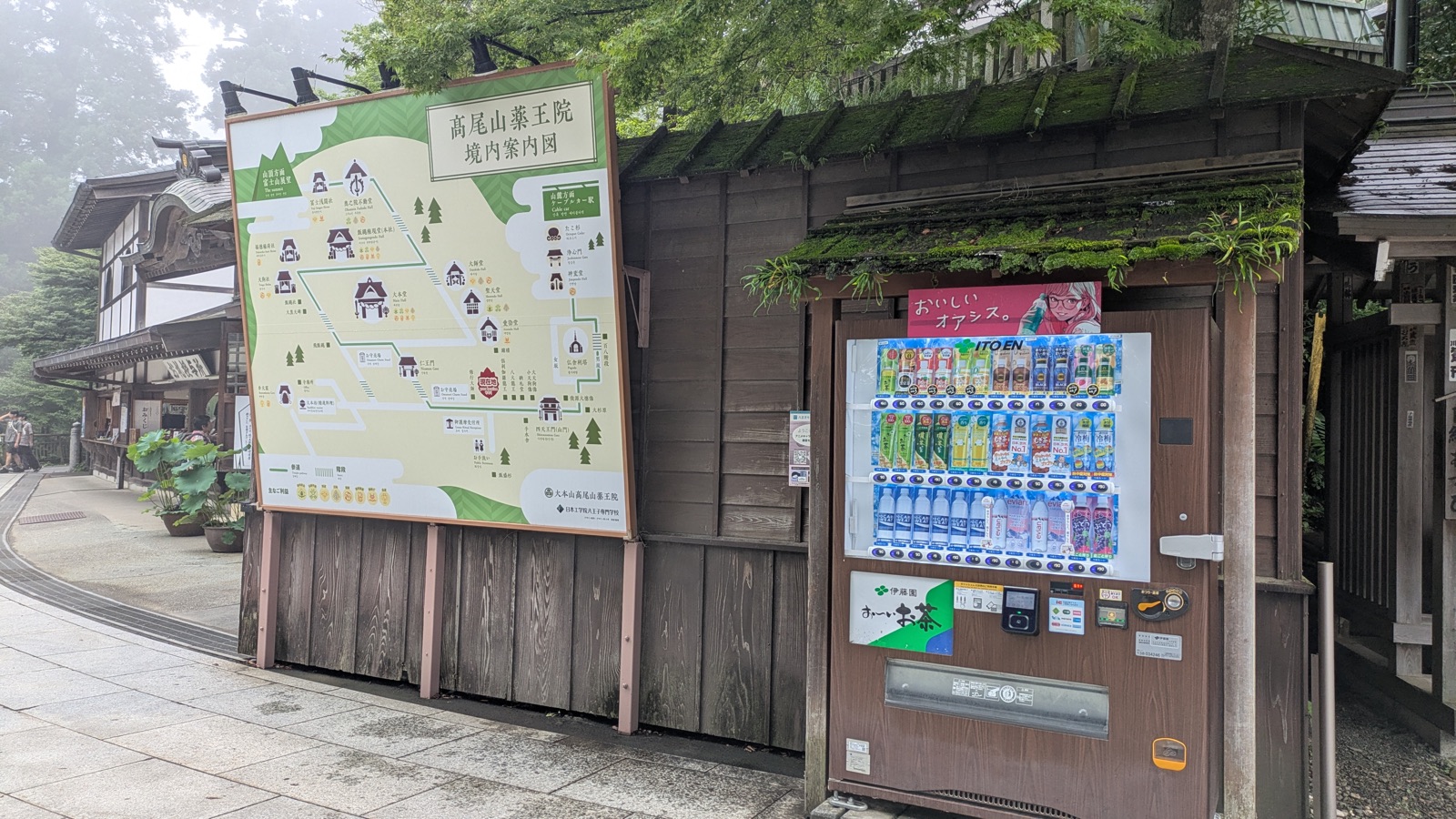
| Paying for things | The vending machine in the grounds takes IC cards and QR payment — but bring cash for amulets, offerings and rituals, and note that the vending machines at the summit are cash only |
Two of these deserve a warning before you go any further.
The walking times are measured from different places. The temple’s “70 minutes” is from the trailhead at the bottom. A trail map board further up the mountain says Trail 1 takes 40 minutes — but that board stands next to the cable car’s upper station, so it is measuring from there. My own time from the station to the summit, at an unhurried pace, was closer to two hours. If a number does not tell you where it starts, it is not telling you anything.
“Cash only” is a moving target on this mountain. Counter-intuitively, the vending machine inside the temple grounds — over 400 metres up — accepts transport IC cards and QR payment, while the machines at the summit above it do not. The rule of thumb is not “the higher you go, the less cashless works.” It is simply: carry coins and notes, and treat every cashless reader as a bonus.
The trail is the temple’s front path
On a map of Mount Takao, Trail 1 is one of six numbered hiking routes. On the temple’s own map of its grounds, the same line is labelled 参道 — sandō, “temple pathway.” Both labels are correct. Trail 1 was a pilgrimage approach centuries before it was a tourist route, and it still is one: the paving, the handrails and the stone lanterns exist because people have been walking up here to pray for close to 1,300 years.
That has a practical consequence. There is no way around the temple. The path does not fork past it or skirt its edge. Trail 1 goes in through one gate, threads between the halls, and leaves through the top of the grounds toward the summit. If you are on Trail 1 and you are going to the top, you are going through Yakuo-in.
It also means the temple sits above the cable car, not below it. The stone staircase in the middle of the grounds is the one climb on Trail 1 that no ticket can remove — which, as covered in the Trail 1 guide, is why the summit is out of reach by pushchair or wheelchair on this route.
Free to walk through. There is no admission fee and no ticket window. There are gates that can be closed, but no opening hours are published on the temple’s website or posted at the entrance, and the temple holds a rite at 5:30 in summer — so the grounds are plainly reachable before dawn. Treat the temple as open whenever the mountain is.
The walk through, in order
What follows is the order you will meet things in, walking up. Each one is optional. Nothing here is a gate you have to unlock.
Joshinmon Gate — the line you cross
The first gate is Joshinmon, written with the characters that mean purify and heart. This is where the mountain becomes temple ground; everything above it is inside the grounds on the temple’s own map.
The custom, if you want it, is small: pause, and bow once — a slight bend from the waist, not a deep one — before you step through. People do it on the way out as well, turning back to face the gate. Plenty of visitors walk straight through without stopping, and that is unremarkable too.
Otoko-zaka and Onna-zaka — and what the 108 means
Past the gate the path splits into the stairs (Otoko-zaka) and the slope (Onna-zaka), and rejoins shortly after. Which one to take is covered in the Trail 1 guide — short version, the slope is easier and you lose nothing by taking it.
What that guide does not tell you is what the staircase is counting. The temple’s own map labels it 百八階段 — the 108 steps. One hundred and eight is the number of bonnō in Buddhism: the defilements, attachments and delusions a person carries. Climbing the stairs is a way of walking up through them, one at a time.
Hold on to that number. You are going to meet it again in a moment, in a completely different form.
Shitennomon Gate — the four kings
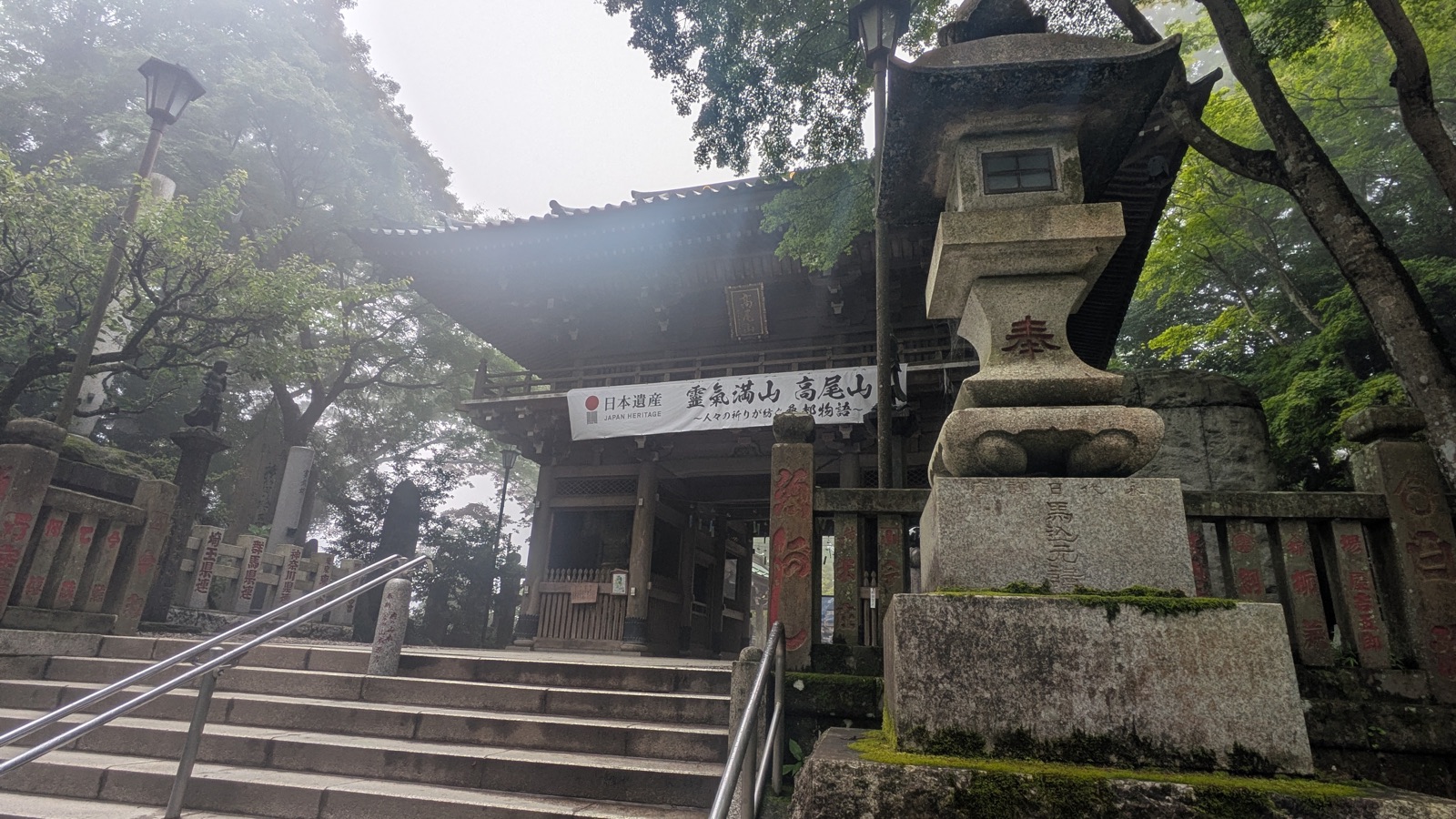
The second gate is Shitennomon, the Gate of the Four Heavenly Kings: four guardian figures, one for each direction, standing watch over the temple. It is the wooden gate with the banner strung beneath its roof reading Reiki Manzan Takaosan — the mountain’s Japan Heritage designation.
This gate, not the first one, is where the grounds start to feel like a temple rather than a trail.
The stone wheels nobody explains
Set into the low stone posts along the approach are small stone wheels, each carved with a character. They turn. Almost nobody who isn’t Japanese touches them, because there is no sign in any language saying what they are.
They are rokkon shōjō wheels. The six characters are the six roots: eyes, ears, nose, tongue, body and mind — the six ways the world gets in and confuses you. The practice is to turn one wheel six times while saying:
Sange sange, rokkon shōjō
懺悔懺悔、六根清浄
“Repentance, repentance. May the six roots be purified.”
Six roots, six turns. And there are wheels scattered all the way up the approach, including near the gates. Turn six of them, six times each, and you have made thirty-six revolutions; the tradition behind the practice is aiming at the same 108 as the staircase you just climbed. The stairs and the wheels are two ways of counting the same thing.
You can turn one in about ten seconds. It is the single most interesting thing in these grounds that no English guide will hand you.
The water basin
Just past the gate is the temizuya, the roofed water basin. This is where you rinse before approaching the halls, and the order is worth knowing because doing it out of order is the one visible slip:
- Right hand holds the ladle, pour over the left hand.
- Swap; pour over the right hand.
- Back to the right hand; pour into your cupped left palm and rinse your mouth from the palm — not from the ladle, and not swallowing.
- Tip the last of the water down the handle to rinse it for the next person.
Never drink directly from the ladle, and never spit into the basin — spit beside it, onto the stones or the drain. If there are no ladles at all (many places removed them and now run the water continuously), just rinse your hands under the spout. Nobody expects more than that.
The two tengu
Immediately past the gate stand two bronze figures, and they are the reason Mount Takao looks the way it does on souvenirs.
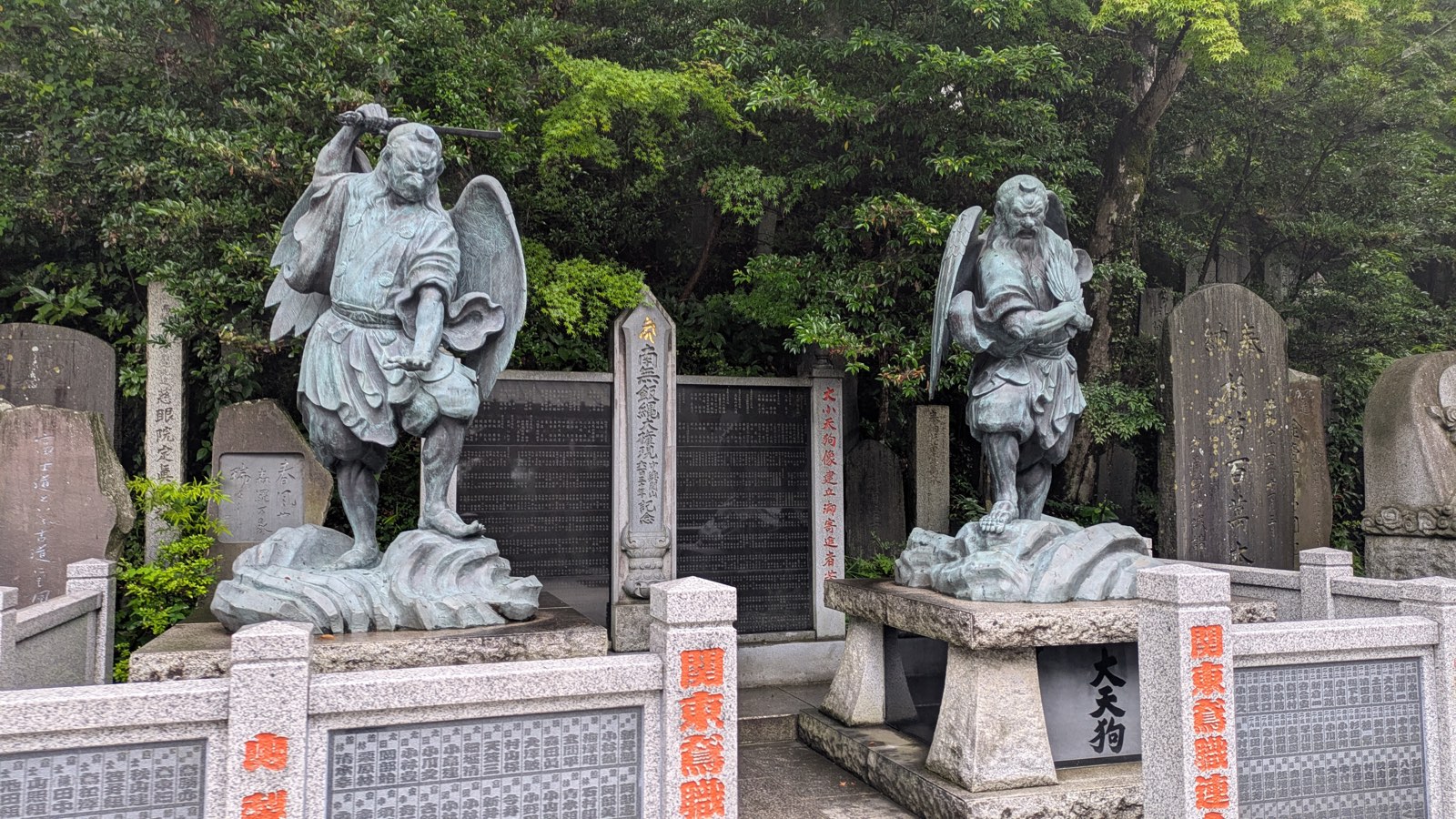
The long-nosed one is Daitengu, the great tengu. The one with a bird’s beak is Kotengu, the lesser tengu. Western write-ups often file tengu under “demons,” which gets them backwards. Here they are kenzoku — attendants of Izuna Daigongen, the deity enshrined at this temple. Their job is protective: warding off misfortune, clearing calamity, carrying the prayers of the mountain. The wings and the swords are on your side.
They are also the reason you will see tengu masks in every shop from here to the station.
The ring you walk through
A little past the gate, on your left, is a stone ring standing upright on a post — the negai-kanau wakuguri, the “wish-granting ring.”
You step through it. That is the whole action. Then you ring the heavy pilgrim’s staff mounted beside it, and — this is the part no sign tells you — you say your name and address, so the prayer knows where it came from. It is a very Japanese detail: even a wish needs a return address.
I walked through it. It takes fifteen seconds and it is one of the few things here you actively do rather than watch.
The wall of names
Near the gate, the path is lined on one side with what looks like a wooden fence made of vertical boards, each one covered in Japanese writing. Almost every visitor walks past it without a glance, because it looks like scaffolding.
It is a list of names. When a wish made at Yakuo-in comes true, the traditional way to say thank you is not money — it is to donate a cedar sapling to the mountain. The boards carry the names of everyone who donated that year, displayed for twelve months in a stretch of the approach called the Ōsugihara, the great cedar field.
The forest you have been walking through is, in part, made of answered prayers. The temple’s first rule has always been sesshō kindan — a prohibition on needless killing, extended to cutting trees. That is why this trail is dark and green rather than open and scenic, and why the cedars are the size they are.
The staircase, and Niomon Gate
Then the stairs. This is the climb described in the Trail 1 guide — the one section of Trail 1 that no ticket removes, sitting above the cable car rather than below it.
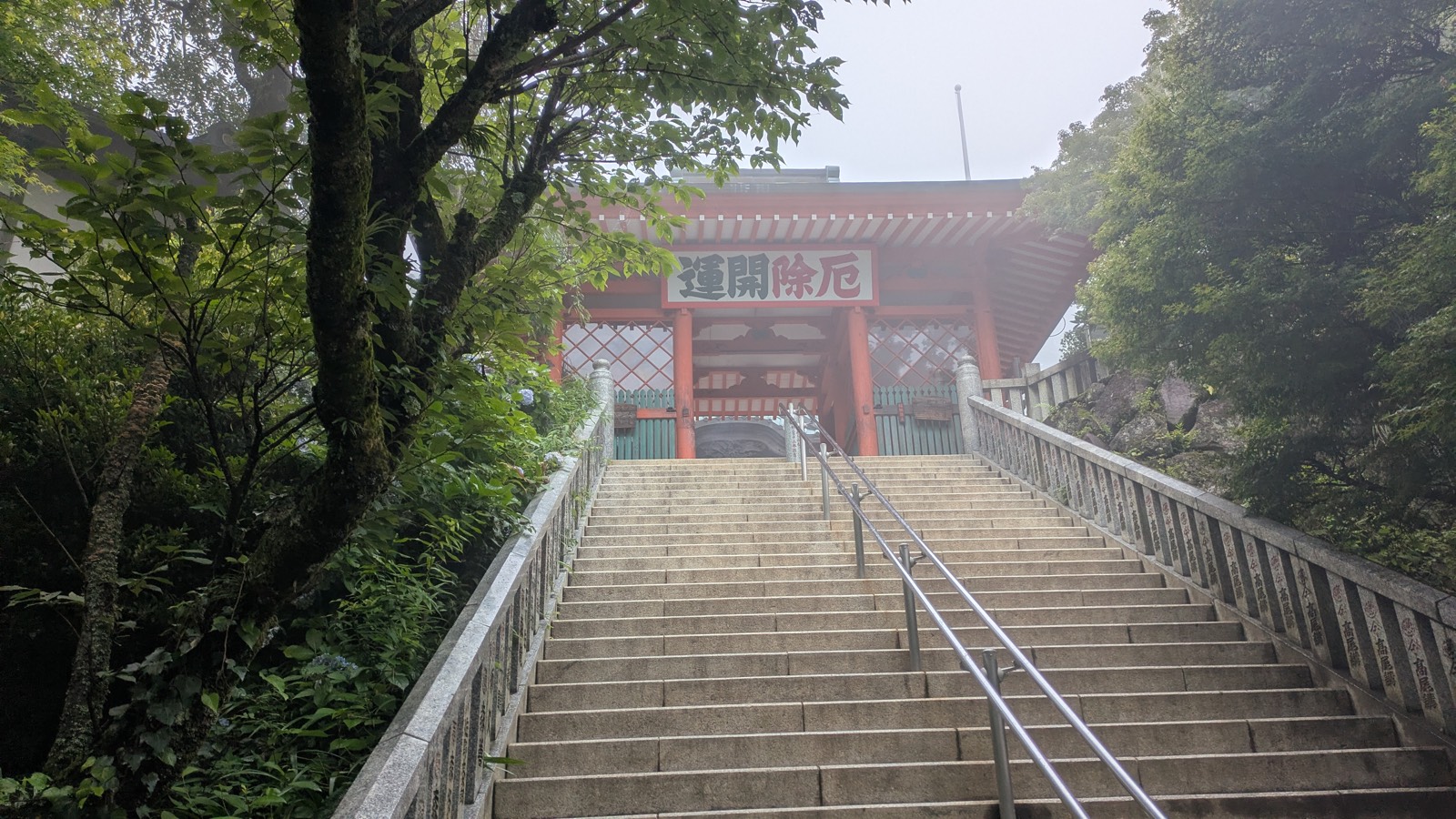
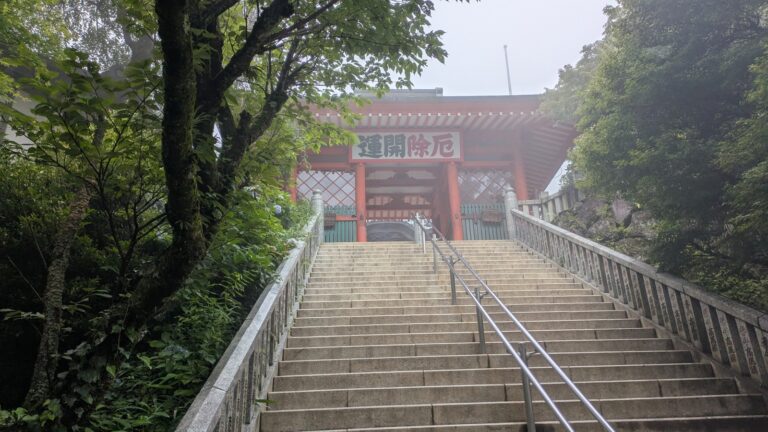
At the top is a vermilion gate, and it is the most photographed structure on the mountain after the summit sign. This is Niomon Gate, named for the two Nio — the muscular guardian figures standing inside it. The plaque above the opening reads 厄除開運: warding off misfortune, opening fortune. That is, in four characters, what most people climb up here to ask for.
The Main Hall
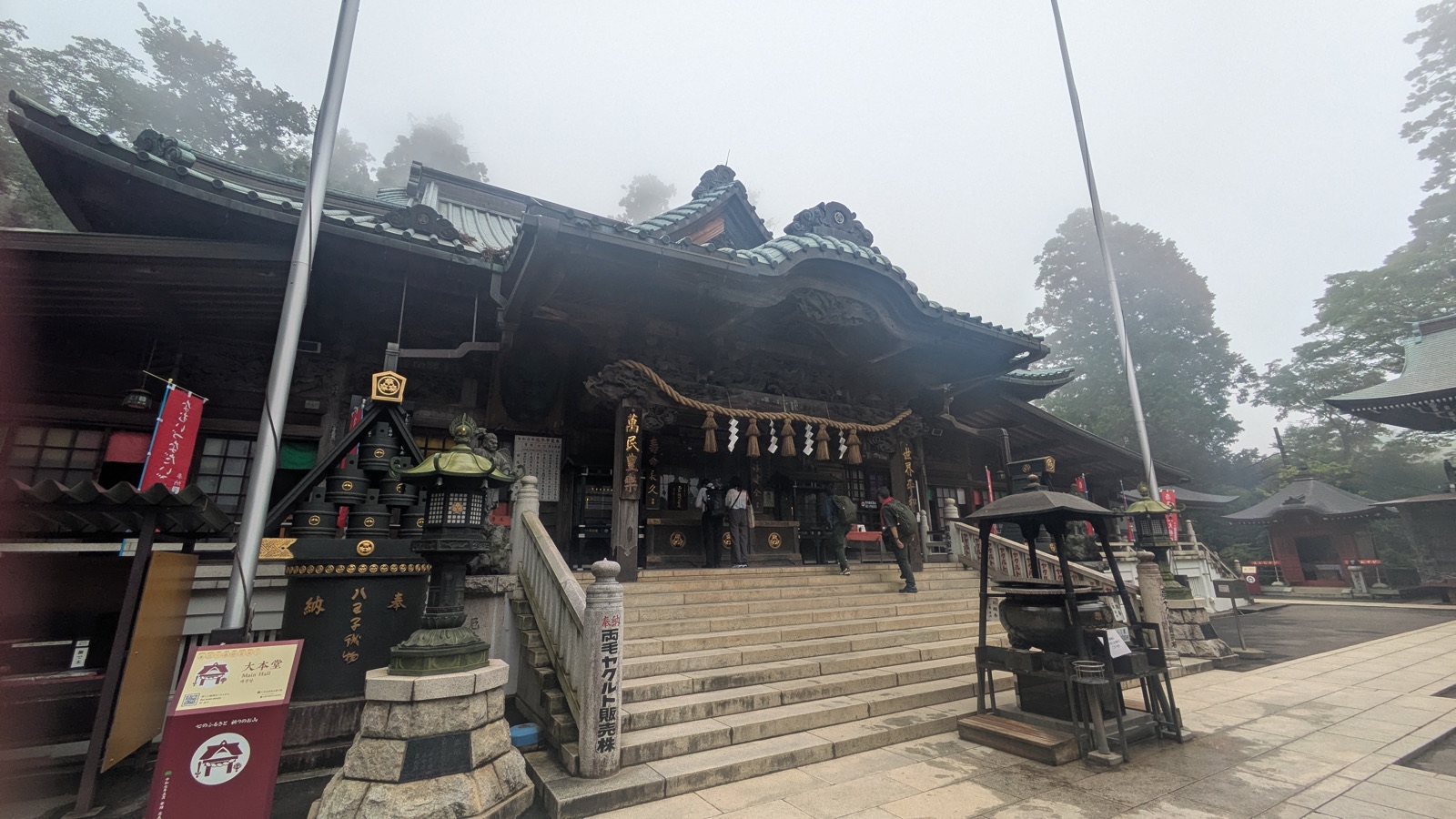
Through the gate and across the courtyard is the Main Hall — the Daihondō. The straw rope above the entrance, the lanterns, the crowd: this is the centre of the temple, and the place where you will see the most people doing the most things.
The building you are looking at dates from April 1901, and it exists because of a storm. In 1886 a typhoon triggered a landslide in these grounds that brought down both the earlier main hall and the hall of the Medicine Buddha. What stands here now is the replacement.
There are three of them, in order.
The incense burner. The large bronze burner in front of the steps is the most visible act in the grounds. People draw the smoke toward themselves with a cupped hand and let it pass over whatever needs help — a sore knee, a tired head, the chest. If you do one thing at Yakuo-in, do this one. It is unmistakable, nobody is watching closely, and it makes physical sense to anyone from anywhere.
The offering. In front of the hall is the offering box. Place a coin in — place, do not throw. Any amount; a ¥100 coin is completely normal, and a ¥5 coin is traditional for reasons of wordplay.
The prayer. Then, and this is the part that separates a temple from a shrine:
Palms together. Bow once. Do not clap.
Clapping belongs at Shinto shrines. This is a Buddhist hall, and the gesture here is gasshō — palms together, quietly, for as long or as short as you like. Say something internally or say nothing. Bow once when you finish.
One hard rule at this building: photography is not allowed inside the Main Hall. Everywhere else in the grounds — the gates, the tengu, the halls from outside, the courtyard — you can shoot freely. Inside this hall, put the camera away. This is the only place on the mountain with a real photography restriction, and it is not signposted in English, which is exactly why it is in this guide.
The Goma Ritual Reception
To the left of the courtyard is the Goma Ritual Reception, and behind that unglamorous English label is the most striking thing you can experience here.
The goma is a fire ritual, and the temple’s own explanation of it is worth having in full, because it closes a loop this guide opened two gates ago. Firewood is set alight by the presiding monk. That firewood represents human bonnō — the defilements, the attachments, the noise in your head. The fire is described as the flame of wisdom, and what it burns is the bonnō. Prayers written by the participants are entrusted to the flames and carried to the deity.
Stop and count what you have walked past. The staircase below counted 108 bonnō, one per step. The stone wheels asked you to purify the six roots that let them in. And at the top, in the Main Hall, they are set on fire. Three ways of handling the same problem, arranged along one path. Nobody tells you they are connected. They are.
There are two entirely different ways to take part, and they are easy to confuse.
Same-day, at the desk. The goma is performed daily at 9:30, 11:00, 12:30, 14:00 and 15:30, plus an early-morning rite at 5:30 (15 April–31 October) or 6:00 (1 November–14 April). The temple’s own site shows the next scheduled time on its goma page, which is the most reliable place to check before you climb.
The temple sets out the procedure in five steps:
- Fill in a request slip at the Goma Ritual Reception.
- Pay the goma fee. You receive a voucher for your tablet, and an offering item.
- Be inside the Main Hall about fifteen minutes before the stated time.
- The ritual is performed with the temple’s monks. You hand over your voucher inside the hall.
- Receive your goma tablet and take it home.
The tablet is treated as a portion of the deity itself — you are meant to keep it somewhere respectful and, when you venerate it, to say the temple’s invocation: “Namu Izuna Daigongen.”
The fee is not published anywhere online. Two amounts do appear on the temple’s goma page, and both are for something else: ¥1,000 is the flat postage for having a tablet mailed to you if you cannot visit, and the ¥3,000 figure is for donating a cedar sapling, an entirely separate custom. Ask at the desk, and carry cash.
Whether you may sit in and watch without submitting a request is something we could not establish. Do not assume you can.
Booked in advance, in English. Separately, the temple sells a bookable experience through an English-language booking page: the goma ritual for ¥10,000, or the ritual plus a shōjin ryōri meal — traditional Buddhist vegetarian cuisine, no animal products — for ¥15,000. It runs about 30 minutes, tickets must be bought online in advance, and you show the ticket screen at the temple. If you want the ritual explained rather than simply witnessed, this is the version to take.
The amulet stands
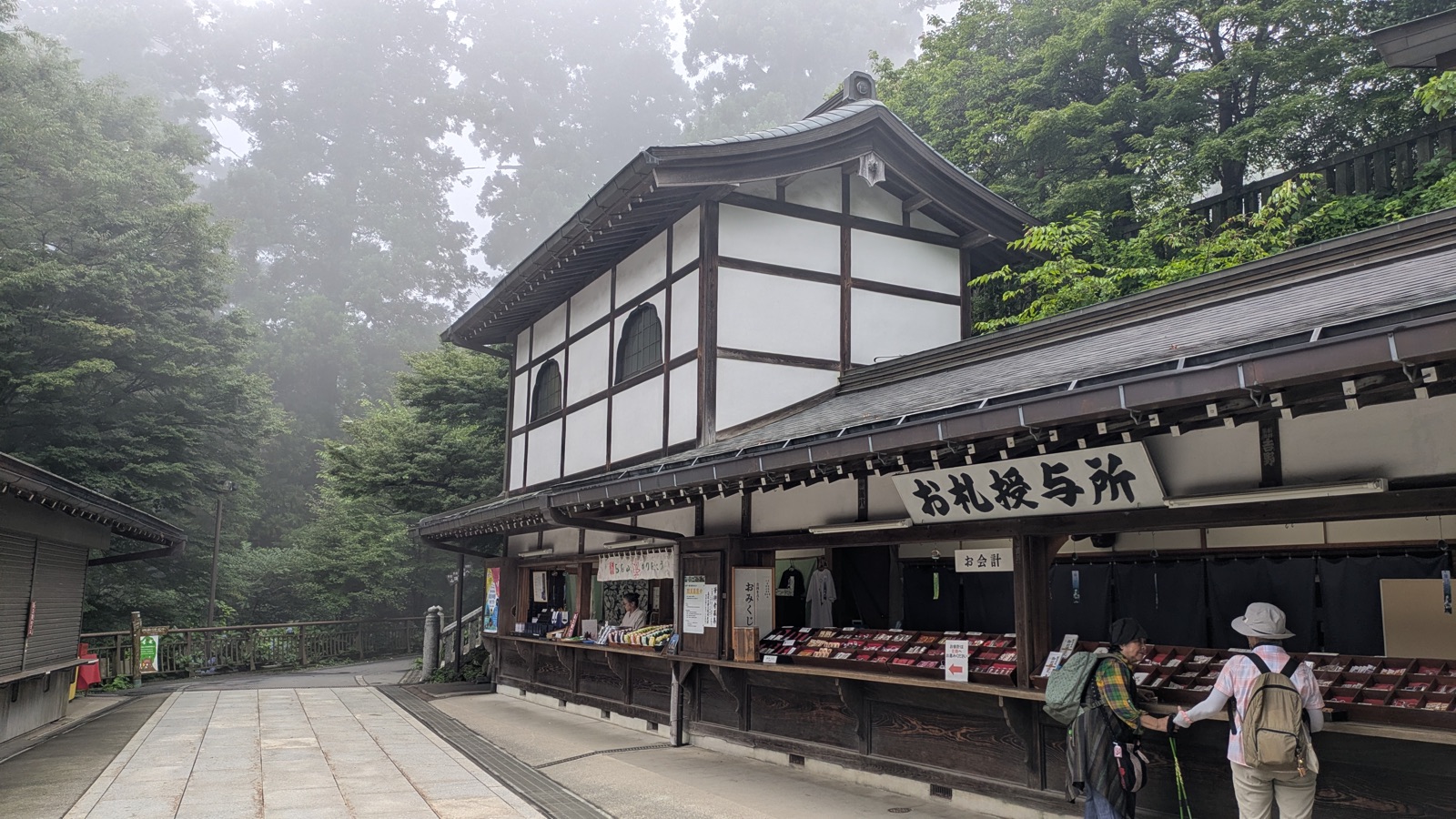
There are two Omamori Charm Stands in the grounds — long wooden counters with amulets laid out in rows, plus omikuji fortune slips.
An omamori is not a souvenir exactly; it is meant to be carried, kept for about a year, and returned to a temple rather than thrown away. Buying one is completely normal for a visitor, and nobody expects you to be Buddhist to want protection on a mountain.
Bring cash. The vending machine forty metres away takes IC cards and QR payment, but do not extend that assumption to the amulet counters.
Izunagongendo Hall — the Honsha
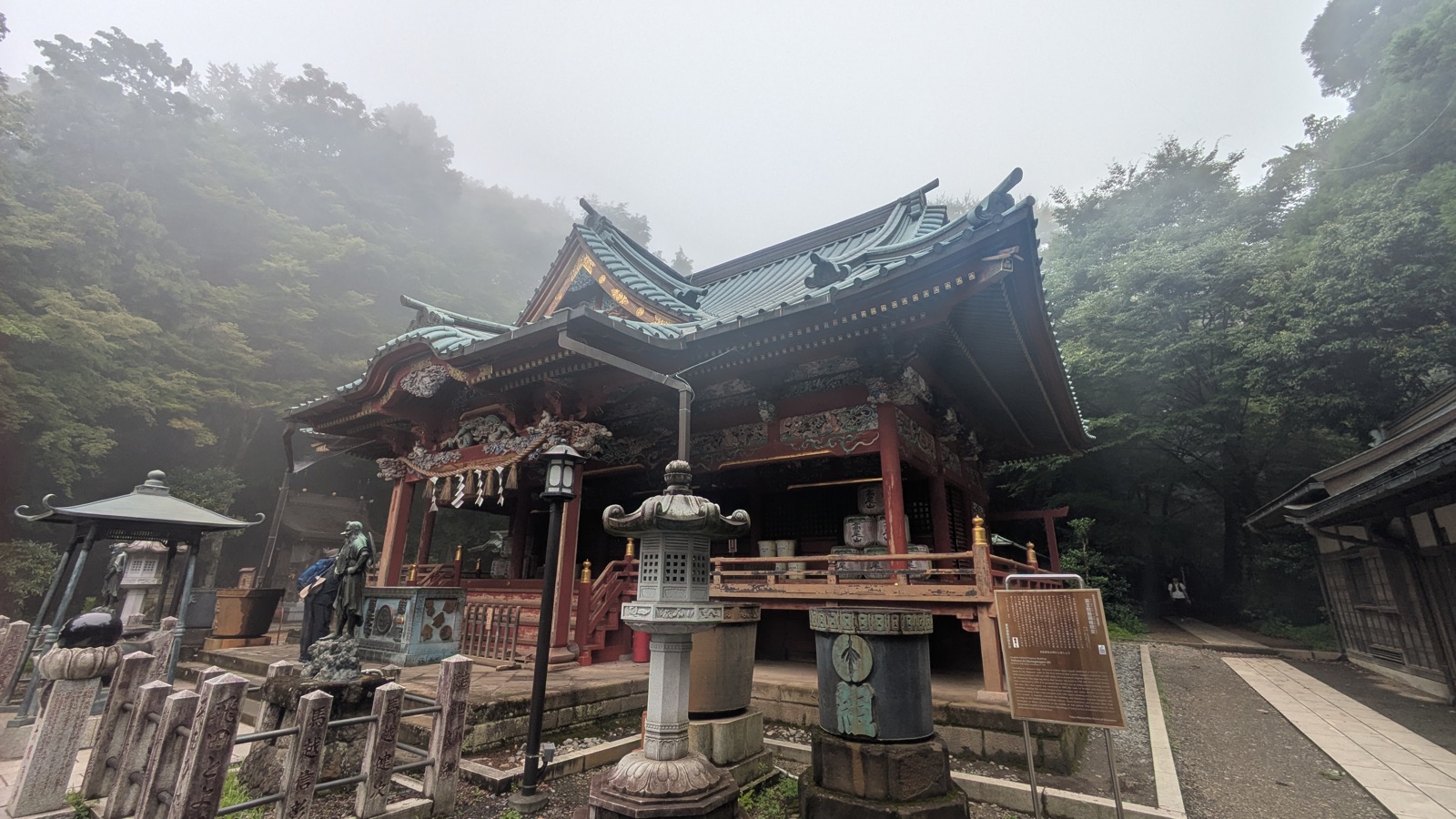
Above the Main Hall, up another set of steps, is the Izunagongendo Hall, also called the Honsha. This is where Izuna Daigongen — the deity this temple has been built around since 1375 — is enshrined. It is the ornate one: red and green, carvings across every surface, a designated Tokyo cultural property with its own explanatory board.
It is also where the simple rule I just gave you stops working.
Okunoin Fudodo Hall, and out
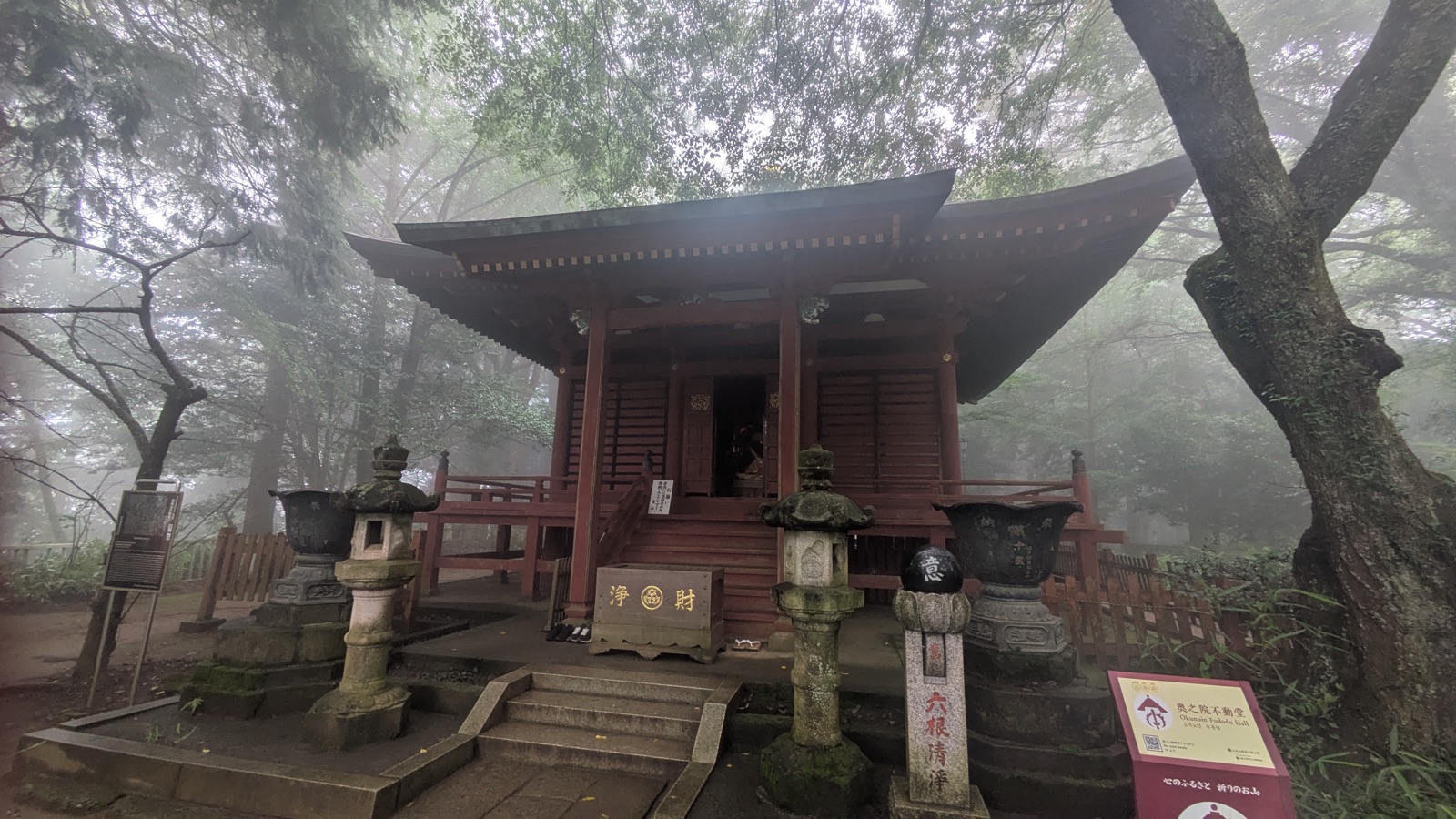
Above the Honsha is the last building, Okunoin Fudodo Hall, standing among tall cedars with a stone wheel and an offering box in front of it. Nearby is Fuji Sengen Shrine.
Past this point the path leaves the grounds and becomes a mountain trail again. The summit is about 20 minutes further up.
The building where nobody agrees whether you clap
Here is the rule everybody learns about Japan: at a Buddhist temple you put your palms together and bow. At a Shinto shrine you bow twice, clap twice, and bow once. Two religions, two gestures, no overlap.
It is a good rule. It works almost everywhere in the country. And at the Honsha of Yakuo-in it falls apart, because the building is not clearly one or the other.
Why it is ambiguous. Izuna Daigongen is a gongen — a Buddhist figure understood to appear in the form of a Shinto deity. That idea, shinbutsu-shūgō, the fusion of the two religions, ran through Japanese religious life for over a thousand years, and mountains were where it was strongest: an ascetic who trained here would not have recognised the distinction between Buddhist and Shinto as a meaningful one to draw. The Meiji government tried to force the two apart from 1868 onwards. On this mountain, the gongen hall is still standing, still called a gongen hall, inside a Shingon Buddhist temple, with a straw rope of the kind you see at shrines hanging across its front.
So: do you clap?
The guides disagree. One well-regarded local Mount Takao guide instructs visitors to do the full Shinto sequence at the Honsha — two bows, two claps, one bow. A licensed interpreter-guide based at the foot of this mountain argues the opposite: skip the clapping, say “Namu Izuna Daigongen”, and put your palms together quietly, because the figure is ultimately Buddhist.
That second position has the temple’s own words behind it. “Namu Izuna Daigongen” is not something the guide invented — it is the temple’s official invocation, printed on its own website in the instructions for how to venerate a goma tablet once you have taken it home. The temple tells you what to say to this deity. It just never tells you what to do with your hands.
Neither guide is being careless. They are disagreeing about something genuinely unresolved.
What actually happens. Stand near the Honsha for five minutes and you will see both. Claps, and quiet palms, from Japanese visitors who all look entirely certain about it. Nobody corrects anybody. There is no monk stationed there adjudicating.
So here is what to do. If you like a definite answer, take either one and perform it calmly; both are defensible and neither will offend.
If you would rather have a gesture that is never wrong anywhere on this mountain:
Palms together. One quiet bow.
That works at the Main Hall, at the Honsha, at Okunoin, at the small shrines off to the side, and at every other temple and shrine you visit in Japan. It is never the incorrect thing. Clapping in the wrong place is the only mistake available to you here — and if you simply never clap, that mistake is off the table.
And then notice what you are looking at. The reason the guidebooks cannot agree is not sloppiness. It is that you are standing in front of thirteen hundred years of two religions sharing one mountain and never quite finishing the argument — compressed into a building the size of a small house, with a rope across the front of it.
That is worth more than a correct gesture.
If you would rather have the halls explained as you walk past them, one small-group guided day on Mount Takao goes through Yakuo-in on the way to the summit with an English-speaking guide.
Affiliate link · Small group of up to 7 · About 8 hours · Free cancellation up to 24 hours before
Practical notes
Toilets. There are public toilets inside the grounds, marked on the temple’s own map, in the flat area below the Main Hall near the Goma Ritual Reception. This is the last reliable stop before the summit.
Water — and one warning. The water basin at the gate is for rinsing, not drinking. Do not treat it as a refill point. Where the actual drinking water is on this mountain, and where it only looks like drinking water, is covered in the route guide.
Money, once more. The vending machine in the grounds takes IC cards and QR payment. The amulet counters and the goma reception should be treated as cash. The vending machines at the summit above here are cash only. Carry coins and small notes; the mountain is not consistent about this and the temple is the exception, not the rule.
Buddhist vegetarian food. The temple serves shōjin ryōri at the Daihonbō, marked on the map as “Buddhist cuisine.” It uses no animal products at all — which makes it one of the few genuinely vegan meals on this mountain, and worth knowing about if you have been struggling with menus in Tokyo. The version we can confirm a price for is the ¥15,000 bundle with the goma ritual, booked in advance through the temple’s English booking page. Whether you can simply turn up and eat is not something we could establish; assume you need to book.
Timing around the fire ritual. The goma times are published, so you can aim at them or away from them. If you want the Main Hall quiet, do not arrive in the fifteen minutes before a scheduled ritual — that is when people are filing in. If you want to see it, that is exactly when to be there.
Something even regulars miss. The temple’s map marks a Bentenkutsu Cave in the grounds, below the Main Hall near the Daihonbō. I have climbed this mountain many times and did not know it was there until I sat down to write this guide — which is the whole problem with Yakuo-in in one sentence. Nothing points to it. I have not been inside, so I am not going to describe it to you; I am telling you it exists so that you have the option I did not know I had.
Before you go at all. Trail closures on this mountain last months, not days, and they do not reach the English-language internet. The Takao Visitor Center posts current conditions.
What to wear. Nothing special. You will be in hiking clothes, and so is everyone else — the trail is the approach path, so hiking clothes are the normal dress for this temple in a way that would be odd at a city temple.
Questions people actually ask
Do I have to pay to enter Yakuo-in?
No. There is no admission fee and no ticket window. You walk in off the trail.
Do I need to be Buddhist to pray at Yakuo-in?
No. Placing a coin in the offering box, letting incense smoke pass over you, or putting your palms together are acts of respect toward the place, and they are read that way. Nobody will ask what you believe.
Should I clap at Yakuo-in?
Not at the Main Hall — that is a Buddhist hall, and the gesture there is palms together and one bow. At the Honsha (Izunagongendo Hall), the guides genuinely disagree, because the deity there is a gongen, a fusion of Buddhist and Shinto. If you never clap anywhere on this mountain, you will never be wrong.
Can I take photos at Yakuo-in?
Yes, almost everywhere — the gates, the tengu statues, the halls from outside, the courtyard. The exception is that photography is not permitted inside the Main Hall. This is not signposted in English.
Can I avoid the temple on my way to the summit?
Not on Trail 1 — the trail runs straight through the grounds. If you would rather not pass through a temple, take Trail 6 or the Inariyama Trail instead; both climb well away from Yakuo-in and rejoin near the top. The route guide compares all of them.
What is the goma, and can I watch without taking part?
It is a fire ritual in which firewood representing human defilements is burned in what the temple calls the flame of wisdom, carrying participants’ prayers to the deity. It runs five times daily plus an early-morning rite. Whether you can observe without submitting a request is something we could not confirm — if that is your plan, ask at the Goma Ritual Reception rather than assuming.
How much time should I allow for Yakuo-in?
Add 20–30 minutes to your walking time if you want to stop at the main points rather than pass through. Taking part in a goma needs roughly an hour, since you should be inside the hall fifteen minutes early and the ritual itself runs about half an hour.
What are the tengu statues for?
They are kenzoku — attendants of Izuna Daigongen, the deity enshrined here. Their role is protective: warding off misfortune and carrying the mountain’s prayers. They are not demons, despite how they are often described in English.
Is Yakuo-in worth stopping for if I only care about hiking?
You are walking through it either way. Stopping costs twenty minutes, and it is the difference between passing a set of buildings and understanding why a mountain in the suburbs of Tokyo has a 1,300-year-old temple two thirds of the way up it.
Is there an English explanation of the practice at Yakuo-in?
Not on the grounds. A map of the site is posted in four languages, so you can put a name to each hall, but nothing at the temple explains the practice itself: what the incense smoke is for, where palms go, what the little stone wheels do. That silence is the reason this article exists, so the simplest fix is to read it before you walk up. If you would rather have a person explain it in front of the building, one full day tour of Mount Takao allows forty minutes here with an English speaking guide: the Mt Takao day tour on GetYourGuide, an affiliate link that earns this site a commission at no extra cost to you.
Affiliate link. This site earns a commission if you book through it, at no extra cost to you. Photo from our own walk.
One last thing
You will be through these grounds in about twenty minutes, and you can do it without stopping once. Plenty of people do.
But you now know what the staircase was counting, what the little stone wheels are for, why there are two birds-and-swords figures at the gate, why a wooden fence is covered in strangers’ names, and why the fire in the main hall is burning firewood that stands for everything you carried up the hill.
That is the difference between walking past a temple and walking through one.
Then keep going. The summit is twenty minutes above the last hall, and the view — on the right day — reaches Mount Fuji.
Where to next
- Choosing your route up the mountain → Mount Takao: Which Trail Should You Take?
- The trail this temple sits on → Mount Takao Trail 1: Should You Walk Up or Take the Cable Car?
- Riding up instead of walking → Cable Car or Chairlift? They Cost the Same
- The hot spring at the bottom → Keio Takaosan Onsen: The Rules That Can Turn You Away
- The trail that skips this temple entirely → Mount Takao Trail 6: The Stream Is the Path
- The long day that ends at this temple → Mount Takao and Lake Sagami: the traverse
- A mountain sanctuary where nothing at all is posted → Musashi Mitake Shrine: the wolf, the dogs, and the missing instructions