Some links on this site are affiliate links. If you book through one, Tokyo Trailhead earns a commission at no extra cost to you. It never decides what appears here.
What this guide covers22 sections
- The short version
- The climb at a glance
- The date was not mine to choose
- The bus does most of the mountain for you
- Eighty-six minutes to the seventh station
- The hut, and the sign that tells you where you are
- Dinner at half past four
- You lie down at five in the afternoon, and nobody tells you to
- The hut has no lights-out, and check-out is six in the morning
- Three reasons I did not sleep, and crowding is not one of them
- Leaving at six minutes past eleven, two hours earlier than planned
- Three hours and nineteen minutes in the dark
- The summit at twenty-five past two. The sun at twenty to five.
- An hour and sixteen minutes around the rim
- You do not have to be on the summit for the sunrise
- What the sunrise was actually worth
- Coming down on twenty hours awake
- What this mountain does not give you
- So, is it worth it?
- If you go
- Questions people actually ask
- Where to next
The short version
Almost every English answer to this question grades the same thing: the climbing. Is the effort of going up worth the view at the top.
I climbed Mount Fuji on the twenty second and twenty third of July 2026, up the Yoshida trail, and I have the timestamps and the GPS altitude from every photograph I took. When I laid the day out, the walking came to about nine hours. The whole thing came to twenty hours and twenty five minutes.
The other eleven hours were spent waiting, and most of that was spent lying awake.
So the honest answer is that the climb is not the hard part. The night is. What you are buying is not a hike. It is one night of sleep, handed over in advance. Whether Mount Fuji is worth it comes down to whether you are willing to pay that.
The climb at a glance
| Dates | 22 to 23 July 2026 |
| Up | Yoshida trail, from the fifth station at 2,305 m (7,562 ft) |
| Slept | Fuji Ichikan, seventh station, 2,800 m (9,186 ft) |
| Down | Gotemba trail, across the Hoei crater, to the Fujinomiya fifth station |
| Time on foot | About 9 hours |
| Time waiting | About 11 hours |
| Trailhead to trailhead | 20 hr 25 min |
| Entry fee | ¥4,000 per person, paid online in advance |
| Booked in advance | Bus seat, entry permit, mountain hut |
| Slept in the hut | No |
The date was not mine to choose
I did not pick a date and then look for a bed. I looked for a bed in early July, found that every hut was full, and worked backwards from whichever nights still had space. The mountain gave me a date and I took it.
That is worth knowing before anything else, because it is the part people discover last. The permit and the hut are separate systems with separate opening days, and for the 2026 season the hut I ended up in opened its bookings on 17 May. By July the choice was gone.
If you are still working out whether Mount Fuji fits into your trip at all, that side of it is covered in Mount Takao or Mount Fuji. This article is about what happens after you have a booking.
The bus does most of the mountain for you
Mount Fuji rises 3,776 m (12,388 ft) from a plain that sits at a few hundred metres. Almost nobody walks that. What nearly everybody does, and what I did, is take a reserved coach out of Shinjuku that drives up a toll road and puts you down at 2,305 m (7,562 ft).
So the mountain hands you two thirds of its own height before you take a step. That is why the walking figures look modest, and it is also the reason the second half of the night is harder than the numbers suggest: you have not earned that altitude slowly, you have been driven to it in a morning.
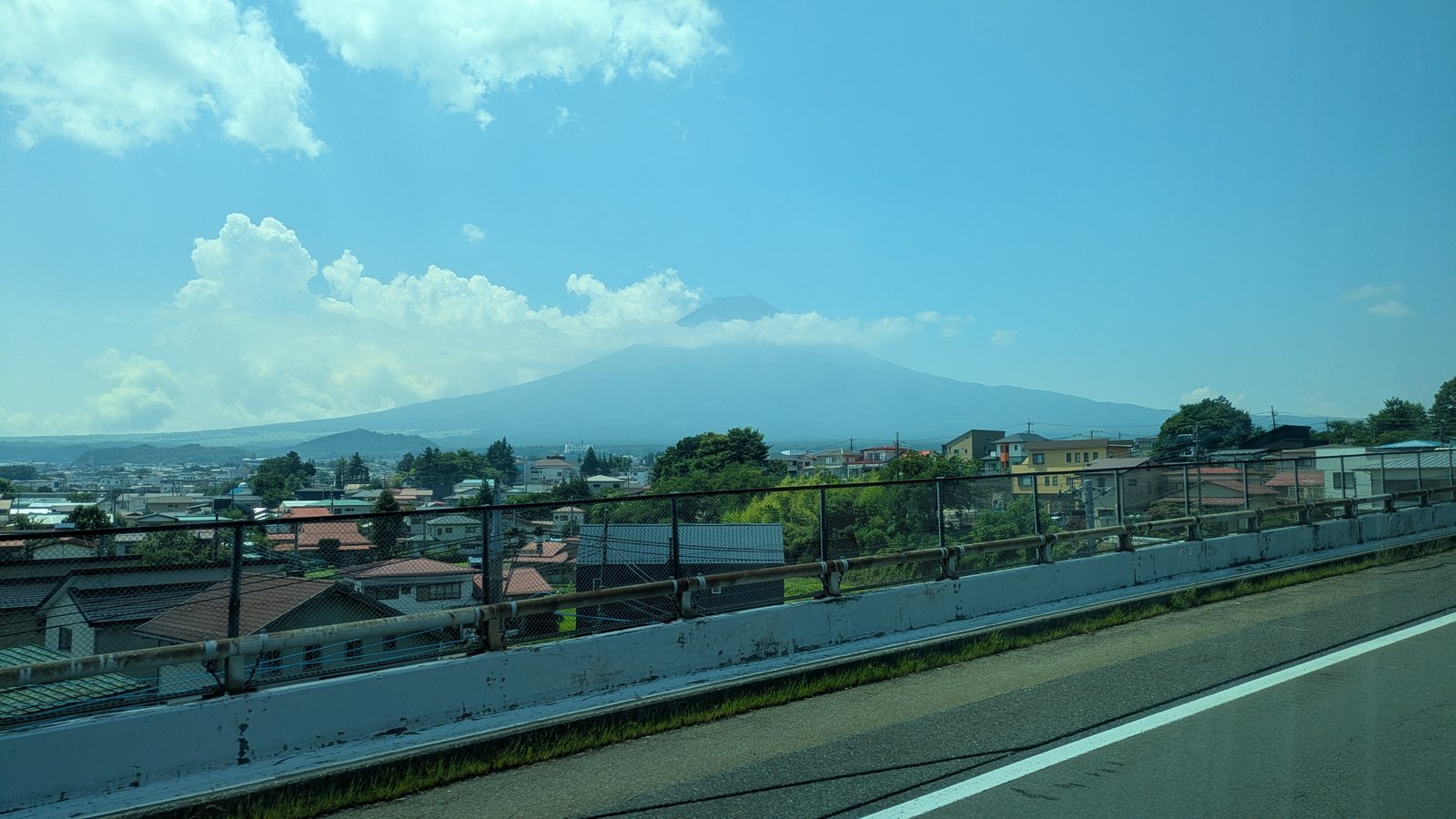
It also means the day starts in a way that has nothing to do with hiking. You watch the mountain through a coach window on a motorway, over the roofs of towns, with a crash barrier in the foreground.
Eighty-six minutes to the seventh station
I was at the fifth station at two minutes past twelve and started walking at twenty six minutes past.
At this height the mountain is still green. There are pines, there is scrub, and there is a wide gravel track with a slow line of people on it. Nothing about the first half hour suggests a mountain that will take twenty hours.
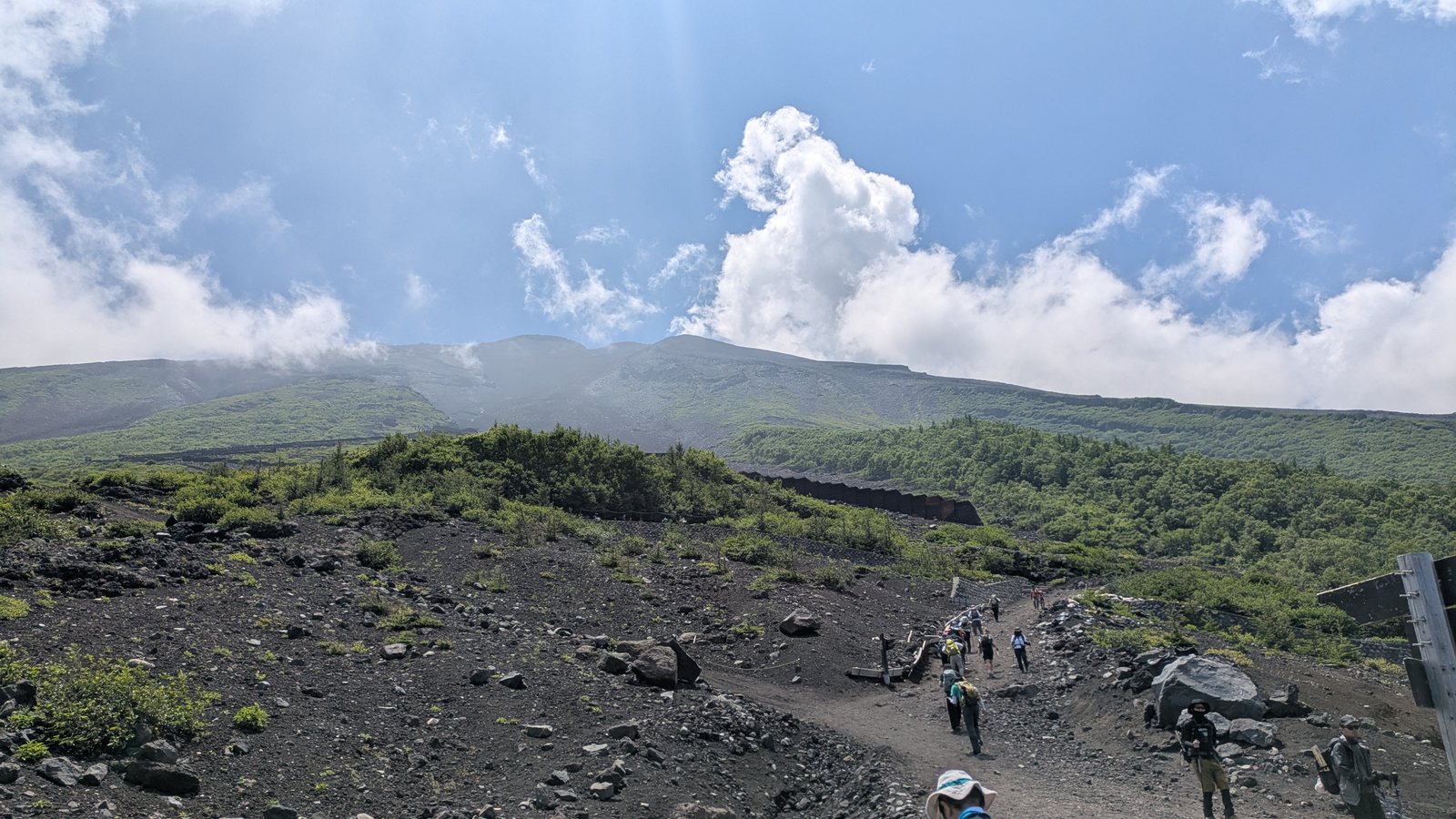
I reached the seventh station at eight minutes to two in the afternoon. Eighty six minutes for about 500 metres (1,640 ft) of climbing, which is brisk rather than fast, and I want to be clear that this was the easy part of the whole trip.
The hut, and the sign that tells you where you are
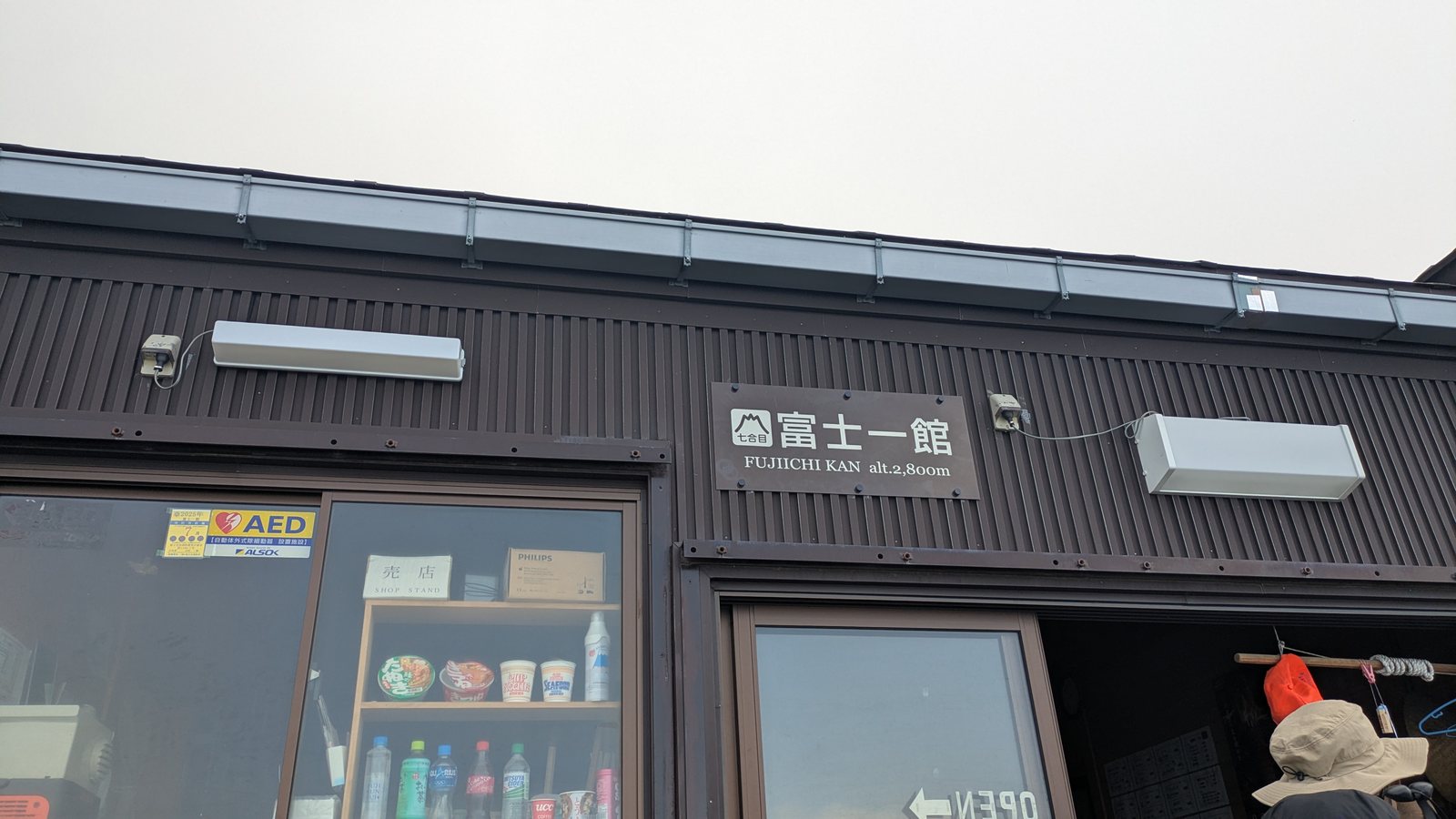
Fuji Ichikan puts its own altitude on the front of the building: 2,800 m. Underneath the sign there is a shop window with instant noodles, bottled drinks, and a defibrillator sticker on the glass.
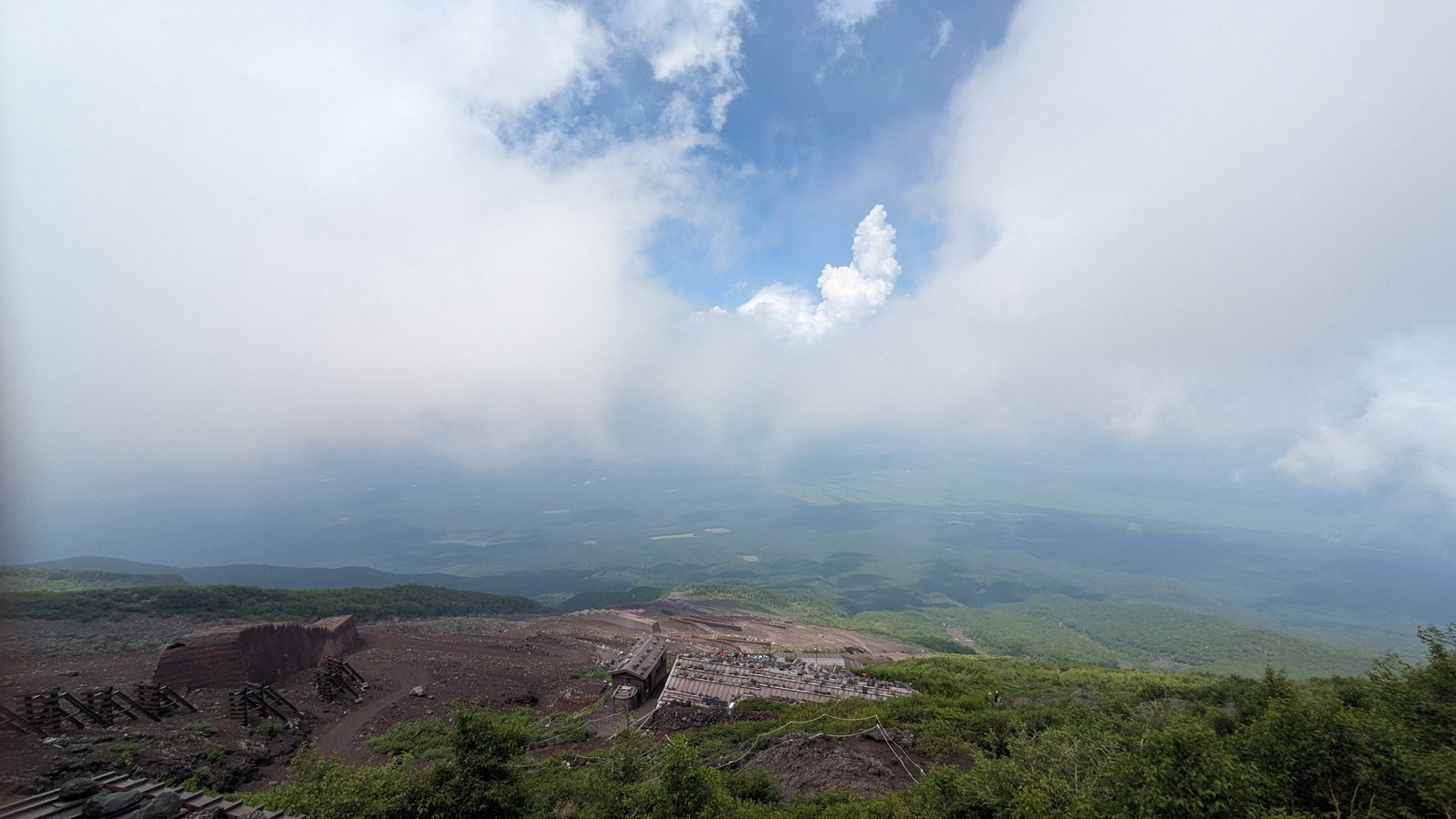
When I arrived, the hut was above the cloud. Twenty minutes later it was inside it, and the view from the deck was a white wall. By five in the afternoon the cloud had dropped again and I could see the fifth station car park far below, along with the whole plain beyond it.
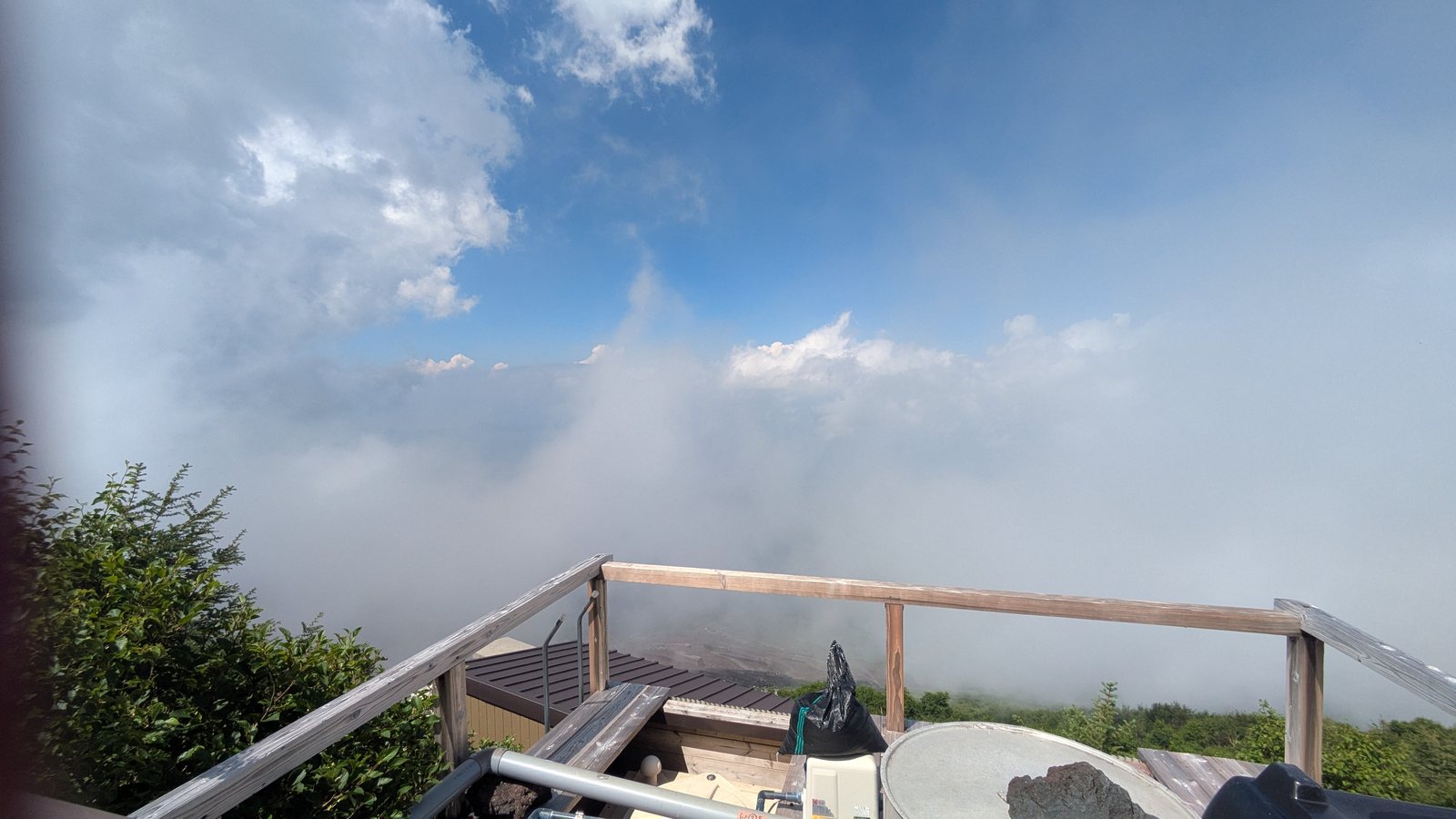
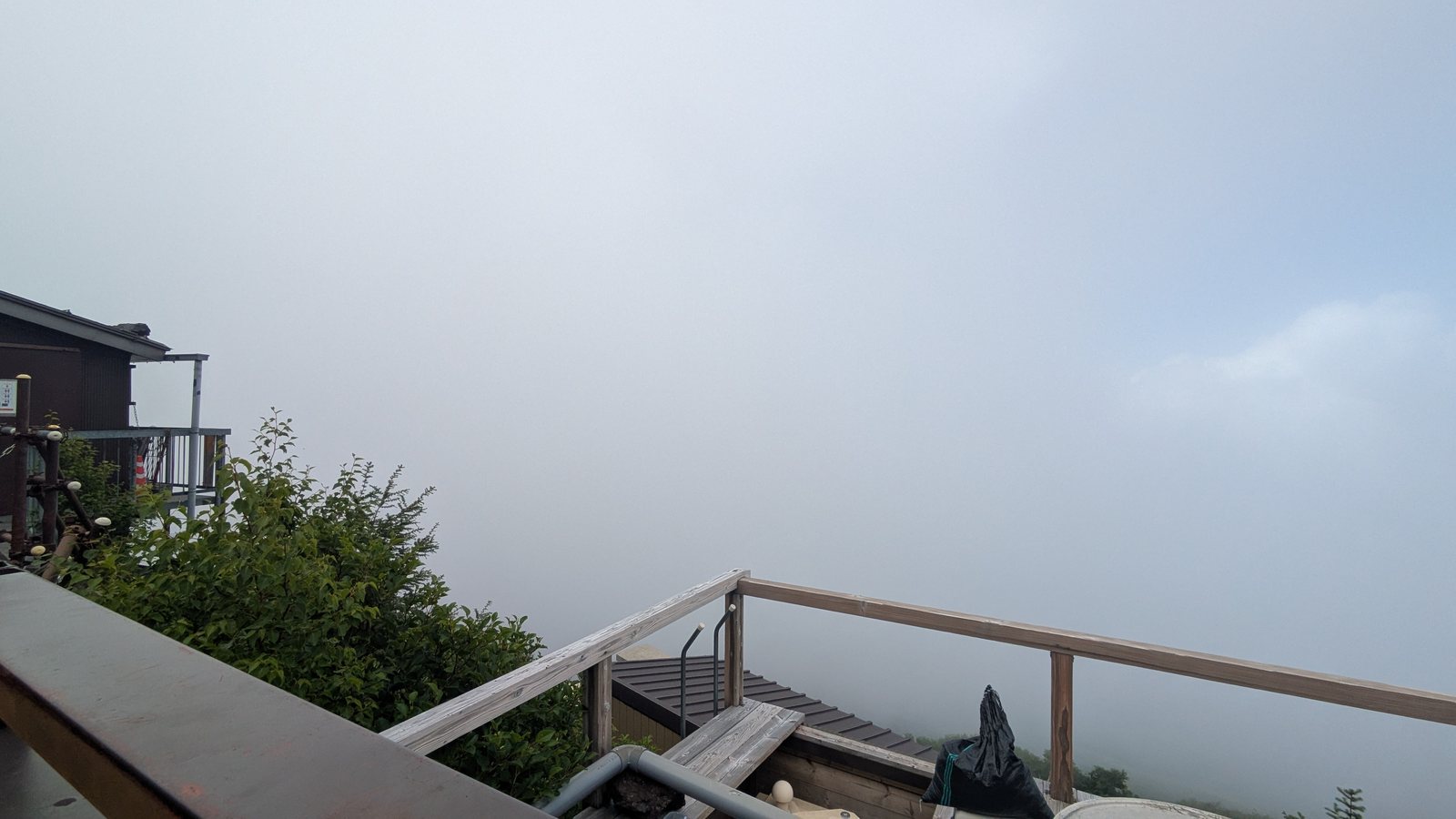
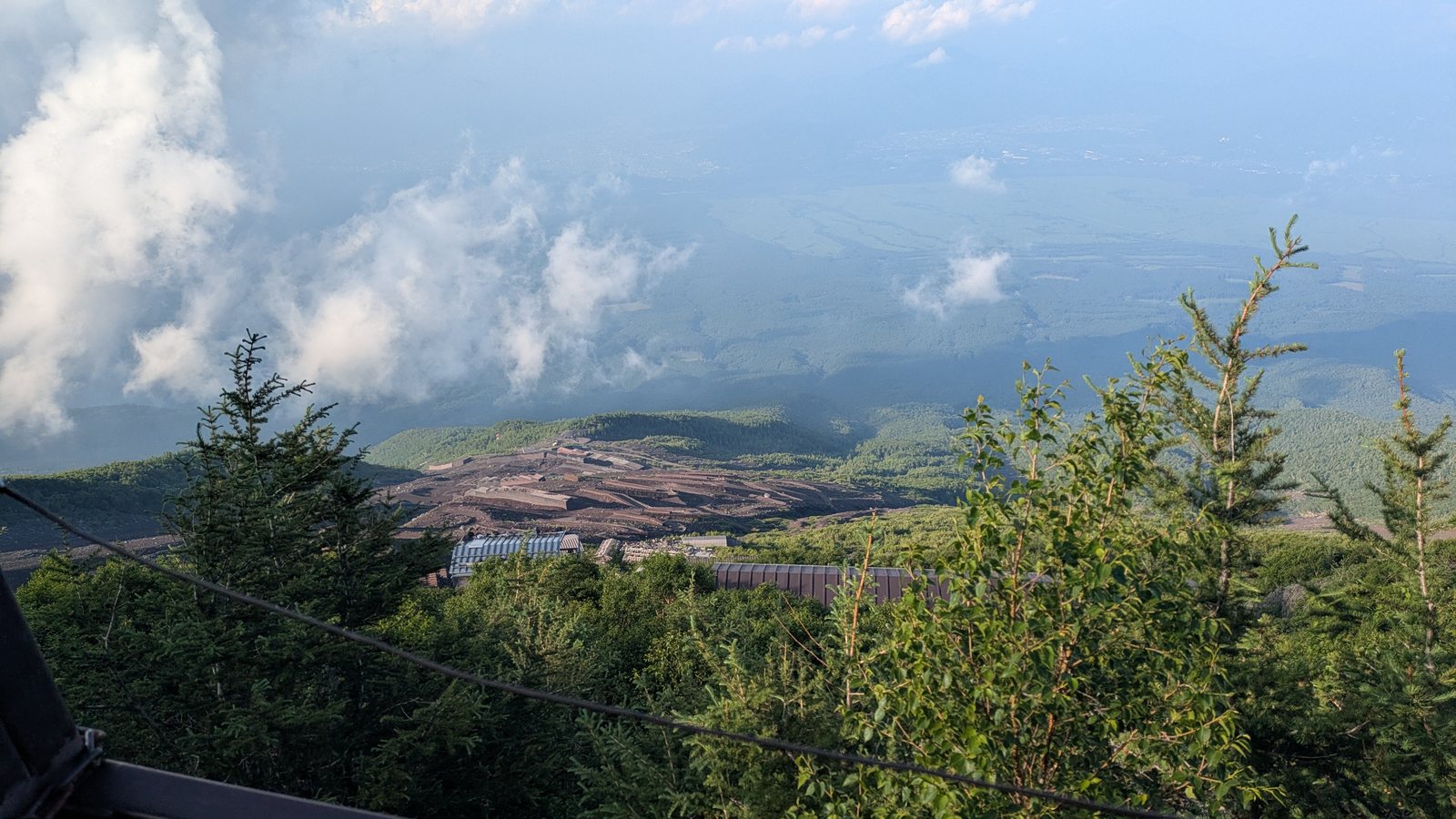
That sequence is worth holding on to, because the afternoon view is the part people plan around and it is the part you have least control over. An afternoon at 2,800 metres is not automatically an afternoon above the clouds. Sometimes you are simply in them.
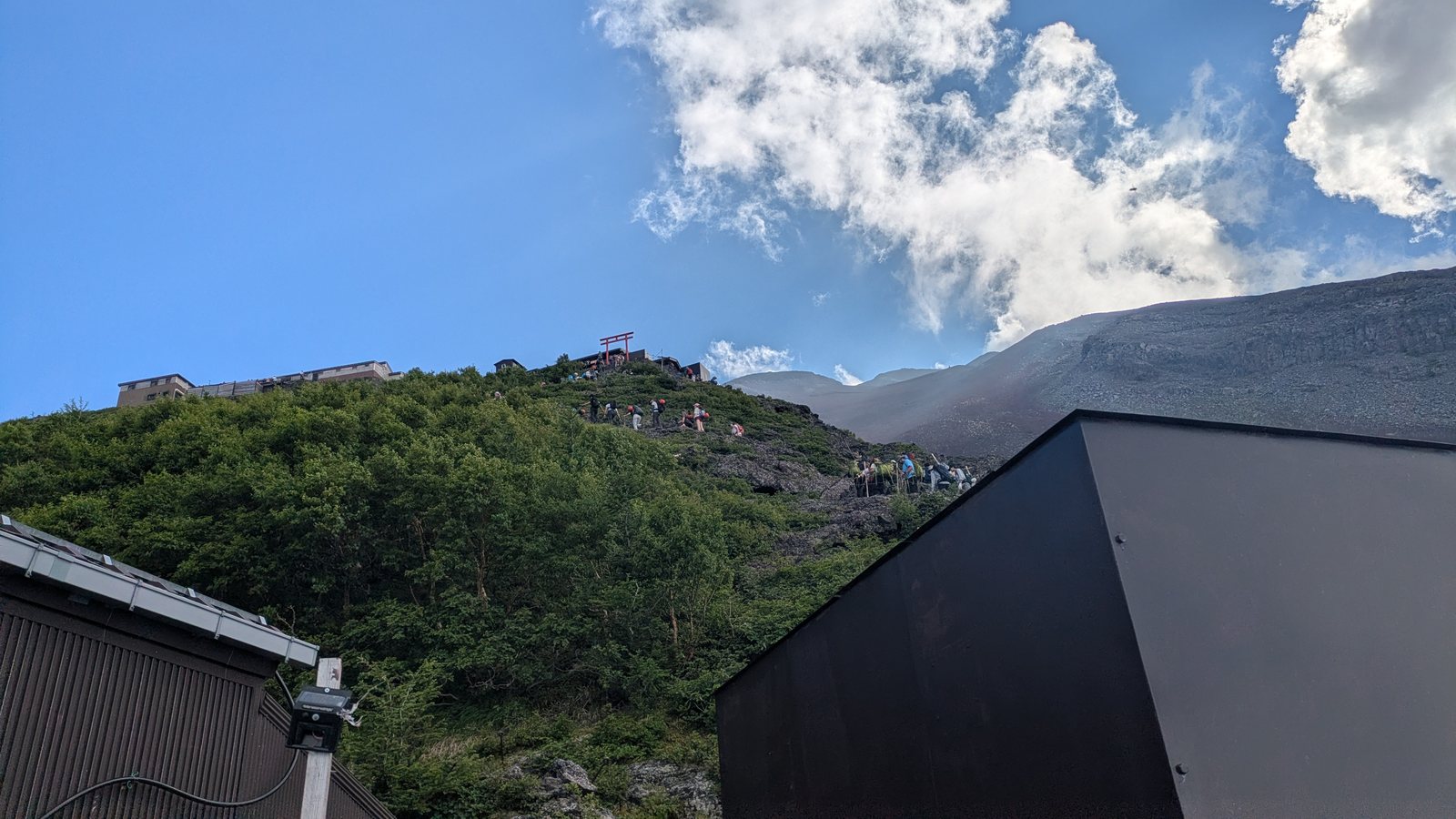
Above the hut, the trail keeps going up in short zigzags with a red torii on the skyline and a steady line of people on it.
Dinner at half past four
Dinner was served at twenty six minutes past four in the afternoon: curry and rice on a foam plate, a piece of fried chicken, a small orange jelly, a bottle of water. It was hot, it was fine, and it took about ten minutes to eat.
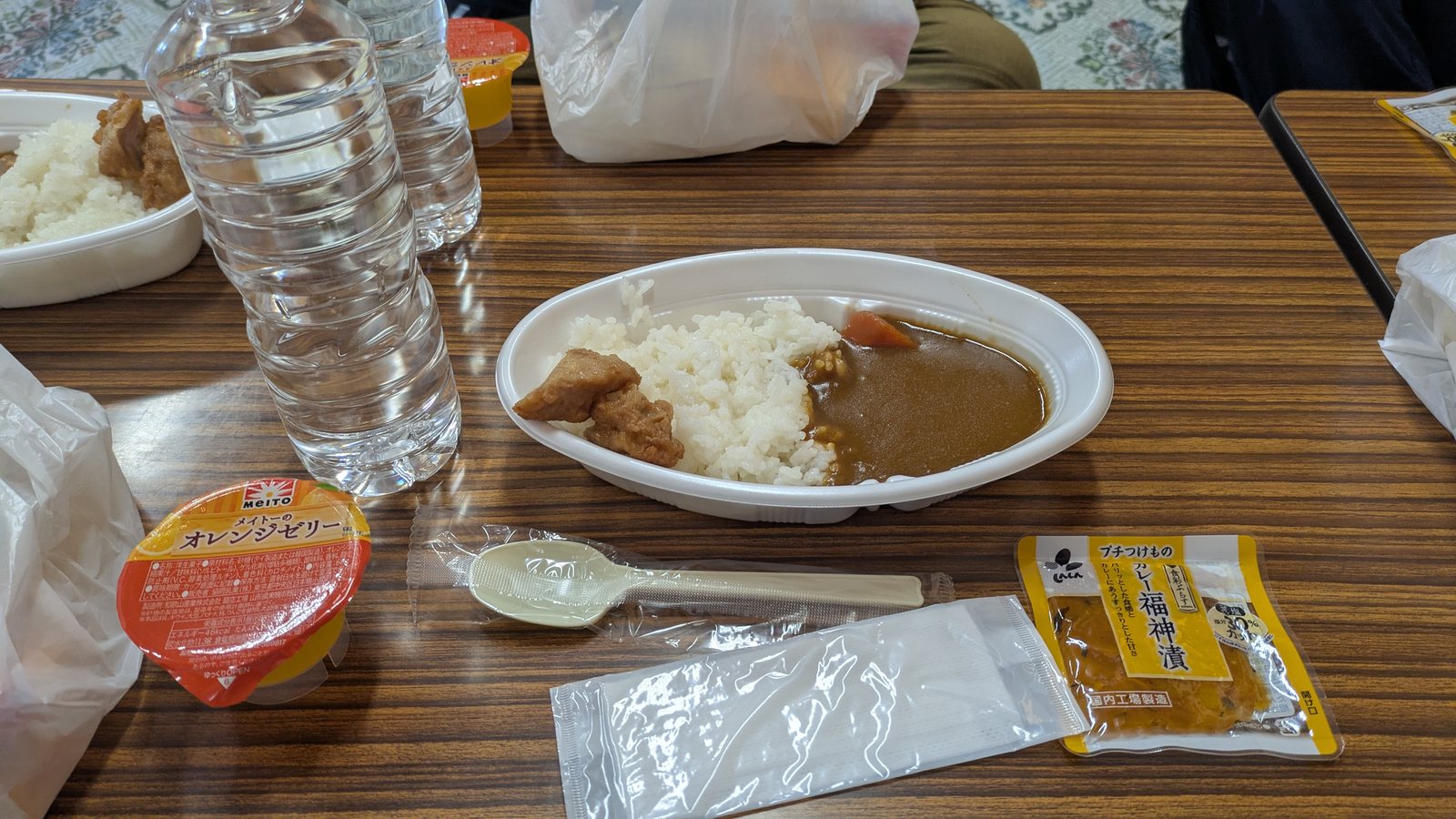
Half past four is the detail to sit with. Not the food.
You lie down at five in the afternoon, and nobody tells you to
By five in the afternoon I was lying down.
I did that because I wanted to be walking again by one in the morning at the latest, and I wanted a margin. Working backwards from that, five in the afternoon is when the night has to start. On an ordinary day I would not be in bed for another five hours.
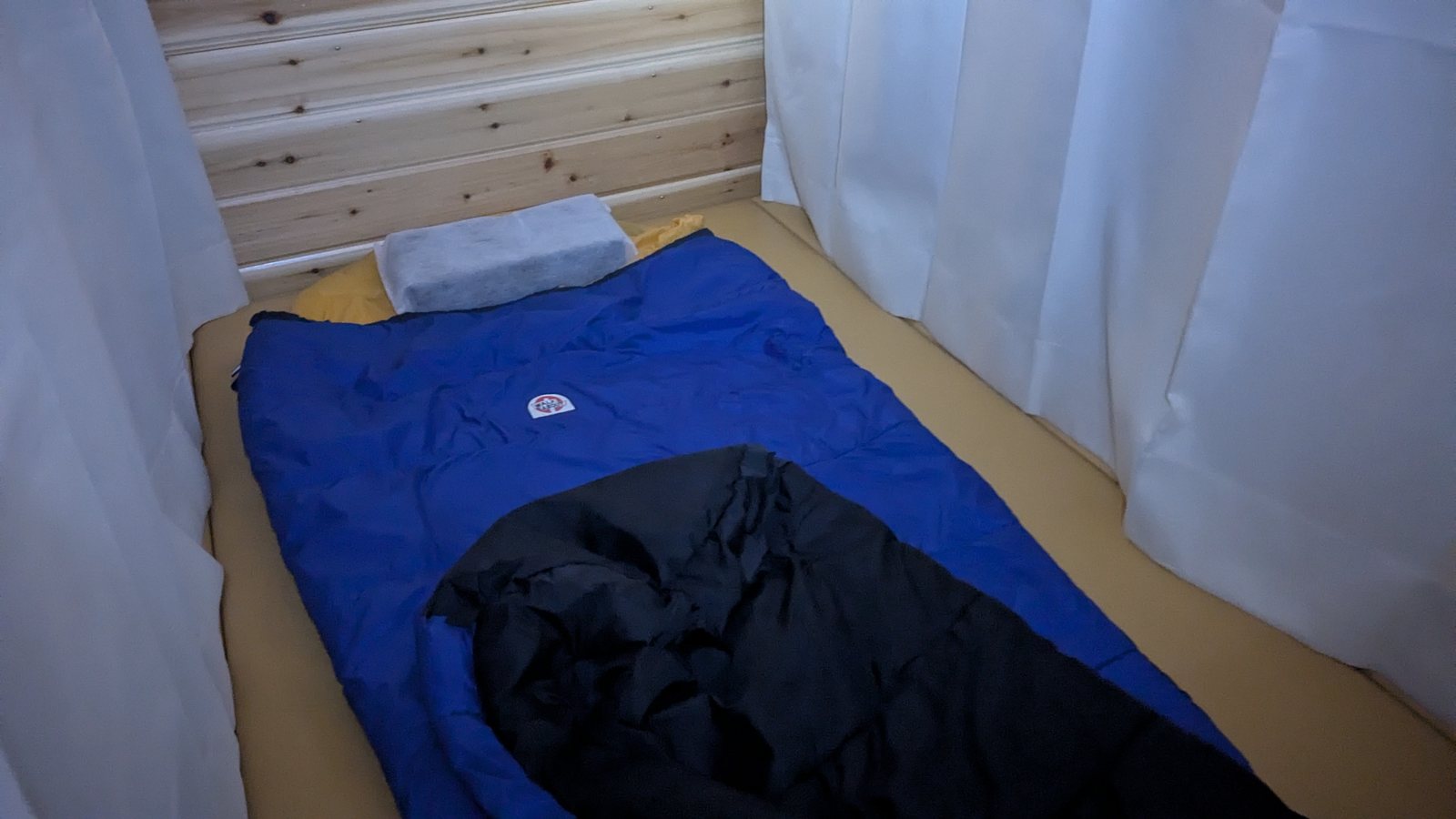
The sleeping space itself was better than the English descriptions had prepared me for. A mat, a sleeping bag, a pillow, and a white curtain on each side. It was clean. It was mine. Nobody was pressed against me.
I mention that because the standard English explanation for why nobody sleeps on Mount Fuji is that the huts are cramped, and you will read the phrase about coffin-sized bunks more than once. That was not my night. My berth was fine and I still did not sleep. If crowding were the whole story, a curtain would have fixed it.
The hut has no lights-out, and check-out is six in the morning
There is no bell. No announcement. No lights-out, and no wake-up call. Check-out runs until six in the morning, which sounds generous until you work out that nobody is there at six.
So the hut is not telling you when to sleep. You are deciding that yourself, on the basis of a sunrise that happens at twenty to five, at a place that is three hours further up.
The clock in the hut stays open until six. The clock on the mountain closes at four forty-one. The second one wins, and it is the reason a room full of adults lies down before the sun has gone.
This is what English guides are describing when they say you can rest at the hut. In practice the hut sells you the right to lie down. Whether anything comes of it is a separate matter.
Three reasons I did not sleep, and crowding is not one of them
Here is what actually kept me awake, in the order they mattered.
The hour. I was horizontal at five in the afternoon, roughly five hours before I would normally sleep, in daylight, after a ten minute dinner. My body had no reason to cooperate.
The noise. Somebody near me snored. People got up, moved around, came back. A wooden hut full of strangers who are all going to leave at different times in the middle of the night is never quiet, and the curtain that gives you privacy does nothing at all for sound.
The mat. The pad under the sleeping bag was firmer than I expected. Not painful, but firm enough that turning over was a decision rather than a reflex.
Of the three, only one has a cheap fix, and it is the single most useful thing in this article: bring earplugs. They weigh nothing. Nobody told me to bring them.
Leaving at six minutes past eleven, two hours earlier than planned
I gave up at six minutes past eleven and went outside.
That was almost two hours earlier than the one in the morning I had planned around. It was not discipline. It was the straightforward logic of lying awake in the dark with a long night ahead: if you are not going to sleep, you may as well be walking.
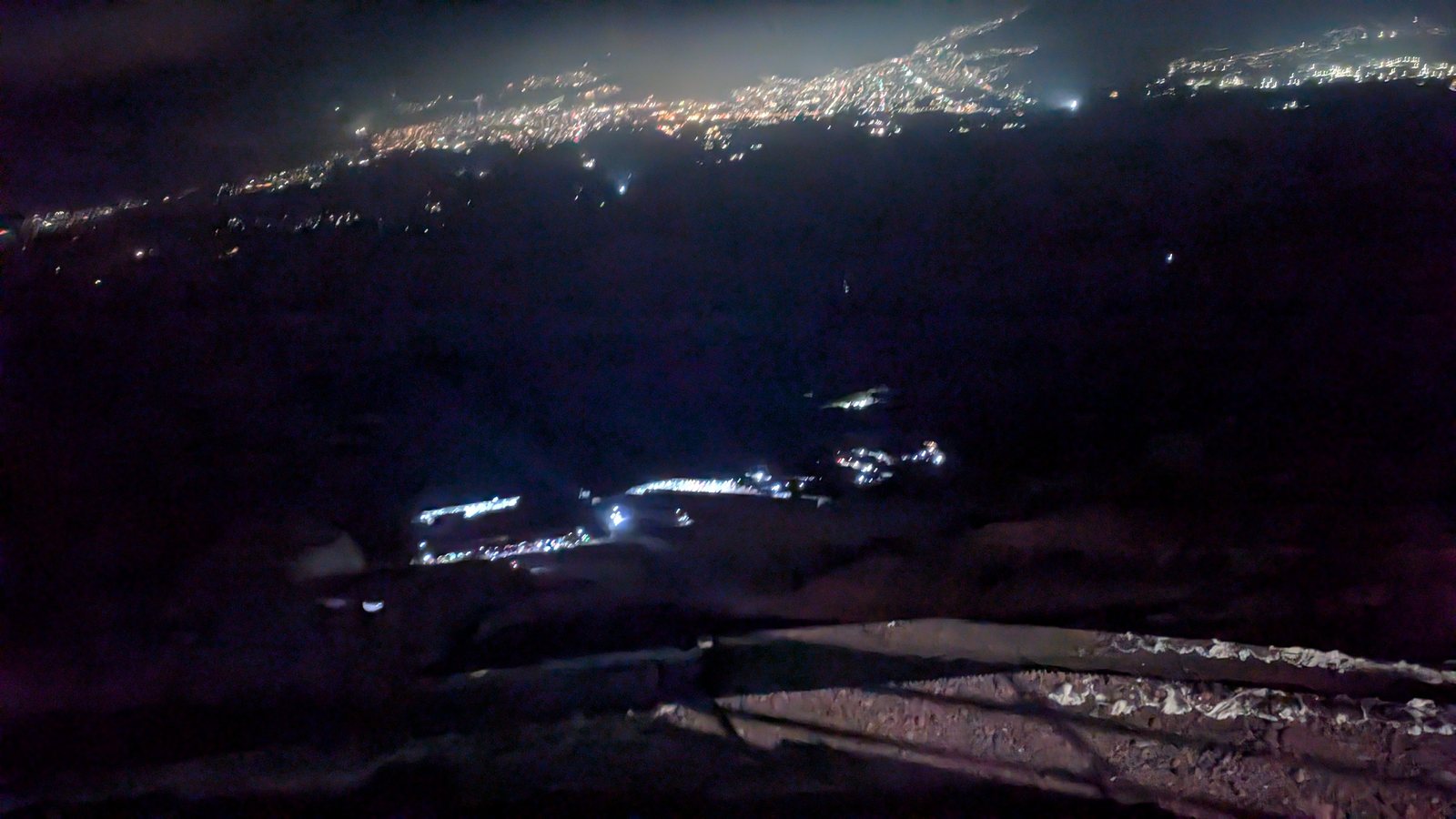
Outside there was no wind to speak of, the sky was clear, and the towns on the plain were a long orange smear far below.
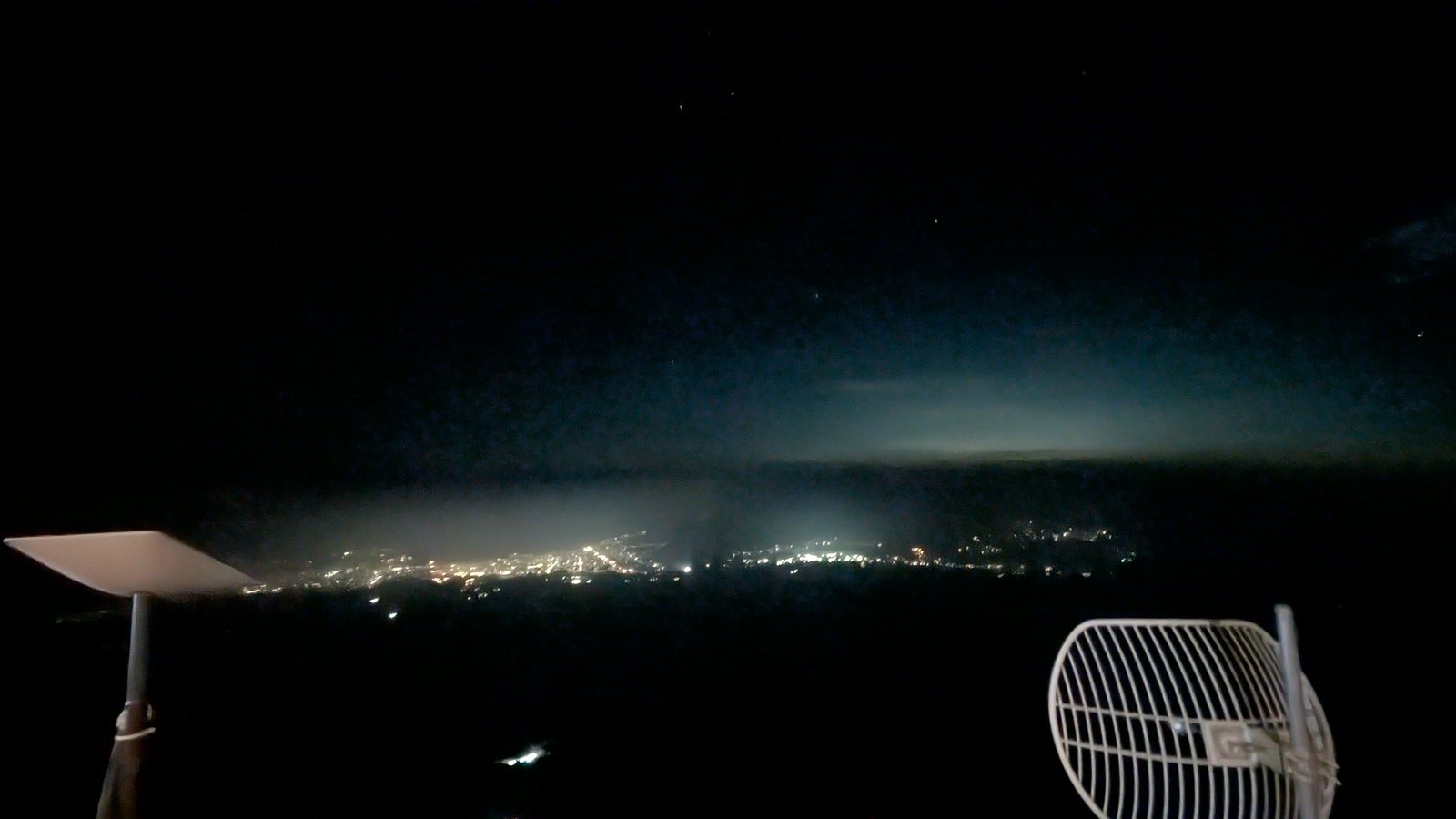
I want to name what just happened, because it is the mechanism that shapes the whole second half of this trip. The failure to sleep did not simply make me tired. It moved my departure, which moved my arrival, which changed what I did at the top. Everything after this point is downstream of a bad night.
Three hours and nineteen minutes in the dark
From the hut to the Yoshida summit took three hours and nineteen minutes. The eighth station at thirteen minutes past midnight. The main eighth station at forty nine minutes past, at 3,400 m (11,155 ft).
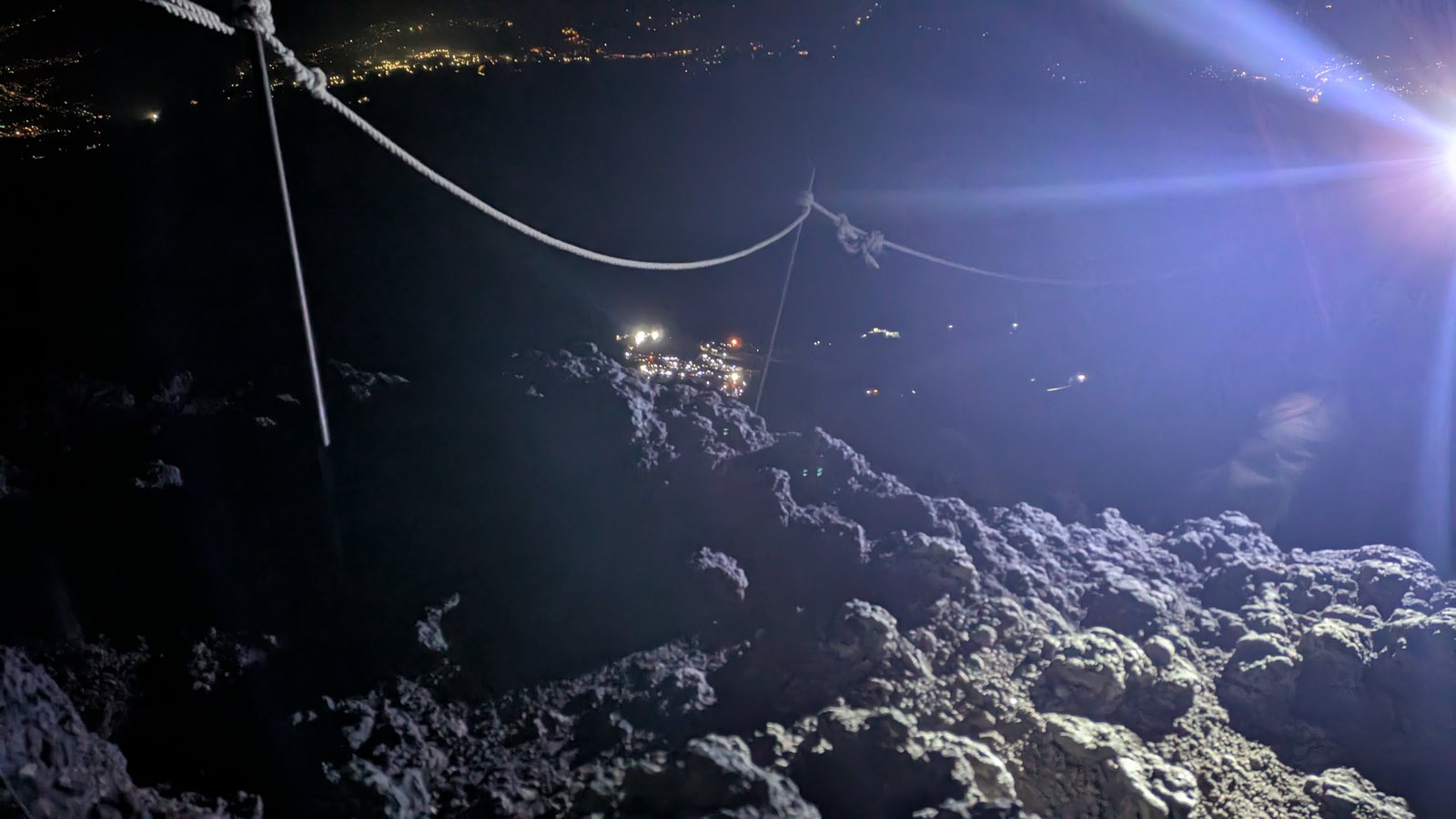
The photograph I keep coming back to from that stretch is not of the trail. It is the view down it.
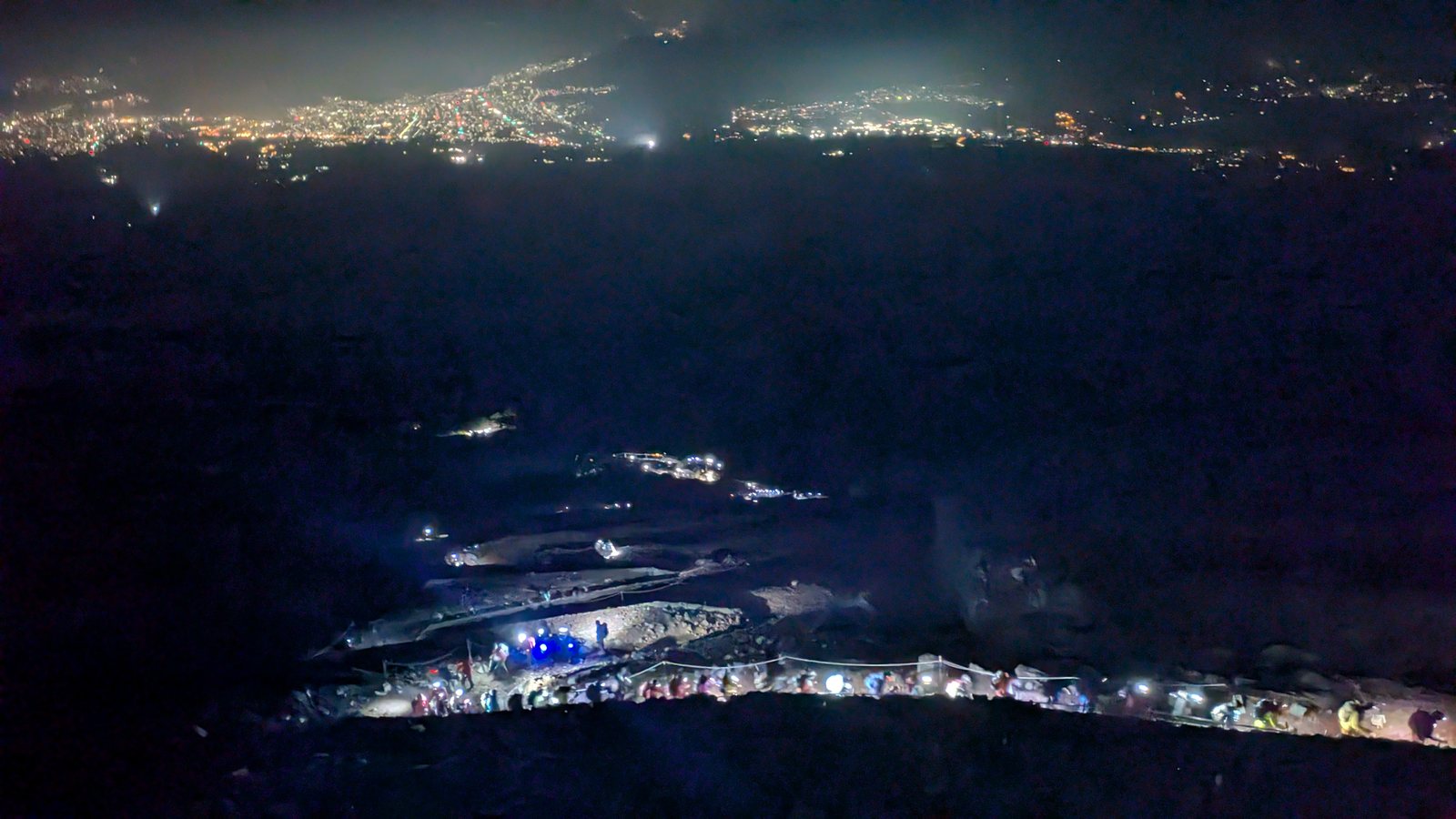
There are the town lights on the plain, there are the lit windows of the huts below, and there is a line of headlamps threading up the dark ground in the middle. You cannot count the people, and I am not going to pretend I could, but you can see the shape of the thing. Everybody is doing this at the same time, in the same direction, because the sun comes up at one specific minute for all of us.
Higher up, it thins out and gets colder and the lights below get further away.
The summit at twenty-five past two. The sun at twenty to five.
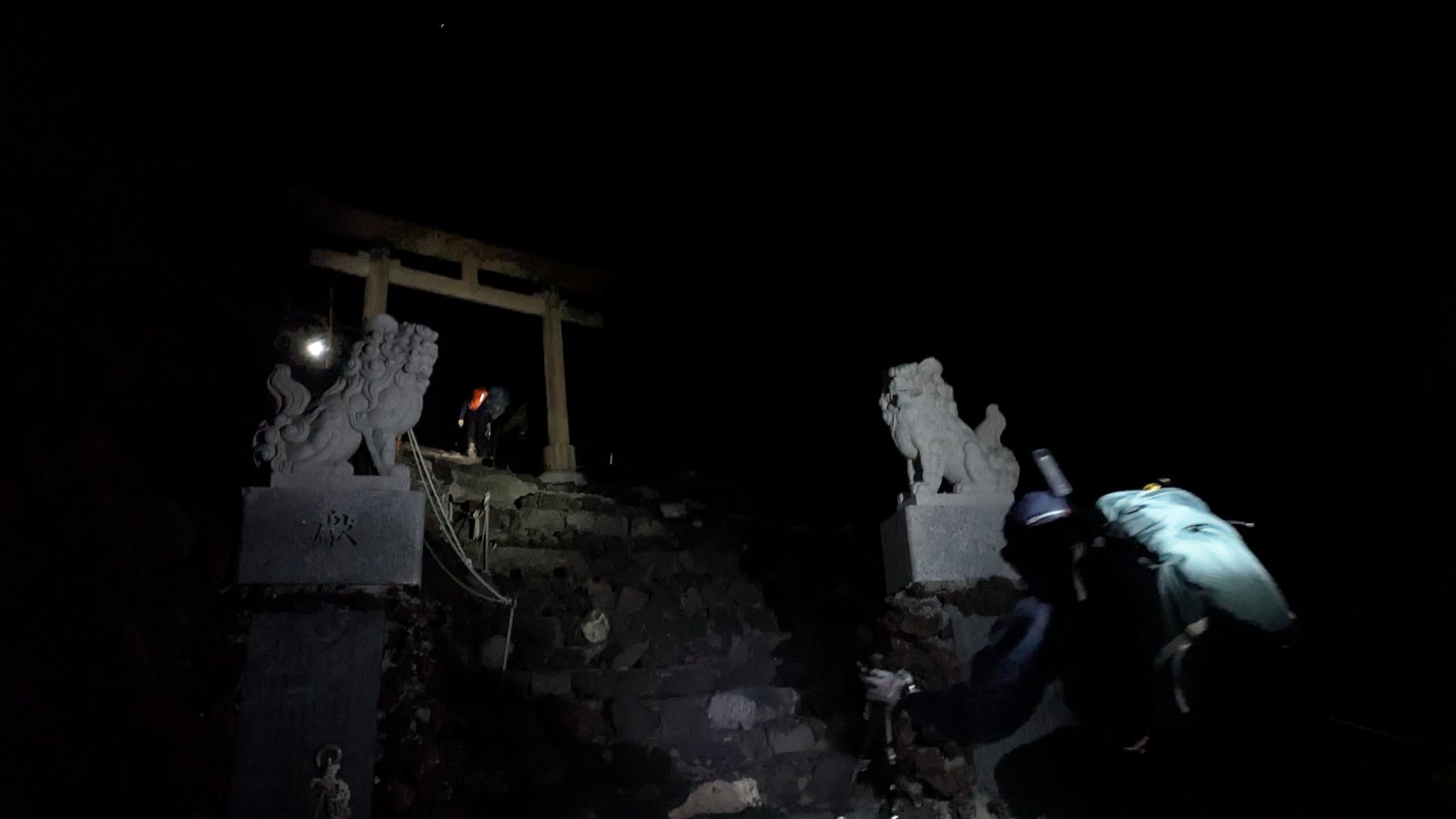
I reached the Yoshida summit at twenty five past two in the morning. There is a stone torii up there with a pair of guardian lions beside it, and at that hour it is lit by whatever headlamp happens to be pointing at it.
Sunrise was at four forty-one.
That is two hours and sixteen minutes of standing on the highest ground in Japan in the dark, at a little under 3,700 metres, in the cold, waiting for something to happen.
Most people would call that a mistake, and on paper it is. I got there far too early because I had left the hut far too early because I could not sleep. But it was also the only reason the rest of the morning worked, and here is why.
I had decided before the trip that I wanted to see the sunrise from Kengamine, the true summit, the highest point in Japan at 3,776 m (12,388 ft). Kengamine is not where the Yoshida trail arrives. It is on the far side of the crater.
An hour and sixteen minutes around the rim
The thing that does not come across in photographs is how big the hole in the top of this mountain is. The crater is a few hundred metres deep and roughly eight hundred across, and the path runs around the outside of it. Walking half of that rim is not a detour of a few minutes. It took me an hour and sixteen minutes, from twenty five past two until forty one minutes past three, and it climbs as it goes.
In the dark it is a strange piece of walking. On one side the ground drops away into the crater and you cannot see the bottom of it. On the other side it drops away down the outside of the mountain, and you cannot see that either. What you can see is the horizon starting to separate itself from the sky, a flat orange band appearing under the stars, and here and there a light on the rim ahead of you where somebody else has had the same idea.
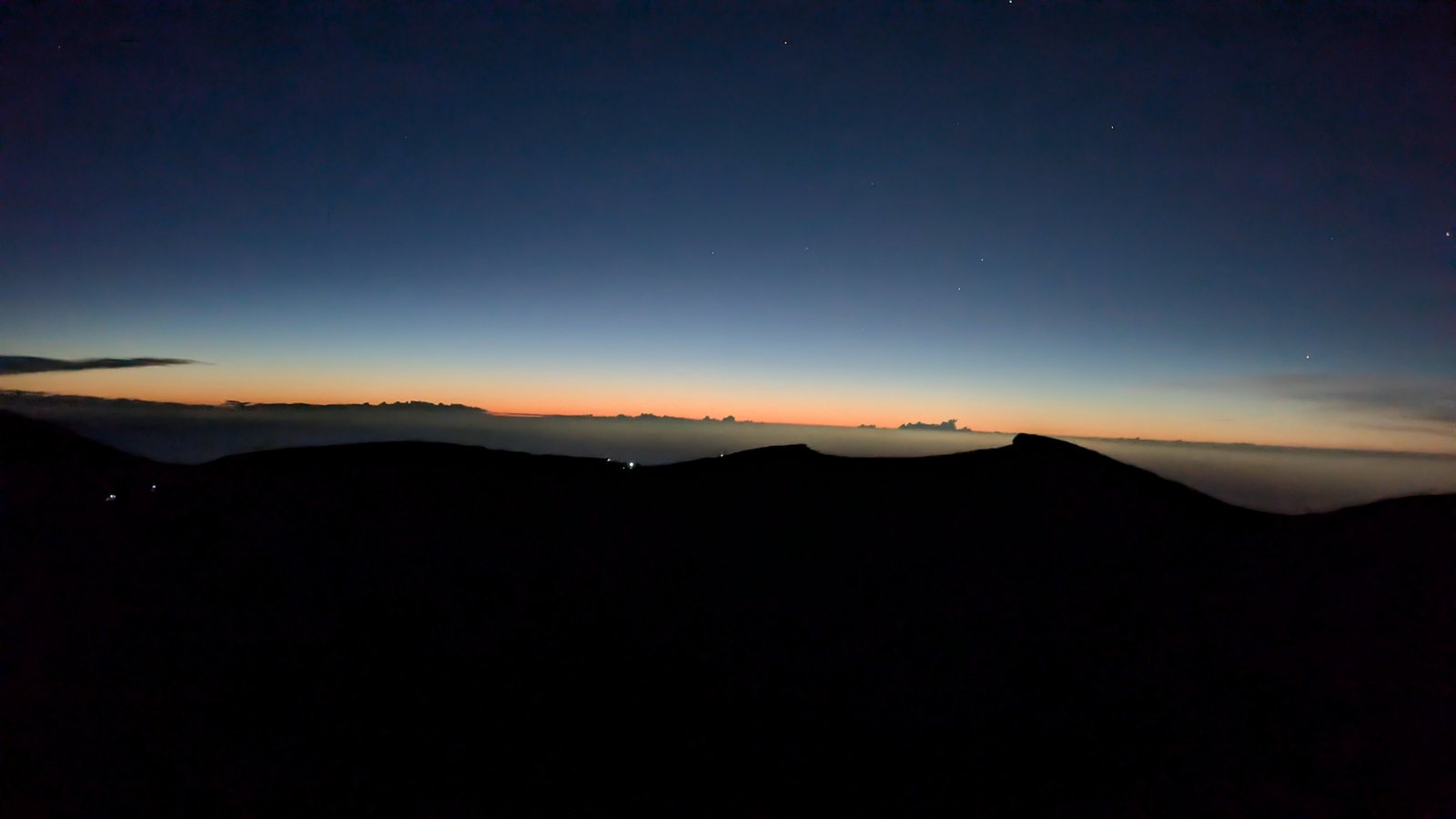
I got to Kengamine at forty one minutes past three, and then I stood there for another hour and thirteen minutes.
There is no way to make that hour sound pleasant. It was cold, it was dark, there was nothing to do, and the sensible part of my brain kept pointing out that a warm hut existed three hours below. But this is the shape of the thing, and it is worth saying clearly to anyone planning it: the summit of Mount Fuji at four in the morning is a place where you stand still and wait.
You do not have to be on the summit for the sunrise
Before I left Tokyo I had already decided that if I fell behind, I would watch the sunrise from wherever I had got to. The ninth station would have been fine.
That sounds trivial. It is not.
Every English account I have read builds the night around reaching the summit before the sun, which quietly turns the whole climb into a pass or fail. Miss it and you have failed. Once you believe that, you leave the hut earlier, you push harder in the dark, and you spend the night watching the clock instead of sleeping.
The mountain does not work that way. The sun comes up over the same horizon whether you are at the top or an hour below it. The light is the same light. Deciding that in advance takes the deadline out of the night, and taking the deadline out of the night is the only thing that gives you any chance of sleeping in the hut.
If I could change one thing about how I planned this, it would not be the gear. It would be to hold that thought more firmly, and go to bed later.
What the sunrise was actually worth
It was very good, and I am not going to undersell it.
The cloud sea went out flat to the horizon and the sun came up through a bank of cloud as a hard orange point. It got warm on my face almost immediately, which at that temperature is a physical relief rather than a poetic one.
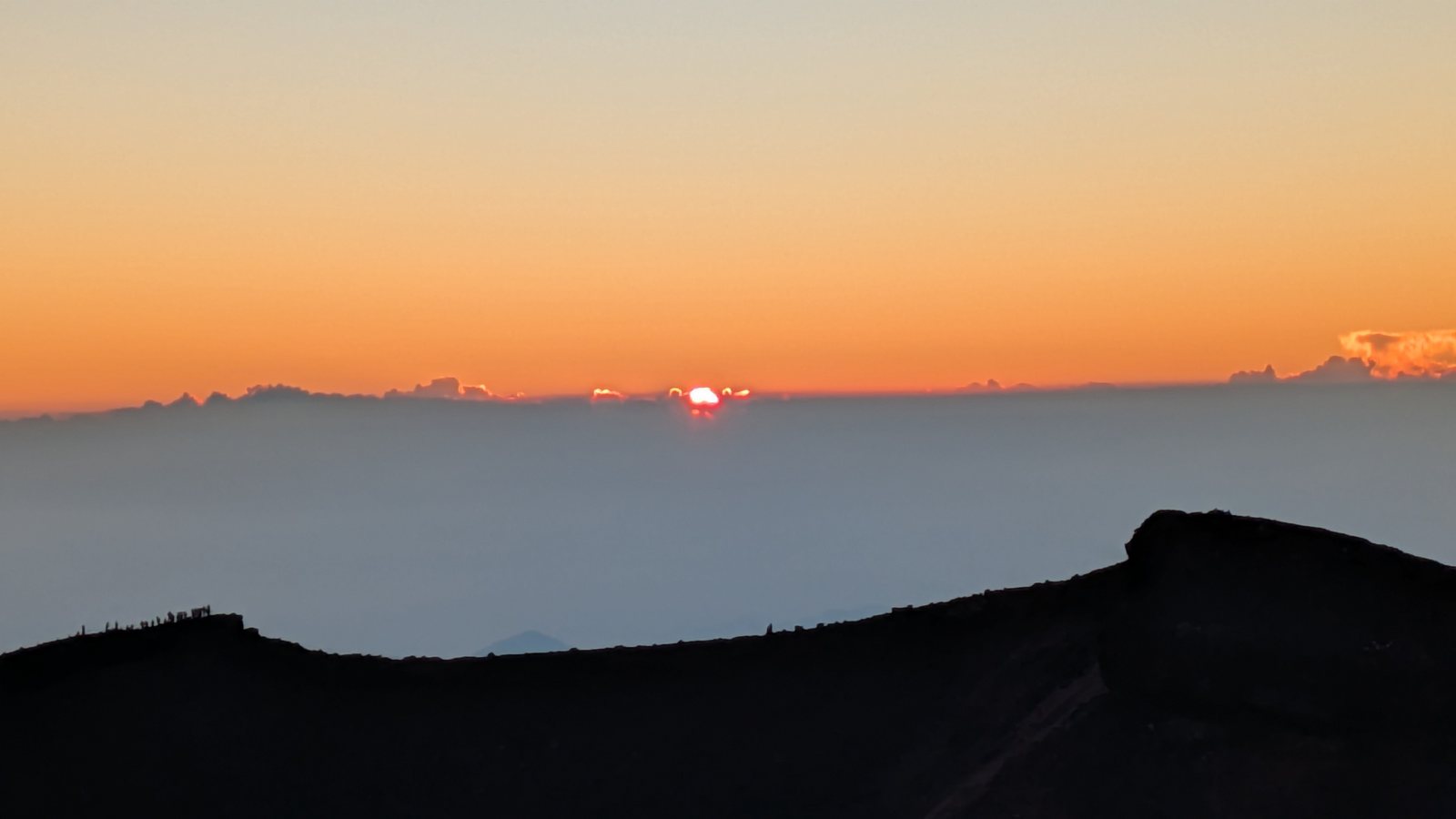
But look at the left of that photograph, along the crater rim.
That dark line with the texture in it is people. That is the Yoshida summit, where the trail arrives, and that is where most of the mountain watches the sun come up.
Kengamine was not empty, and I do not want to give the impression that it was. There were about thirty of us standing on the true summit. Every one of them had made the same calculation I had: if you are going to be awake on this mountain at four in the morning anyway, you may as well be on the highest ground in the country when the light arrives.
Thirty people is not solitude. It is, however, a completely different thing from the line on the far rim, and it is a self-selected group. Nobody arrives at Kengamine by accident. Everybody there has walked an extra hour in the dark for the same reason, which gives the place a particular quiet that has nothing to do with how many people are in it.
That is what two hours of walking round the crater in the dark actually buys. Not an empty summit. A smaller one, where everybody is there on purpose.
Coming down on twenty hours awake
I started down at six minutes to five, passed the top of the Gotemba trail at eight minutes to six, and came off the mountain at the Fujinomiya fifth station at nine minutes to nine. Three hours and fifty seven minutes.
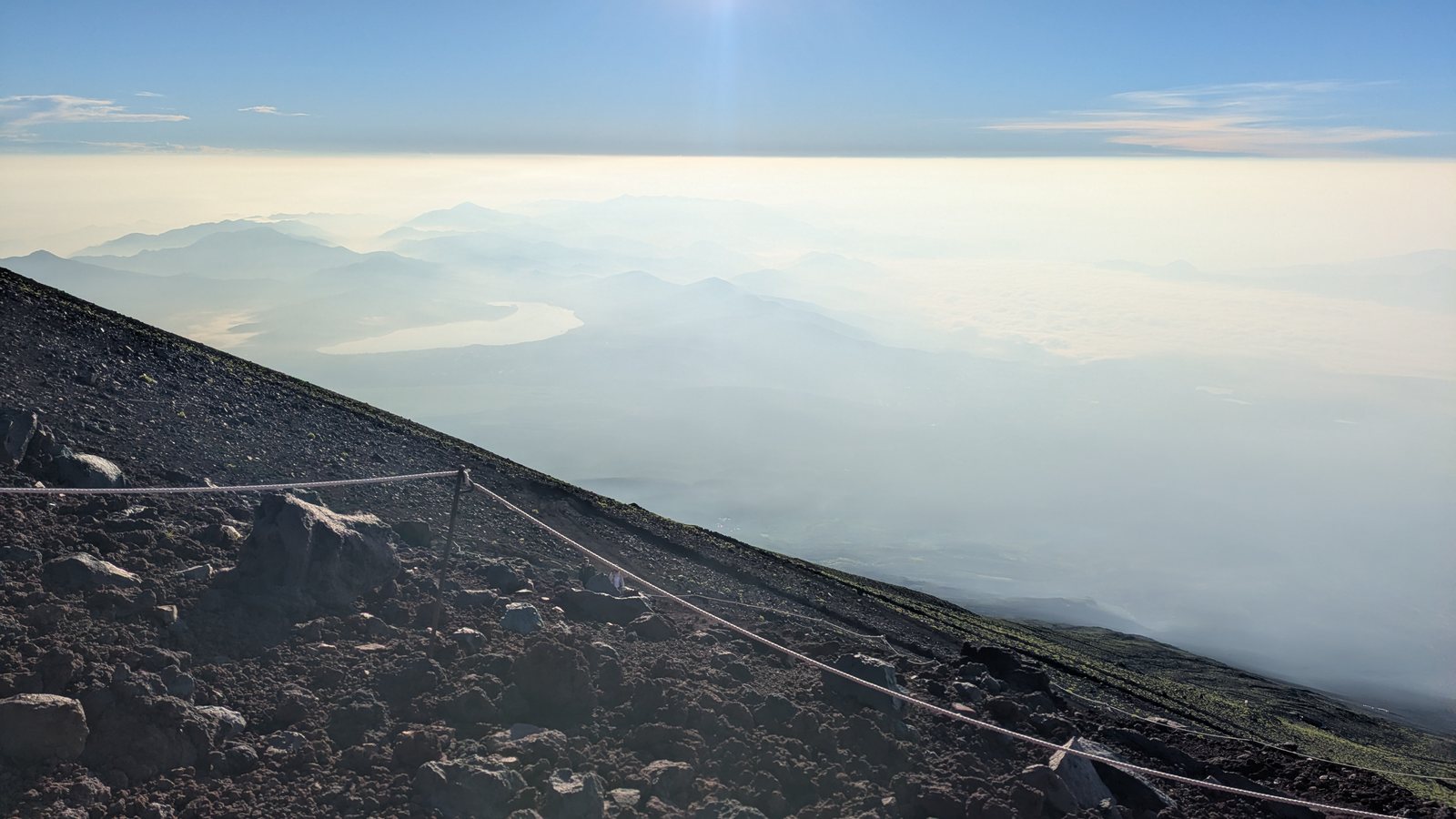
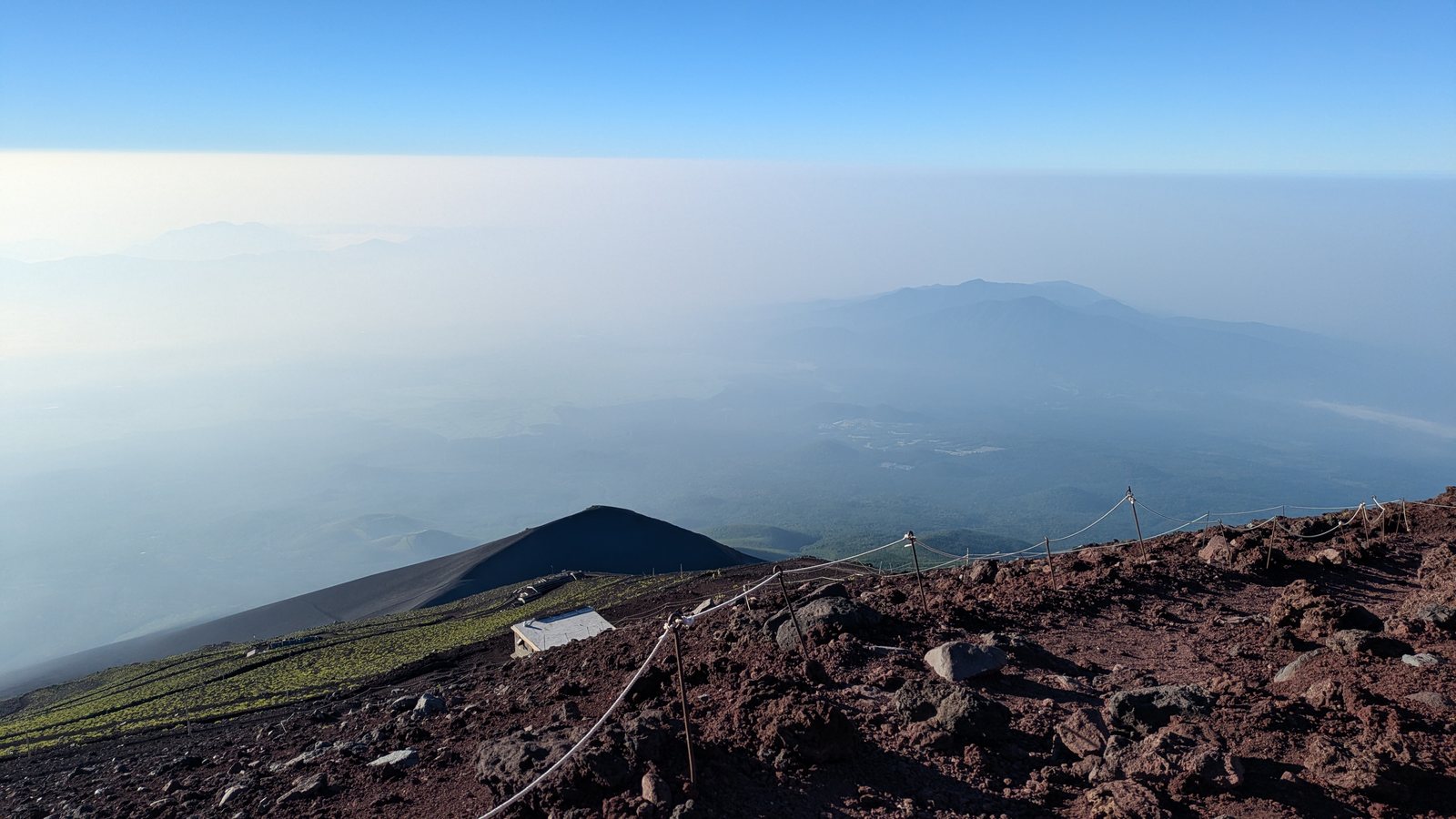
The published time for the Yoshida descent is about three hours thirty five minutes. Mine is not directly comparable, because I started from further round the rim and came down a route that is not one of the four official trails, so no standard time exists for it. But I was slower than the numbers suggest, and I know exactly why.
Published walking times assume a rested body.
That assumption is fine on an ordinary mountain, where you set out in the morning after a night at home. On Mount Fuji the descent starts after a night that was not a night. By the time I was going downhill I had been awake for twenty hours, and the thing that decided my pace was not the gradient or the surface. It was that.
Nobody writes the descent that way. It gets a line in the table, next to a number, as though it were the easy half.
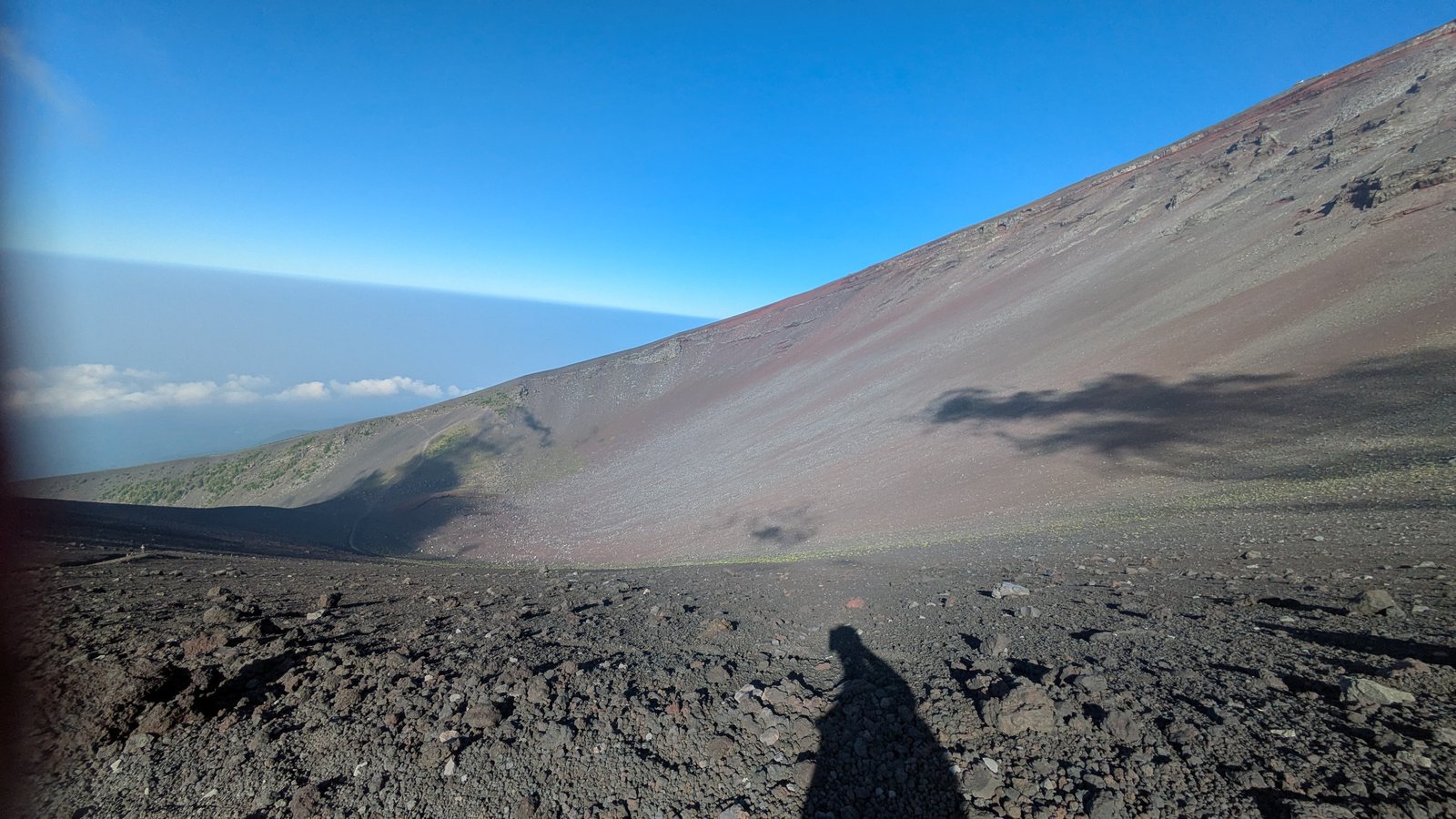
Lower down, the route crosses the Hoei crater, which is a separate hole in the flank of the mountain from the one at the summit, and it is the single most impressive piece of ground on the whole trip. It is a vast open bowl of red and grey and black, big enough that the people on the far side of it are specks, and at eight in the morning the light comes in sideways and throws the whole rim into relief.
It is also, in a way that took me by surprise, where the mountain starts being alive again. Green appears in the gravel at around 2,500 metres. There had been none of it since the afternoon before.
You walk up out of the living part of the mountain in the afternoon and back down into it the next morning, and the second one feels much better than the first. Whatever else the descent is, it is warm, it is getting lighter, and every step gives you back a little air.
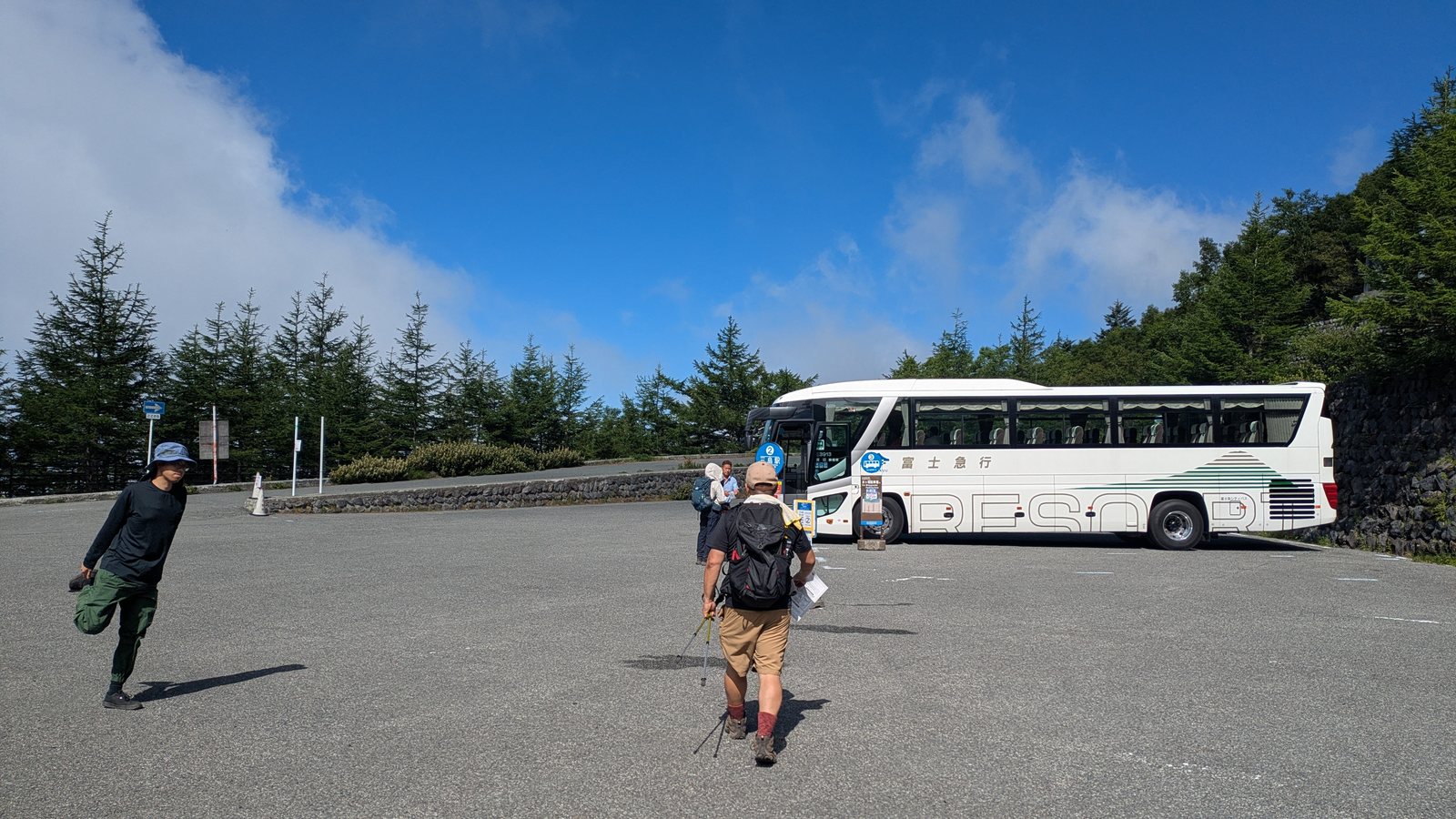
The day ended in a car park on the wrong side of the mountain, waiting for a bus that goes to a different city from the one I had left.
What this mountain does not give you
Three things, stated plainly, because the tour photographs will not tell you.
It does not give you a view all day. The afternoon at the hut can be a white wall. Mine was, for a while.
There is also a plainer problem, and nobody says it out loud. The one view you cannot get on Mount Fuji is Mount Fuji. You are standing on it. What is on offer instead is cloud, the plain below, and whatever other ranges happen to be clear that morning, and some of the time you are walking inside the cloud rather than above it. If the view is the reason you are going, you are gambling, and you are gambling for the wrong prize.
It does not give you rest. Nine hours in a hut is not nine hours of sleep, and possibly not any. Plan the following day accordingly, and do not schedule anything you would be sad to do badly.
It does not give you the option to change your mind. Once you are above the hut in the dark, there is no cable car, no shortcut, and no easy way back. On the mountains this site usually writes about you can turn round at any point. Here you cannot.
So, is it worth it?
It depends on one thing, and it is not your fitness.
| You | The answer |
|---|---|
| Can lose a night of sleep, then function the next day | Yes. This is the whole test |
| Want the sunrise above a cloud sea | Yes, though you do not have to be on the summit for it |
| Fall apart without sleep | No. This mountain takes the sleep first |
| Are mainly here for the view | No. The view is not guaranteed. The best views of Mount Fuji are of it, from a train |
| Have not booked anything yet | See Mount Takao or Mount Fuji first |
The people who come back saying it was miserable are usually people who paid for a night of sleep without knowing that was the price. The people who come back happy tend to be the ones who worked that out in advance and shrugged.
I would do it again. I would not do it the week before something important.
If you go
Four things, in the order they will matter.
Book in May. The entry registration and the hut are different systems with different opening dates. If you book in July you are not picking a date, you are taking what is left, and everything downstream of that changes.
Take the highest hut you can get. I slept at the seventh station, which the hut itself puts at four to five hours below the summit. The hut closest to the summit on the Yoshida trail sits at the eight and a half station and gives its own figure as about ninety minutes. That difference of three hours or more lands entirely on your second day, in the dark, when you are already tired.
Bring earplugs. Cheap, weightless, and the only one of my three sleepless reasons that has a fix.
Decide now that you do not need the summit for sunrise. It removes the deadline from the night. It is the closest thing there is to a way of actually sleeping up there.
Questions people actually ask
Is climbing Mount Fuji hard? The walking is moderate and long rather than technical. There is no scrambling on the Yoshida trail, no exposure, and no need for anything beyond ordinary hiking gear. What makes it hard is the schedule: altitude, cold, darkness, and no sleep, in that combination.
Is it dangerous? The trail itself is not. The two things that turn it dangerous are altitude and going up overnight without a hut. For the 2026 season the rules are built around exactly that: on the Yoshida trail the gate closes from two in the afternoon until three in the morning to anyone without a hut booking.
Why do some people say you should never climb it? Because they went in a peak week, queued, did not sleep, and got cloud instead of a view. Every one of those is a scheduling problem rather than a mountain problem, which is the argument this whole article is making.
Can you do it in one day? Physically some people do. The 2026 rules make it awkward on purpose, and the gate hours above are the reason. This account is of a two day climb with a hut, which is what the rules are designed to push you towards.
Do you need a guide? Not for route finding. The trail is wide, it is marked, and at night you are following a line of headlamps.
What a guide removes is the admin. Doing this independently means handling all of the following yourself: the entry registration when it opens in May, the hut booking in a separate system on a different date, the coach seat, the decision about which station to sleep at, and enough reading beforehand to know what the night is going to do to you. None of it is hard. All of it is fiddly, a fair amount of it is in Japanese, and the deadlines fall months before you travel.
A guided package hands that entire list to somebody else. If you are short of time, or you are arriving without a plan already made, that is the thing you are paying for. You are not paying for navigation.
If you want to see what one of those packages actually contains, the two day climbs with a hut booking are listed here: guided Mount Fuji climbs on GetYourGuide. That is an affiliate link, so this site earns a commission if you book through it, at no extra cost to you. I climbed independently. I have not taken one of these tours.
Affiliate link. This site earns a commission if you book through it, at no extra cost to you. Photo from our own climb.
What is the entry fee? For the 2026 season it is ¥4,000 per person per climb, on all four trails, paid with the advance registration. I paid mine online by card rather than in cash on the day.
Where to next
If you are still deciding whether Mount Fuji fits your trip at all, read Mount Takao or Mount Fuji, which compares the two by the only thing that separates them: how far in advance you have to commit.
If the answer to this article was no, the mountains this site covers most closely are Mount Takao and Mount Mitake. Both are day trips from Tokyo, both let you decide on the morning, and both let you sleep in your own bed the night before.
Sources: Mount Fuji Climbing Official Site, Yoshida trail regulations / Mount Fuji Climbing Official Site, Shizuoka side regulations / Mount Fuji Climbing Official Site, comparison of routes / Fuji Ichikan, seventh station / Goraikokan, eight and a half station
If you are weighing that against booking a guided climb, Mount Fuji alone or on a guided tour sets my measured day beside two published tour itineraries, including the part I watched from the trail.
The hut night in this account was not only a place to lie down. Under the 2026 rules it was what permitted me to be walking at all at six minutes past eleven at night, because the gate at the Fifth Station is shut from two in the afternoon until three in the morning for everybody without a hut booking. Mount Fuji in 2026: the 4,000 yen is not the rule that decides your climb works through what the current system asks of you, in what order.