Some links on this site are affiliate links. If you book through one, Tokyo Trailhead earns a commission at no extra cost to you. It never decides what appears here.
What this guide covers12 sections
- The short version
- The two days at a glance
- What I am comparing, and what I am not
- The first difference is the paperwork, and it is the real one
- The second difference is pace, and I watched it happen
- The gear problem, which is bigger than it sounds
- The third difference is where you are standing at the end
- A smaller thing, which happens to be the best thing
- What a guided tour does not fix
- So which one
- If you are looking at tours
- Where to next
The short version
Once you have decided to climb Mount Fuji, the next question arrives immediately: do you arrange it yourself, or do you book a guided tour.
It is a hard question to research, because the two sides are argued by people with no reason to compare. Tour operators describe their own product. Independent climbers describe the one method they used. Almost nobody has stood on the mountain and watched the other option go past.
I have. I climbed on the twenty second and twenty third of July 2026, entirely under my own arrangements, and I passed guided groups repeatedly on the way up.
A tour is not buying you time on this mountain. It is buying you the paperwork, the bed, and the gear. What you hand over in exchange is your pace, your route off the mountain, and where your day ends.
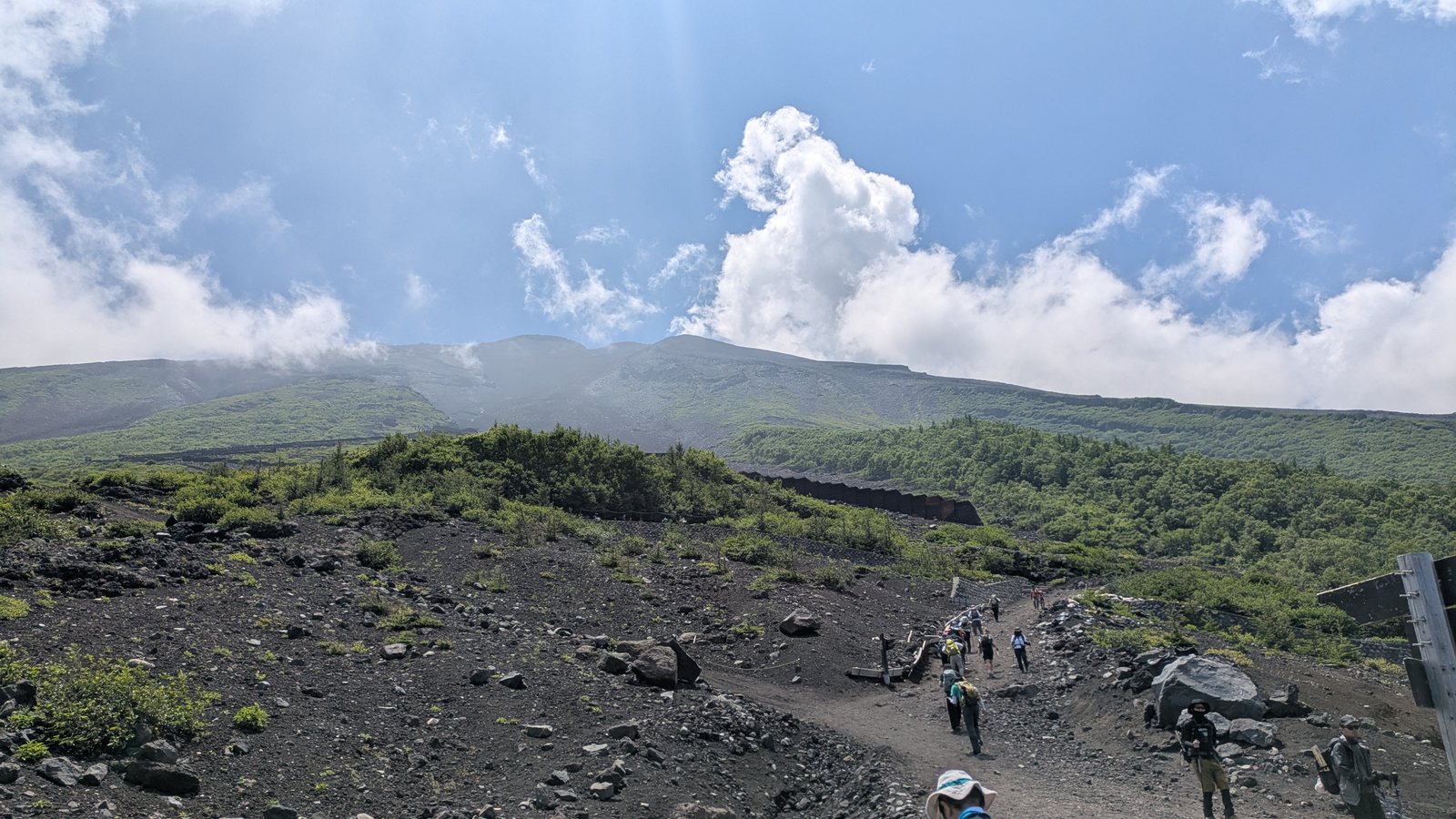
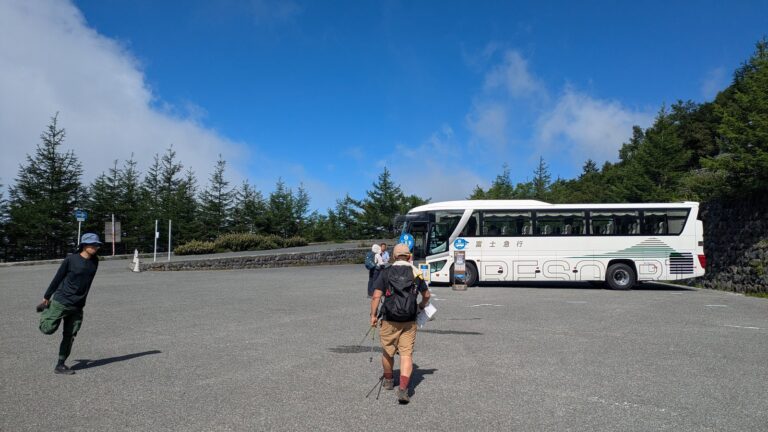
Affiliate link. This site earns a commission if you book through it, at no extra cost to you. Photo from our own climb.
The two days at a glance
| Independent, measured | Guided tour, as published | |
|---|---|---|
| Left the fifth station | 12:26 | About 11:30 |
| Reached the hut | 13:52, seventh station | 18:00 to 19:00, eighth station |
| Time to the hut | 1 hr 26 min | 5 to 6 hours |
| Left the hut | 23:06 | 01:00 |
| On the summit | 02:25 | 04:00 to 05:00 |
| Crater rim | Walked it, no charge | Extra ¥1,000 on one tour |
| Off the mountain at | Fujinomiya, Shizuoka | Yoshida fifth station |
| End of the day | A hot spring in Atami | Shinjuku, 18:00 |
Everything in the left column is mine, from photograph timestamps. Everything in the right column is printed in a tour itinerary that anybody can read before booking.
What I am comparing, and what I am not
My side of this is measured. Every time below comes from the timestamp on a photograph, and the full account is in Is climbing Mount Fuji worth it?.
The tour side is taken from published itineraries on two currently bookable two day climbs, quoted below. I have not taken a guided tour up Mount Fuji, and nothing here is a review of one. Where I describe what a tour does, it is either printed in the itinerary or it is something I watched happen from a few metres away.
One more thing has to be said before any of the numbers, because it is the single most useful finding here.
Two tours that look identical in the search results are not the same product. Of the two I examined, one caps the group at a size it calls small. The other states a maximum of forty nine people. Both are described as a two day climb with a hut stay and a guide. If you take nothing else from this article, take that: read the group size and the hour-by-hour itinerary before you read the price.
The first difference is the paperwork, and it is the real one
This is what climbing Mount Fuji independently required of me, in the order the deadlines fell.
| Independent | Guided tour | |
|---|---|---|
| Entry registration | Mine to do, opens in May | Included |
| Mountain hut | Separate system, separate opening date | Allocation already held |
| Which station to sleep at | My decision, made badly | Decided for you |
| Coach seat from Shinjuku | Booked separately | Included |
| Equipment | Mine to own | Rental arranged |
| Meals | Bought at the hut | Included in both itineraries |
None of that list is difficult on its own. What makes it awkward is that the pieces open on different dates, live in different systems, and most of them are in Japanese. For the 2026 season the entry registration on the Shizuoka side opened on 8 May. The hut I eventually slept in opened its own bookings, in a different place entirely, on 17 May. Nothing tells you that those are two separate acts until you have missed one of them.
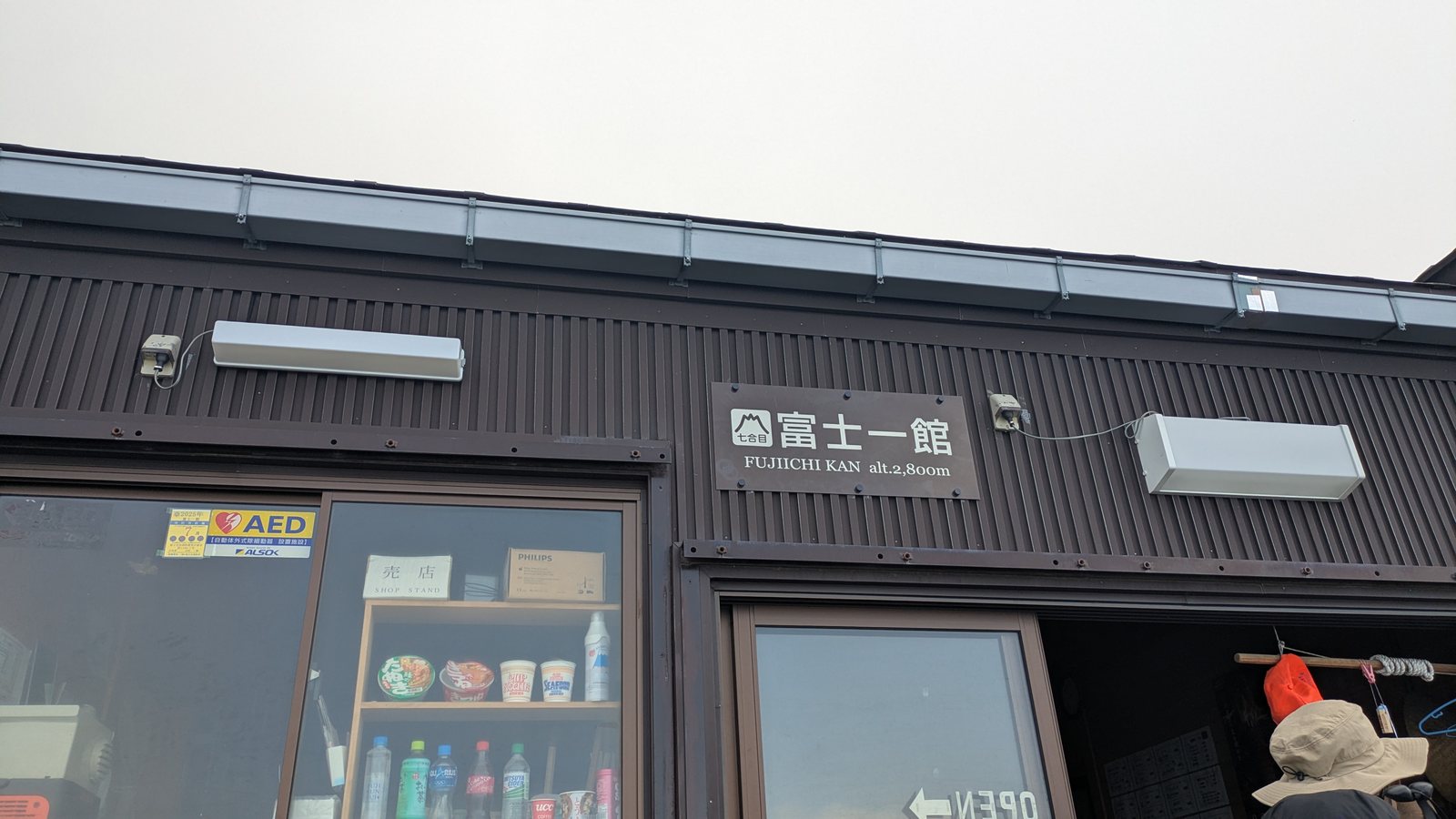
The hut is the part that matters. I went looking in early July and every hut was full, so I did not choose a date at all. I took whichever night still had a bed, and the bed I got was at the seventh station.
A tour is not subject to that. The operators hold allocation. One of the two itineraries states plainly that a hut at the eighth station is confirmed as part of the booking.
That single line is worth more than it looks. The higher you sleep, the shorter your second day, and by July the high huts are exactly the ones that are gone.
The second difference is pace, and I watched it happen
Here is the part I can speak to directly, because I walked past it.
I left the Yoshida fifth station at twenty six minutes past twelve and reached my hut at the seventh station at eight minutes to two. Eighty six minutes.
One of the published itineraries has its group leaving the fifth station at around half past eleven in the morning and arriving at the eighth station at six or seven in the evening. Five to six hours. The other tour is described in a customer review as taking about six hours to the eighth station.
The eighth station is higher than the seventh, so the tour is covering more ground. It is not covering three times more.
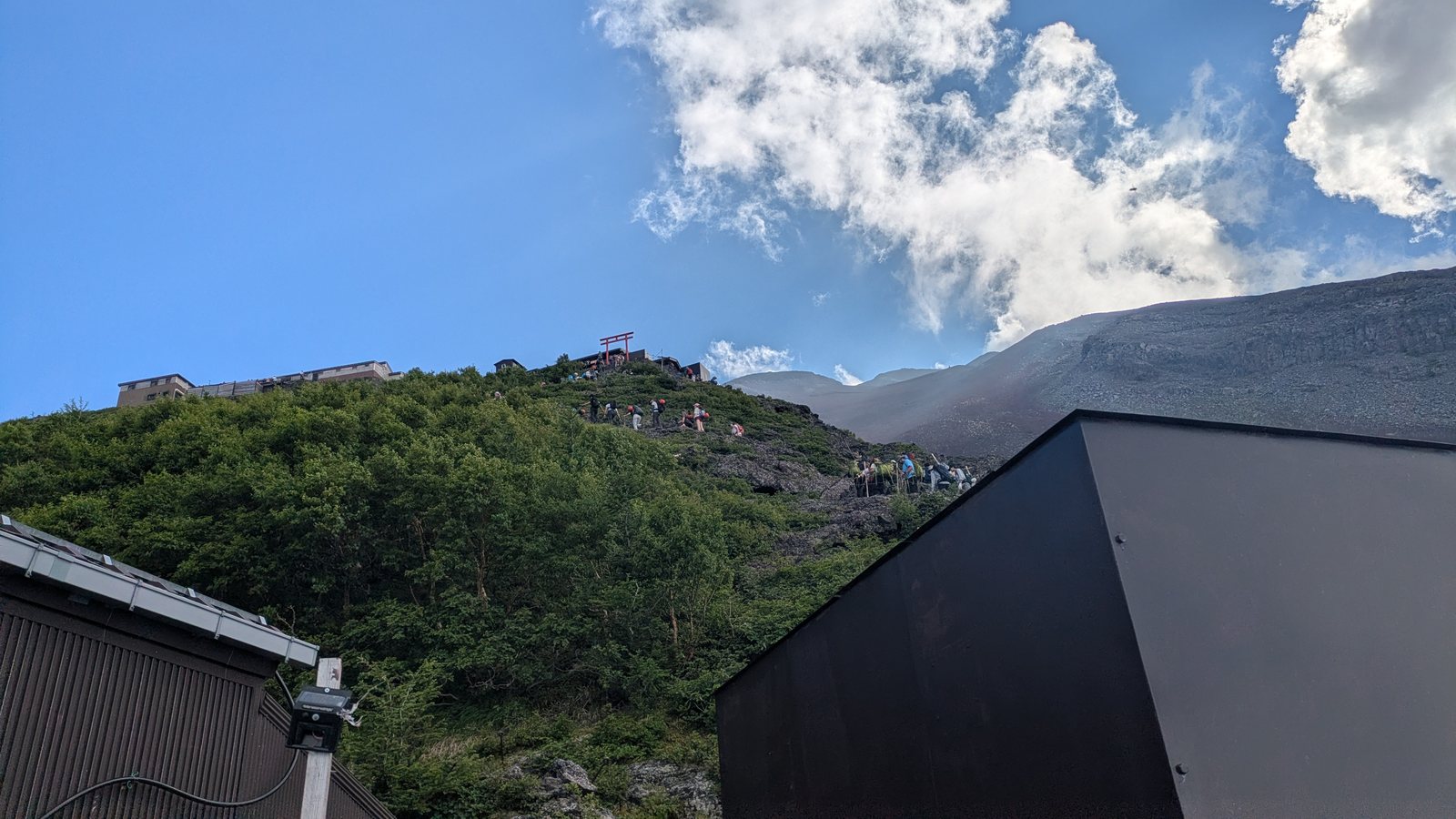
I passed guided groups repeatedly that afternoon. They were moving slowly, and I saw several of them stopped outside the huts, resting.
Now, the obvious way to write that sentence is as a criticism, and I want to avoid it, because I think it would be wrong.
I do not know why those groups were slow. I can guess, and my guess is that you cannot move forty nine people of mixed fitness up to three thousand metres quickly without somebody getting altitude sickness. But that is a guess, and guessing is how travel writing goes bad.
So here is somebody who was actually inside one of those groups, reviewing the tour after climbing it:
Initially I thought that a guided tour would be too slow but the rests were essential due to the altitude.
That is the answer, from a participant rather than from me. The slow pace is not a failure of the tour. It is the tour. The rests are the product. Somebody who has done this many times is deciding when you stop, and the reason you are moving at that speed is so that you arrive at all.
I passed those groups. Not because I was faster in any way that matters, but because they had bought something different.
The gear problem, which is bigger than it sounds
There is one line in the longer itinerary that is easy to skim past, and it may be the most practical thing in this whole comparison.
09:30 Stop at rental store.
The coach leaves Shinjuku at ten past seven in the morning and, before it reaches the mountain, it stops so that the group can rent equipment. Boots, rain jacket and trousers, a pack, poles, a headlamp, a fleece.
Think about who is on that coach. Somebody who flew into Japan with a suitcase. Mount Fuji in the dark at 3,400 metres is cold, it is frequently wet, and it is not survivable in the clothes you wore around Asakusa the day before. The gear is not optional, it is heavy, it is expensive, and almost nobody carries it across an ocean for one night.
Owning the gear does not fully solve it either, and this is the part I underrated. Boots, a fleece and waterproofs have to be carried through the rest of the trip as well. They take up the space, and the airline weight, of everything else you came to Japan to do, for the sake of one night on one mountain.
I owned mine, so this cost me nothing and I nearly left it out of this article. For a visitor it may be the entire argument. Solving it independently means finding a rental shop, ordering in advance in Japanese, and collecting it somewhere near the trailhead. On the tour it is a scheduled stop on the way, before anybody has to think about it.
The third difference is where you are standing at the end
This is the one nobody writes about, and it is the one that would decide it for me.
The published itinerary I looked at ends this way: descend to the fifth station by half past ten, bus out at half past eleven, bathe and eat at a hot spring at one, leave again at half past two, arrive back in Shinjuku at six in the evening.
Look at where that finishes. Shinjuku. The coach that carried the group up is the same coach that carries them down, and it goes back to the place it came from. That is not a flaw. It is how a coach tour has to work.
Now here is my own descent.
I came down the other side of the mountain, crossed the Hoei crater, and came off at the Fujinomiya fifth station in Shizuoka at nine minutes to nine in the morning. Then a bus down to Mishima, and the rest of the day in a hot spring in Atami, which is nowhere near where I started.
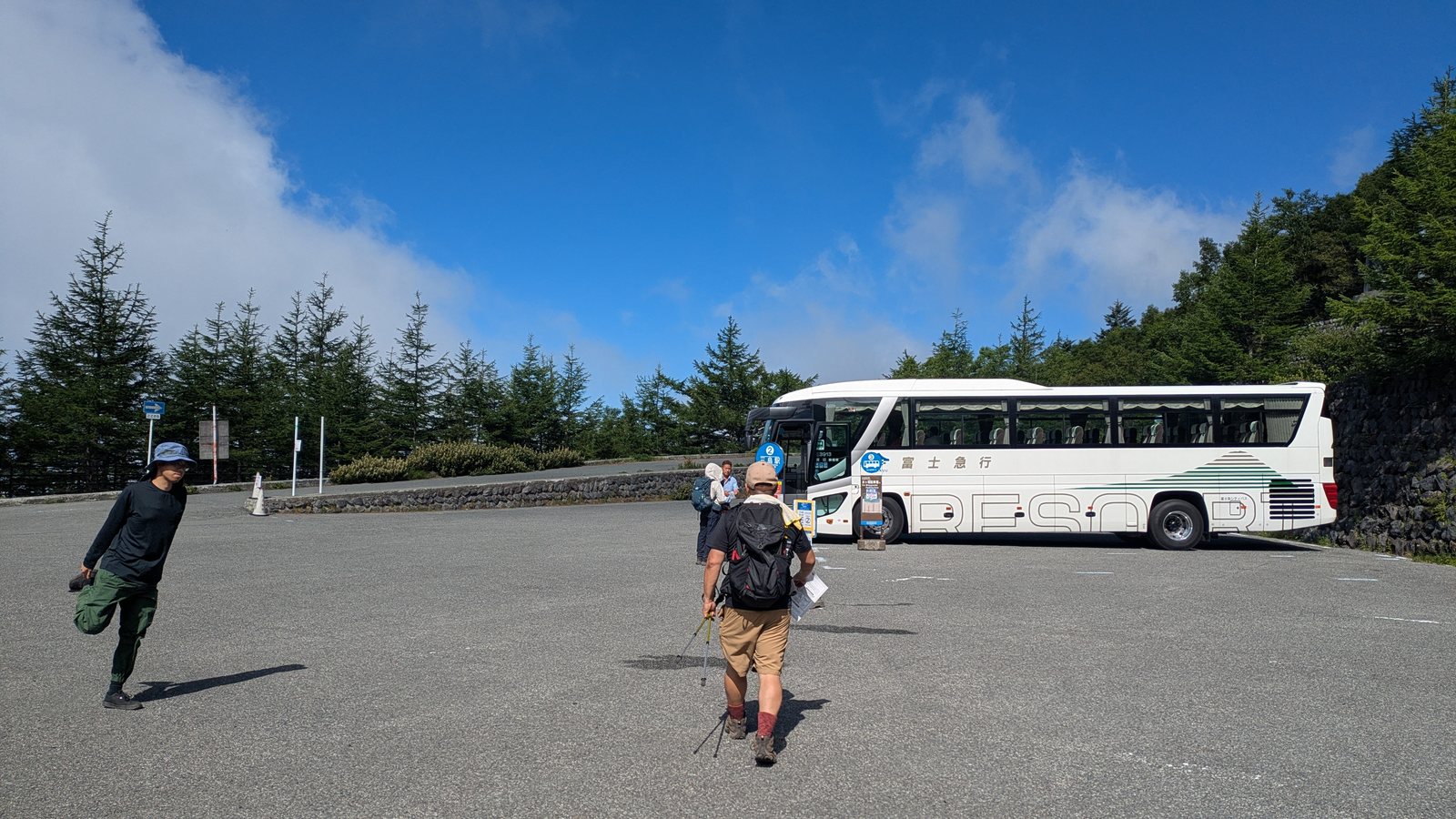
I chose that descent before I ever got on the bus at Shinjuku, and I chose it because of where I wanted to be that evening. On a mountain where you go up one side and come down another, the descent is a decision about how your day ends, and it is the first thing a coach tour takes away from you.
A smaller thing, which happens to be the best thing
One of the two itineraries prices the crater rim separately. Going around the crater at the top is an extra thousand yen, paid to the guide on the day.
I mention it because of what is on the far side of that crater.
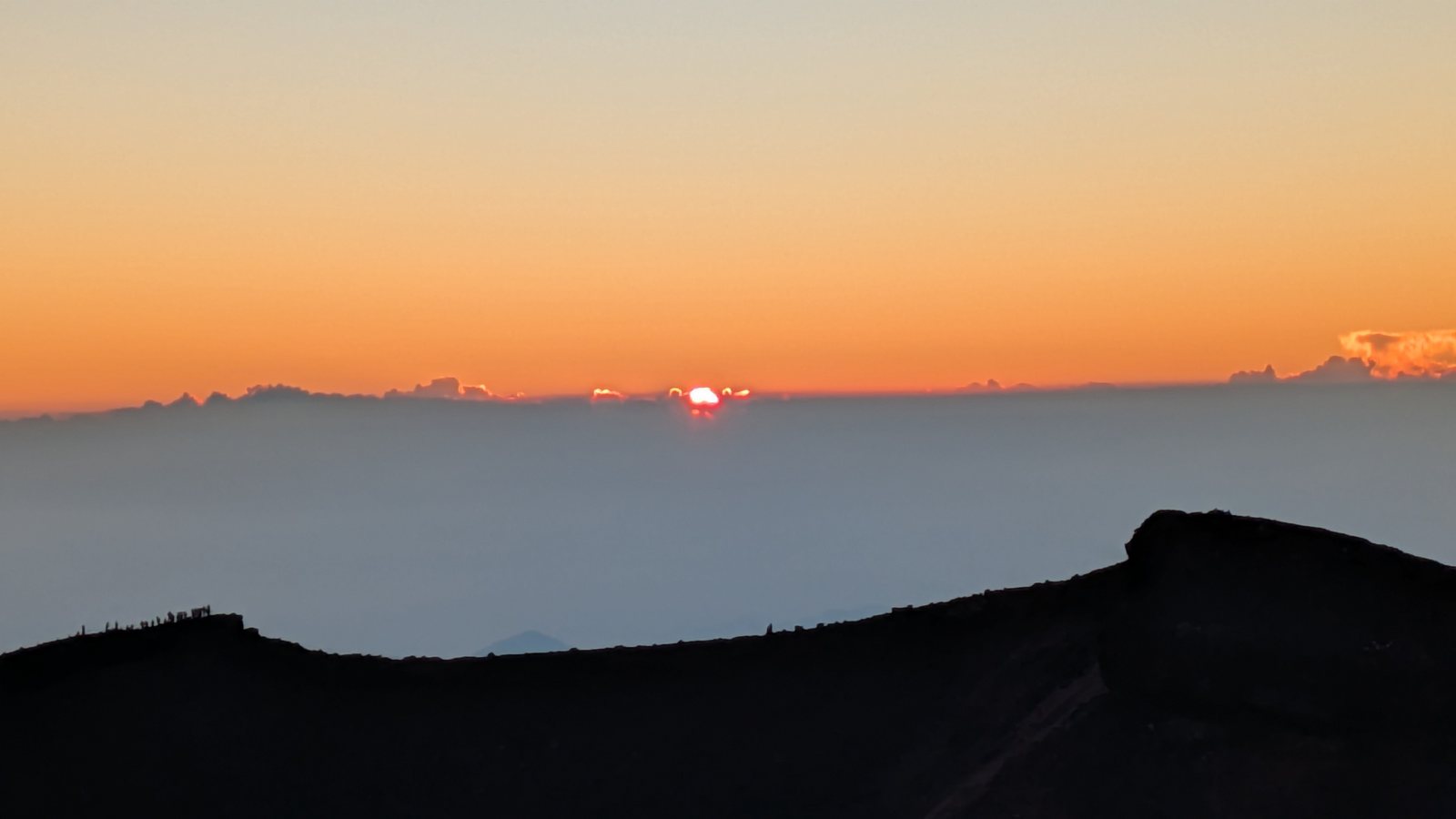
The Yoshida trail arrives at one edge of the summit. Kengamine, the true summit and the highest point in Japan, is on the opposite edge, an hour and sixteen minutes of walking round the rim in the dark. That walk was the best hour of my climb, and I have written about why: the sun came up with a line of people along the far rim, and about thirty of us on the high side.
On my climb that was a choice I made at half past two in the morning, standing at the top, because I had the time and nobody was managing me.
On a tour it is a line item.
What a guided tour does not fix
Three things, because the itinerary photographs will not show you any of them.
You will still not sleep. A guided tour puts you in a mountain hut, which is the same building, with the same conditions, as the one I was in. You will lie down in the late afternoon because the summit is hours above you. There is no lights-out and no wake-up call. A wooden room full of strangers who are all leaving at different times in the dark is not quiet, and no guide can make it quiet.
The itinerary of the larger tour is honest about this in a way I did not expect. Its entry for the evening at the hut reads, in full, dinner and nap. Not a night. A nap. That is the correct word, and it is the operator who chose it.
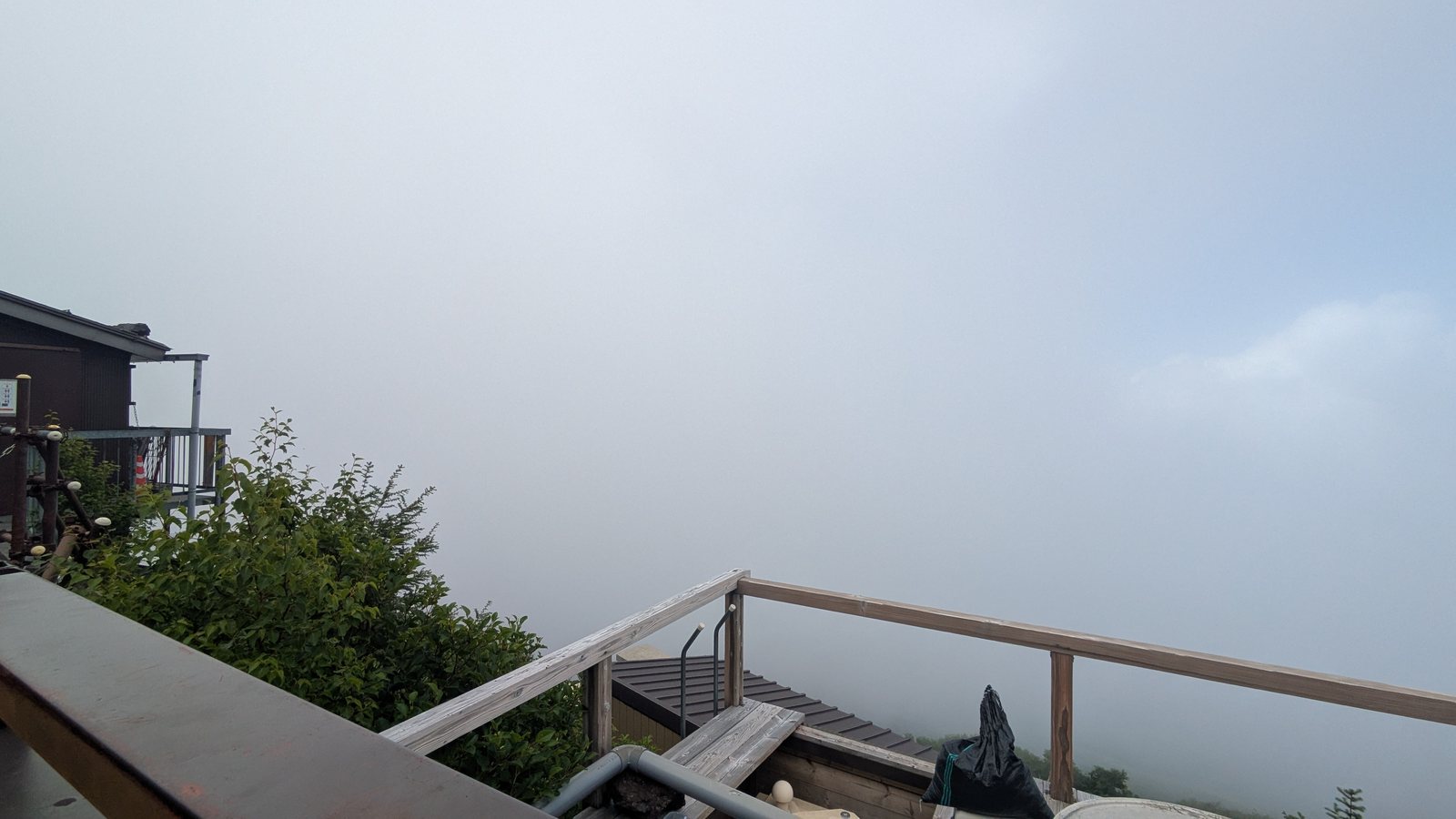
The weather is the same weather. Cloud does not check whether you booked. My own afternoon at the hut was spent looking at a white wall for a while, and a tour would have been looking at the same wall. Nobody refunds a view.
Some of the money is still yours to pay. The entry fee of ¥4,000 per person for the 2026 season is charged separately on at least one of the two tours, collected on the day rather than included in the price you see. On that same tour, going around the crater at the summit costs another thousand yen. Read the exclusions, not only the inclusions.
None of this is an argument against booking a tour. It is an argument against expecting a tour to change the mountain. What it changes is the paperwork in front of the mountain.
So which one
Not by price. By what you can afford to hand over.
| You | Take |
|---|---|
| Do not own hiking gear | The tour. Rental is arranged as part of it |
| Have not booked a hut, and it is already summer | The tour. They hold allocation. You will not find one |
| Are uneasy arranging things in Japanese | The tour |
| Have a short trip with no room for a failed attempt | The tour |
| Want to walk at your own speed | Independent |
| Want the crater rim, or Kengamine, on your own terms | Independent |
| Want to come down somewhere other than where you started | Independent. The coach goes home to Shinjuku |
Notice that nothing in the left column is about fitness, and nothing is about whether you are a real climber. It is about what is actually in your way.
For most people arriving in Japan for two weeks, without gear, in the middle of the season, with the huts already full, the honest answer is the tour, and the reason is the hut allocation rather than the guiding.
For me it was the wrong trade, because the thing I wanted most from that mountain was the hour on the crater rim in the dark, and the bath in a town on the other side. Both of those are the exact things a coach tour cannot sell.
It is worth being clear about what that trade is not. It is not a trade of a real climb for an easy one. The guided groups I passed were doing the same 1,400 metres of ascent that I was, on the same trail, in the same weather, and finishing at the same summit. One of the reviews of the tour I read describes it as a serious undertaking, with sections where you are pulling yourself up rocks. Nothing about a guide removes the mountain.
The trade is narrower than that, and it is entirely about control. You give up the timetable. You give up the descent. You give up the improvised hour at the top that turns out to be the part you remember. In exchange, somebody else holds a bed at three thousand metres in a month when there are none, puts a rain jacket in your hands, and tells you when to stop walking so that you keep walking.
If you are looking at tours
Read these three lines of the itinerary before the price.
Group size. One of the two I looked at states a maximum of forty nine. The other calls itself small. That difference will shape your entire second day.
Which station the hut is at. Higher is a shorter second morning. The itineraries state it.
What is not included. The entry fee of ¥4,000 for the 2026 season is charged separately on at least some tours, and on one of them the crater rim is an extra thousand yen.
The two day climbs with a hut booking are listed here: guided Mount Fuji climbs on GetYourGuide. That is an affiliate link, so this site earns a commission if you book through it, at no extra cost to you.
Affiliate link. This site earns a commission if you book through it, at no extra cost to you. Photo from our own climb.
Where to next
The full measured account of the independent climb, including the night in the hut and why nobody sleeps in it, is in Is climbing Mount Fuji worth it?.
If you have not settled on Mount Fuji at all yet, Mount Takao or Mount Fuji compares it with the mountain at the end of a commuter line, by the one thing that separates them: how far ahead you have to commit.
Sources: Mt. Fuji: 2-Day Climb with Hut Stay, Meals, and Hot Springs (archived copy, September 2026; no longer listed) / Mt. Fuji: 2-Day Climbing Tour with Mountain Guide (archived copy, February 2025; no longer listed) / Mount Fuji Climbing Official Site, Yoshida trail regulations
One thing has changed the arithmetic of that paperwork since this was written: under the 2026 rules, a hut booking is what allows anybody to pass the Fifth Station gate at night. Mount Fuji in 2026: the 4,000 yen is not the rule that decides your climb sets out the system, including the reason the huts sell out months before the trail does.