Some links on this site are affiliate links. If you book through one, Tokyo Trailhead earns a commission at no extra cost to you. It never decides what appears here.
Shinjuku Gyoen is ten minutes on foot from the south exit of Shinjuku Station, and it charges 500 yen at the gate. Most English pages stop there, and add that it is a good place for cherry blossoms.
Two things they tend to leave out decide whether your visit works. The garden is closed one day a week, and that day is Monday. And you cannot bring alcohol in. Get those two right, and the rest of the day takes care of itself. The gates take cards, IC cards and QR payments, and on the day of this visit there was no queue at all.
This page comes from one afternoon inside. Wednesday 23 September 2026, a public holiday, in steady rain. In through Okido Gate at 13:00, out past the lawns towards Shinjuku Gate at 14:08. Opening hours, closing days and rules were checked against the official English site on 25 September 2026, and the questions the site does not answer were put to the garden service centre by phone.
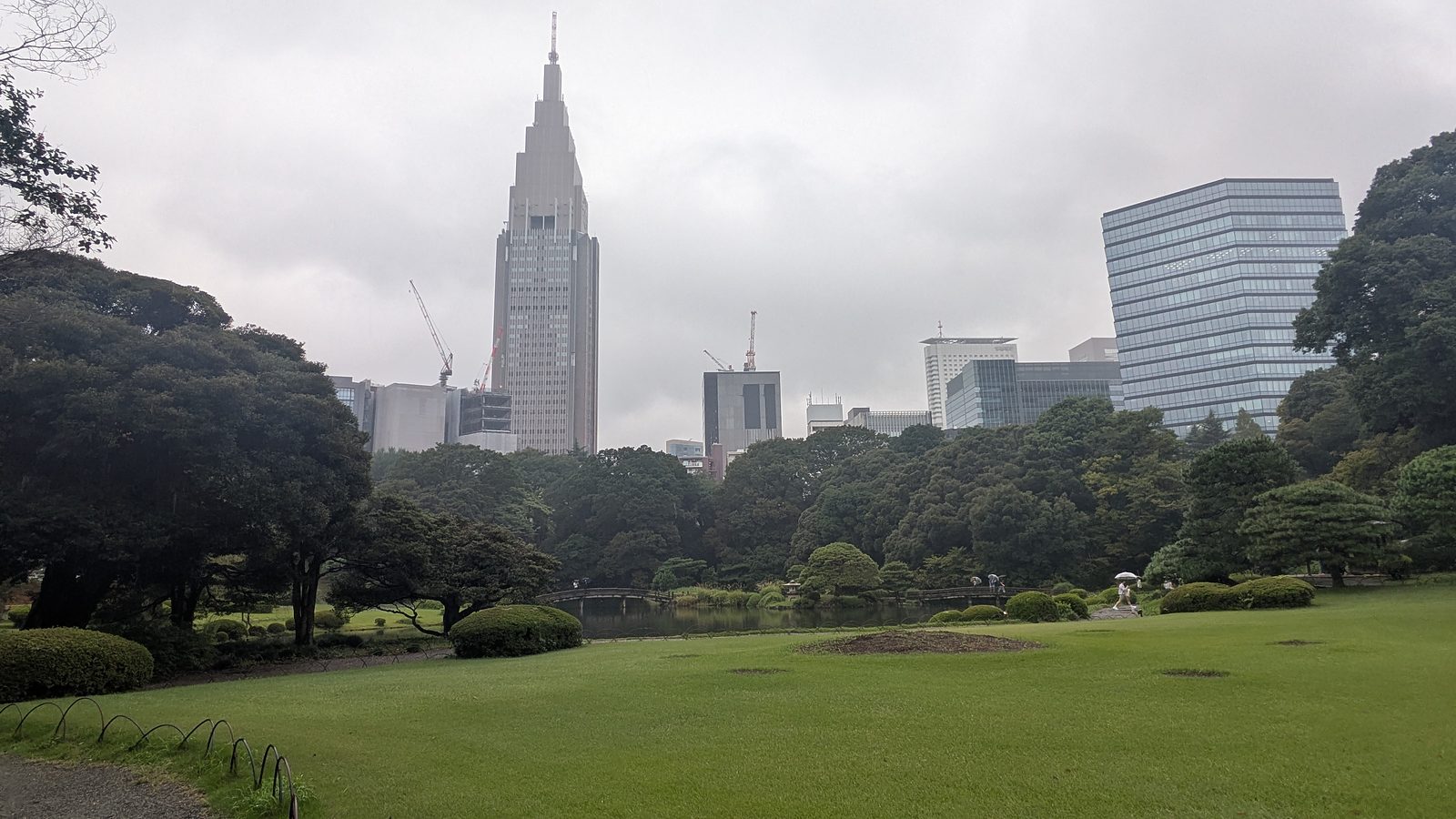
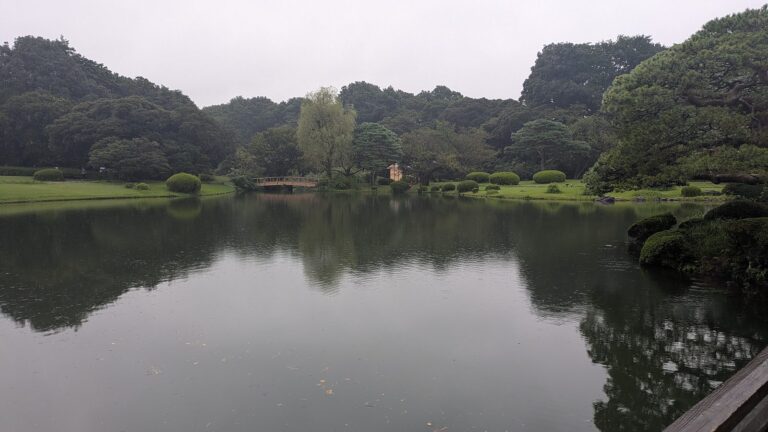
Affiliate link. This site earns a commission if you book through it, at no extra cost to you. Photo from our own walk.
What this guide covers15 sections
- Shinjuku Gyoen, in figures
- Rule one: do not come on a Monday
- Rule two: leave the alcohol behind
- Food is fine. A party is not
- Running is allowed, on one route, and not in spring
- The rest of the list: relaxing on the grass, yes. Playing on it, no
- Paying the 500 yen: a card works, and an IC card skips the machine
- Three gates, and which one to use
- An hour and ten minutes, gate to gate
- What is in flower depends on when you come
- The gate closes to new visitors 30 minutes before the garden does
- The English information is accurate. It just does not tell you everything
- Questions people actually ask
- What to settle before you go
- Where to next
Shinjuku Gyoen, in figures
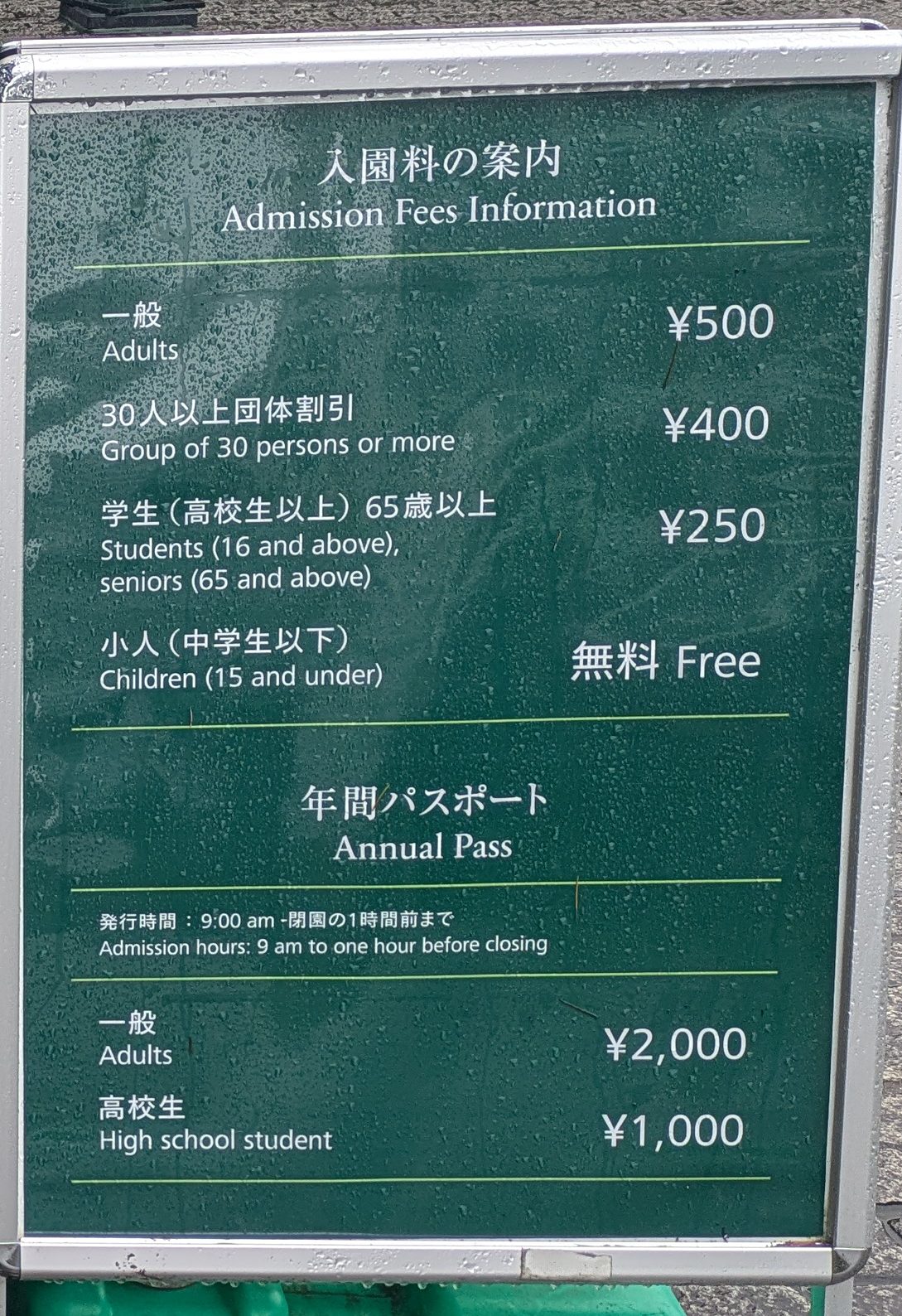
| Admission | 500 yen for adults, 250 yen for students aged 16 and over and for seniors aged 65 and over, free for children aged 15 and under, 400 yen each for groups of 30 or more |
| Annual pass | 2,000 yen for adults, 1,000 yen for high school students. It pays for itself on the fourth visit |
| Closed | Mondays (the next weekday when Monday is a public holiday), and 29 December to 3 January |
| Open every day | 25 March to 24 April and 1 to 15 November |
| Hours, 15 March to 30 September | 09:00 to 18:00, last entry 17:30 |
| Hours, 11 June to 31 July | 09:00 to 19:00, last entry 18:30 |
| Hours, 1 October to 14 March | 09:00 to 16:30, last entry 16:00 |
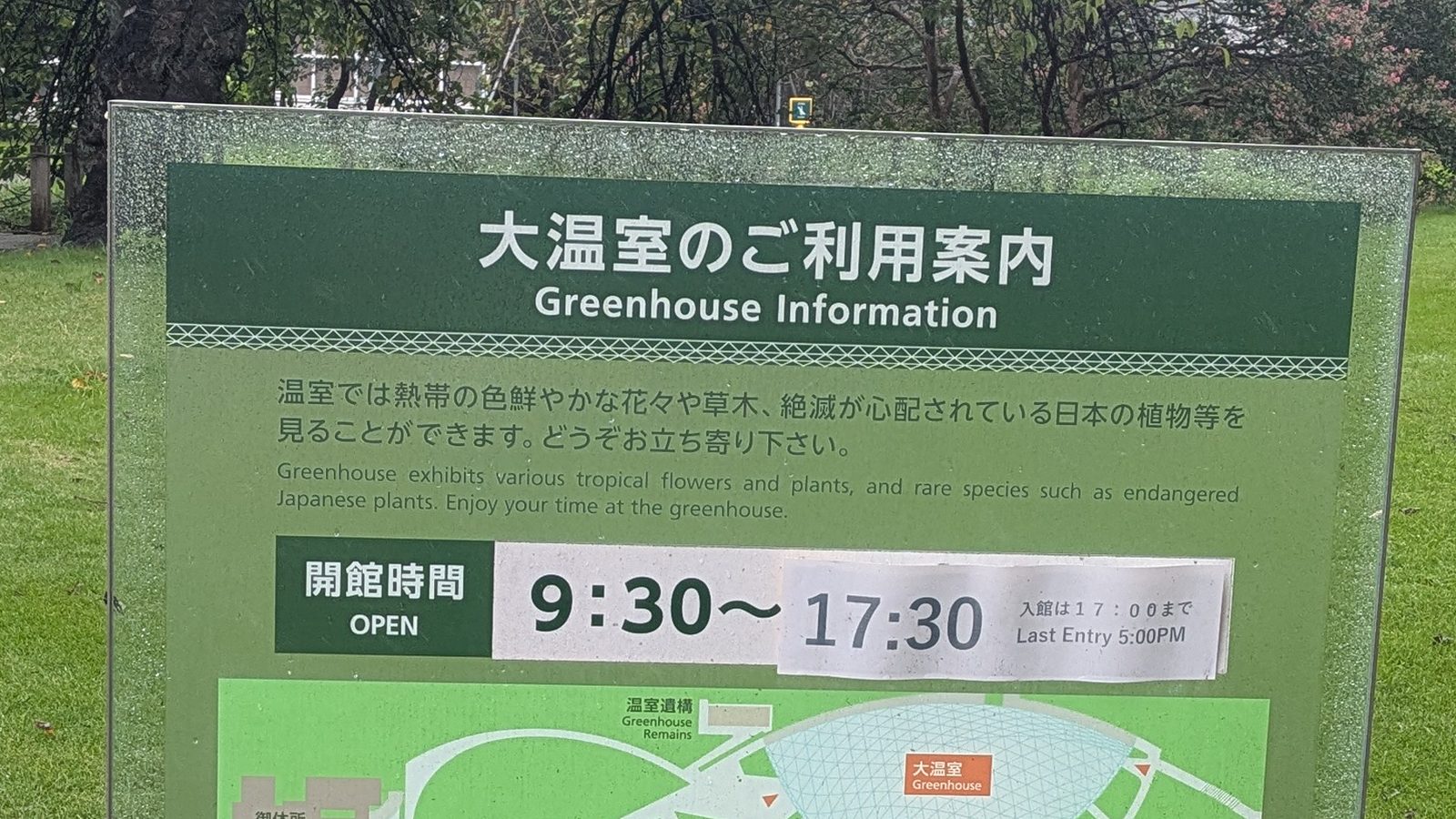
| Greenhouse | 09:30 to 17:30, last entry 17:00 (the board on the day) |
| Gates | Shinjuku Gate, Okido Gate, Sendagaya Gate |
| Payment | Cash, credit cards, IC cards, QR code payments at the machines. IC cards and Visa contactless directly at the gate |
| Alcohol | Not allowed in, and not allowed to be drunk inside |
| Coin lockers | 500 yen large, 300 yen small (Okido Gate) |
| Size | 58.3 hectares, around 10,000 trees |
Rule one: do not come on a Monday
Shinjuku Gyoen closes every Monday. When Monday is a public holiday, it opens that Monday and closes the next weekday instead. It also closes from 29 December to 3 January.
There are two exceptions, and they are the only reason the Monday rule ever needs a second thought. From 25 March to 24 April, the cherry blossom season, the garden opens every day. From 1 to 15 November, during the Chrysanthemum Exhibition, it opens every day again. Note what the November exception is for. It is the chrysanthemums, not the autumn leaves, which usually colour later than that.
So the check before you go is one question. Is my day a Monday, and if it is, does it fall inside one of those two windows? If the answer is Monday and no, go to Yoyogi Park or Meiji Jingu instead, both of which are open.
This visit was on a Wednesday public holiday, which is an ordinary open day. A public holiday on a Monday is the case that catches people out, because the garden is open on the holiday and shut on the Tuesday that follows.
Rule two: leave the alcohol behind
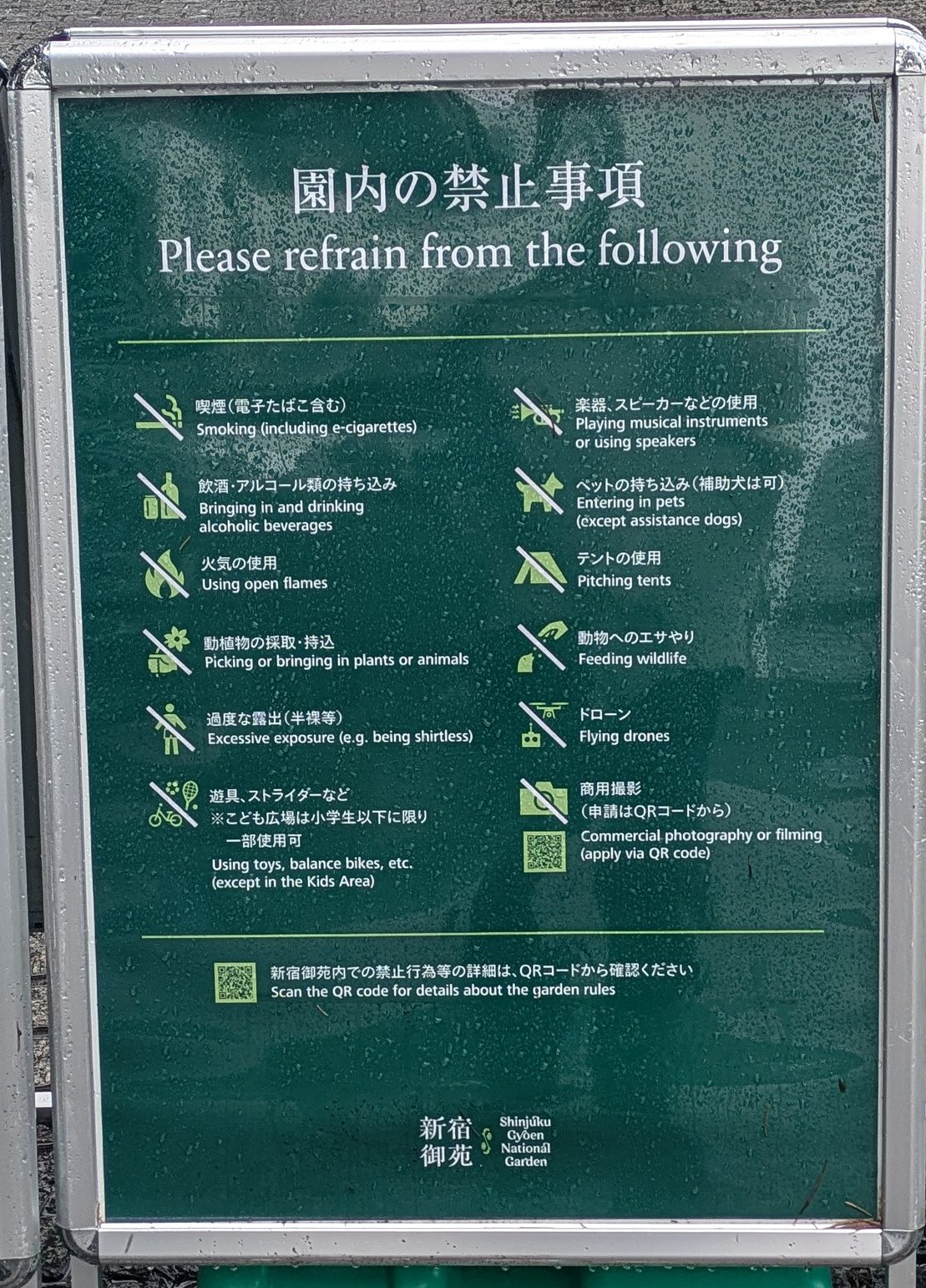
Alcohol is not allowed into Shinjuku Gyoen, and it is not allowed to be drunk inside. It is the first item on the list of things you may not bring in, on the official English site.
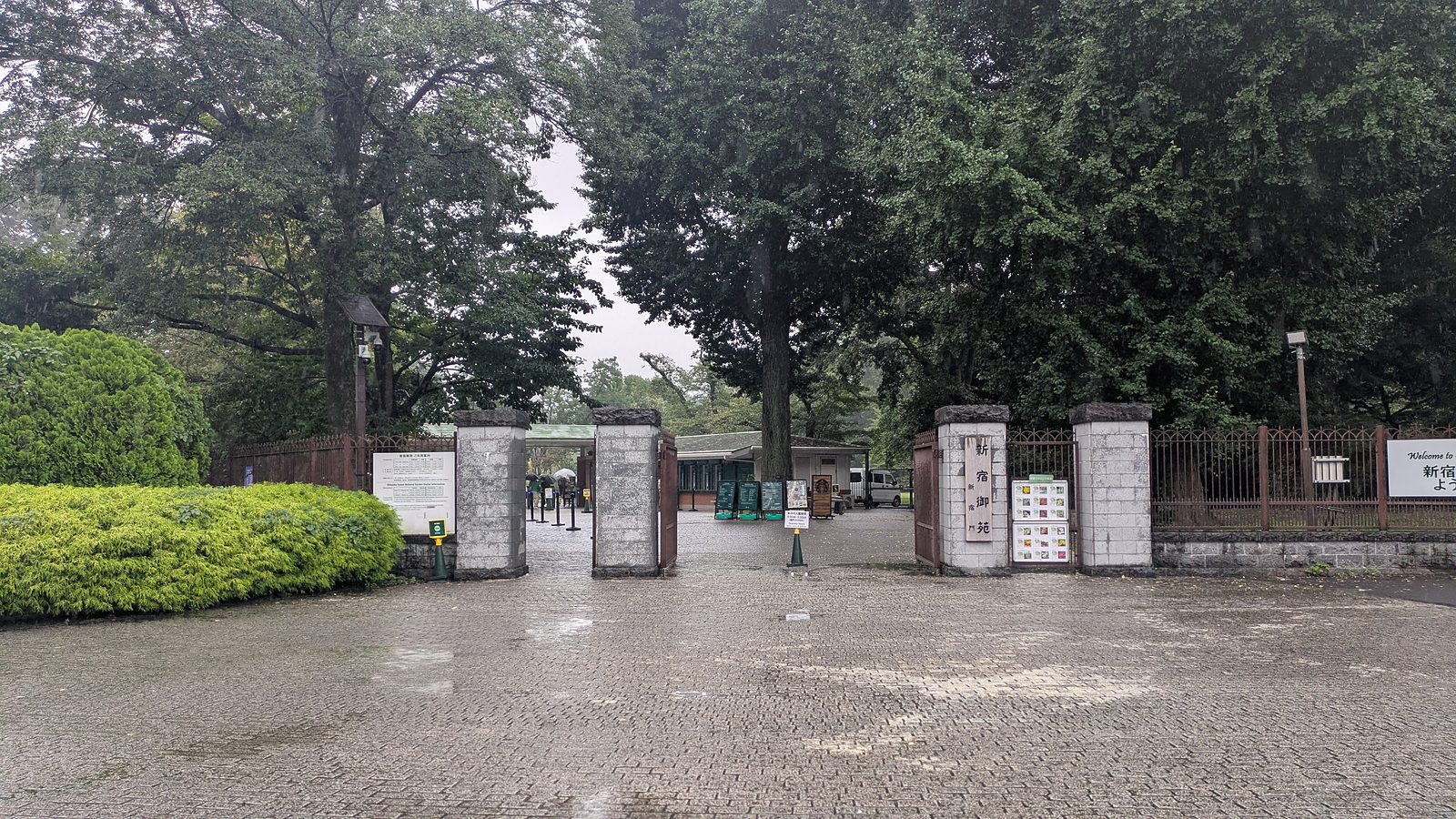
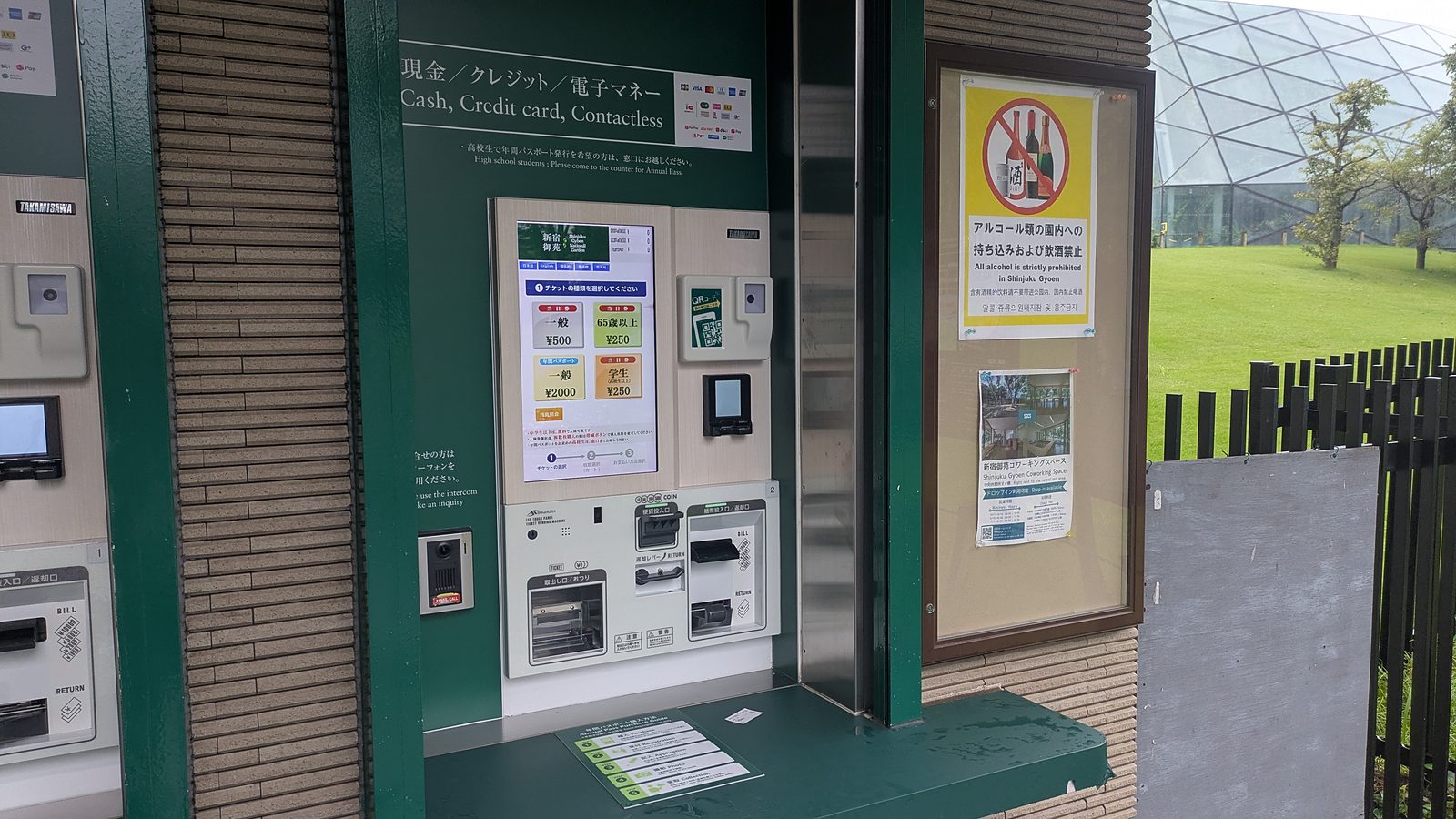
It is also hard to miss at the gate. At Okido Gate on the day of this visit, the rule appeared in English three times before the turnstiles. A free-standing sign on the path reads, in full: Alcoholic beverages are not permitted in the garden. The rules board at the entrance puts it second of twelve items. And a poster beside the ticket machines states it again in Japanese, English, Chinese and Korean.
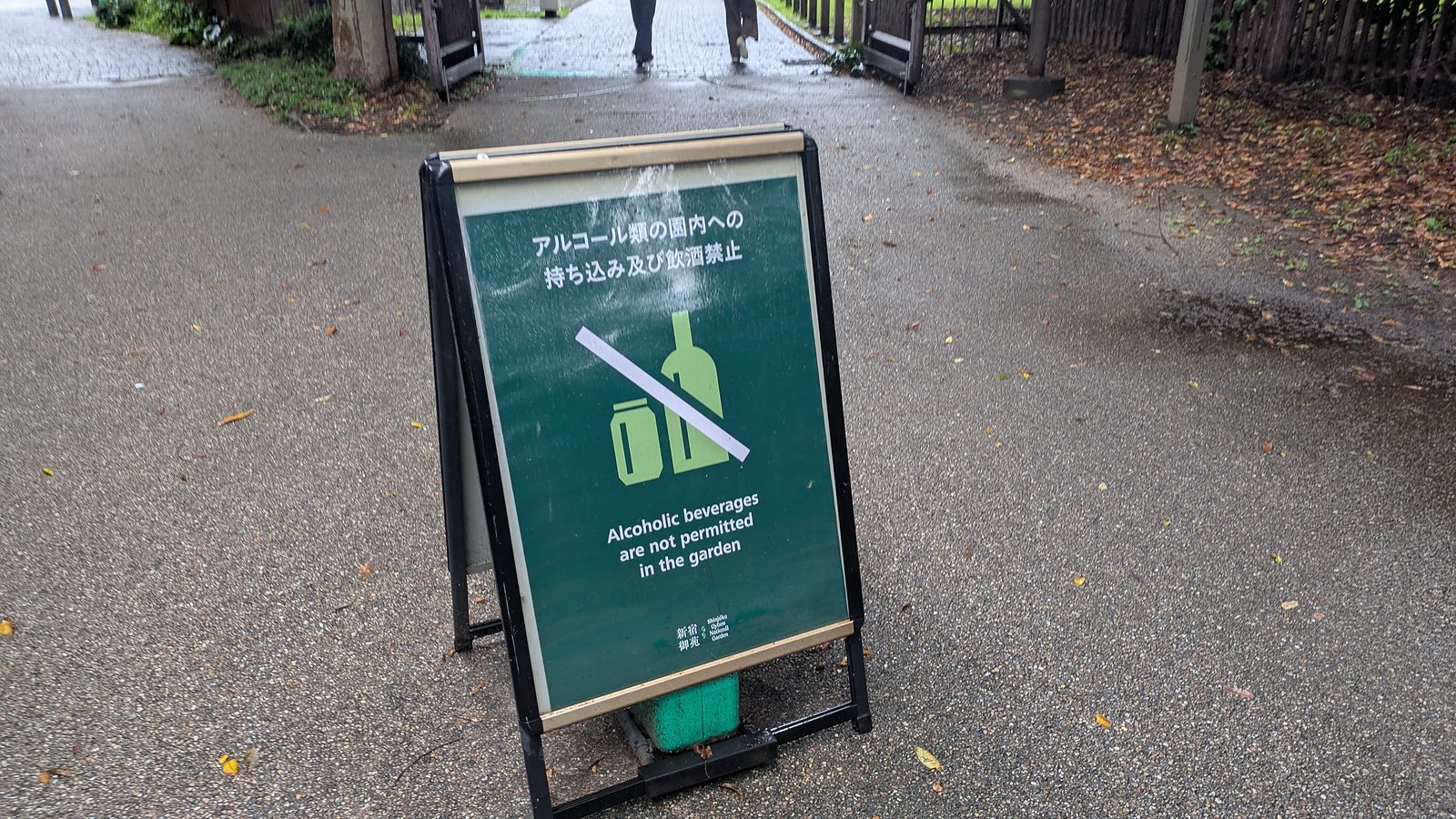
So the rule is not hidden. People still get it wrong for a different reason. English guides to Tokyo parks list Shinjuku Gyoen next to Ueno Park and Yoyogi Park, and in spring those two are where Tokyo sits on blue sheets and drinks under the cherry trees. The lists rarely say that Shinjuku Gyoen is the one that does not work that way.
Neither is better. They are for different afternoons. If the plan is a long picnic with beer, Yoyogi or Ueno is the right place. If the plan is a walk through a garden with the city out of earshot, this is.
One more thing from the day: there was no bag check at the gate. Nobody looked inside a bag, and nobody asked. The rule is posted, and keeping it is left to you.
Food is fine. A party is not
You can eat in Shinjuku Gyoen, and you can sit on the grass to do it. What the rules stop is everything that turns a picnic into a party:
- Alcohol, as above
- Fires and portable stoves
- Tents and parasols (one exception: small sun tents up to 150 cm high for children, in the Kids Area, from 7 May to 31 October)
- Occupying the same spot for a long time
- Musical instruments and speakers
Put simply, a picnic is fine and a party is not.
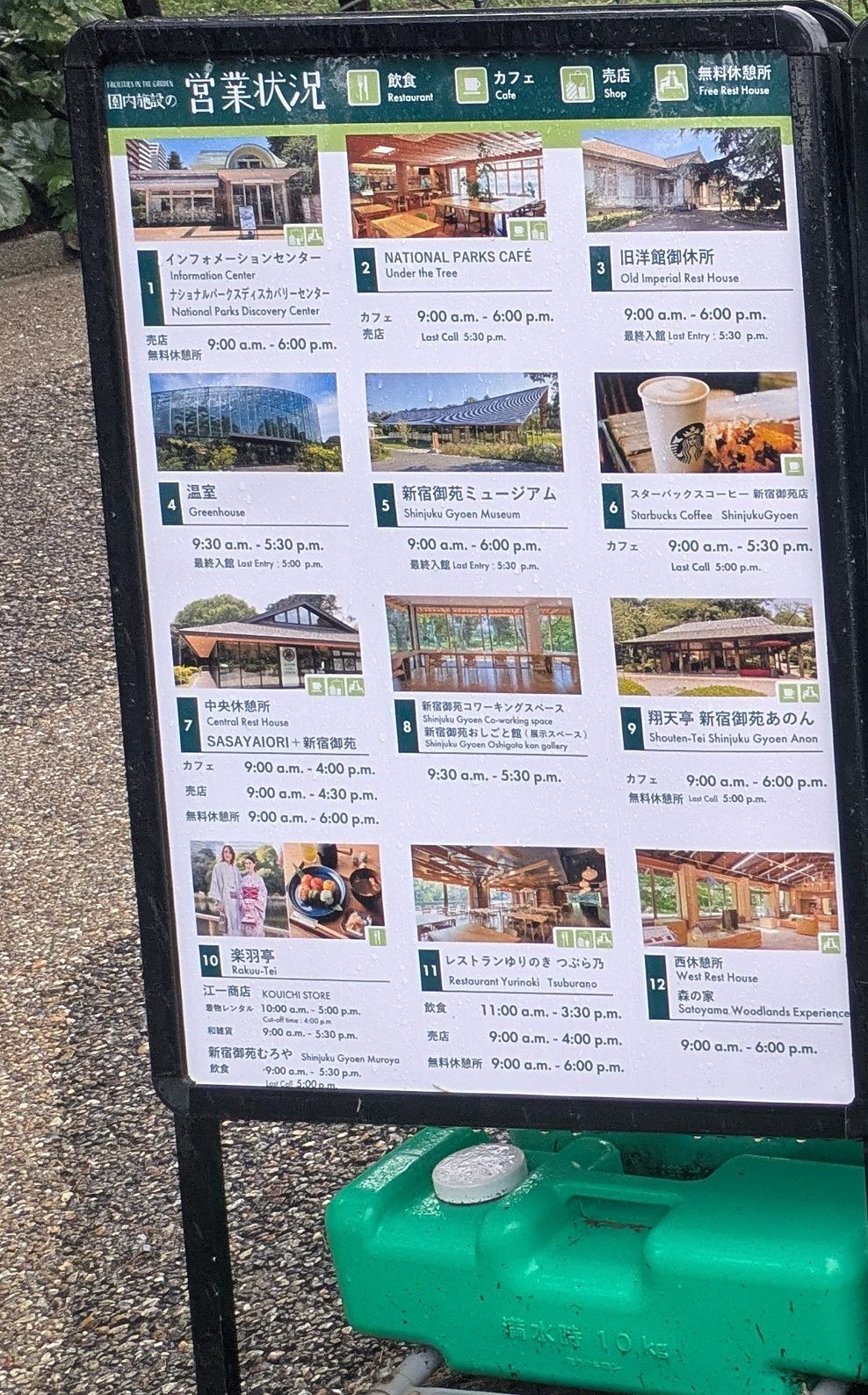
If you would rather not carry food in, there are cafes, restaurants and rest houses inside. The board at Okido Gate listed twelve facilities with their hours on the day, including a Starbucks, a restaurant, and free rest houses open until 18:00. Their hours change with the season, so check the board at the gate.
Running is allowed, on one route, and not in spring
Yes, you can run in Shinjuku Gyoen, with three conditions from the official rules:
- Only on the designated running course
- Not in a group of 10 or more
- Not at all during the cherry blossom season, 25 March to 24 April
The course is drawn on a board just inside Okido Gate. It follows the outer edge of the garden in a loop. The board gives two rules in English: run in groups of nine or under, and give priority to walkers.
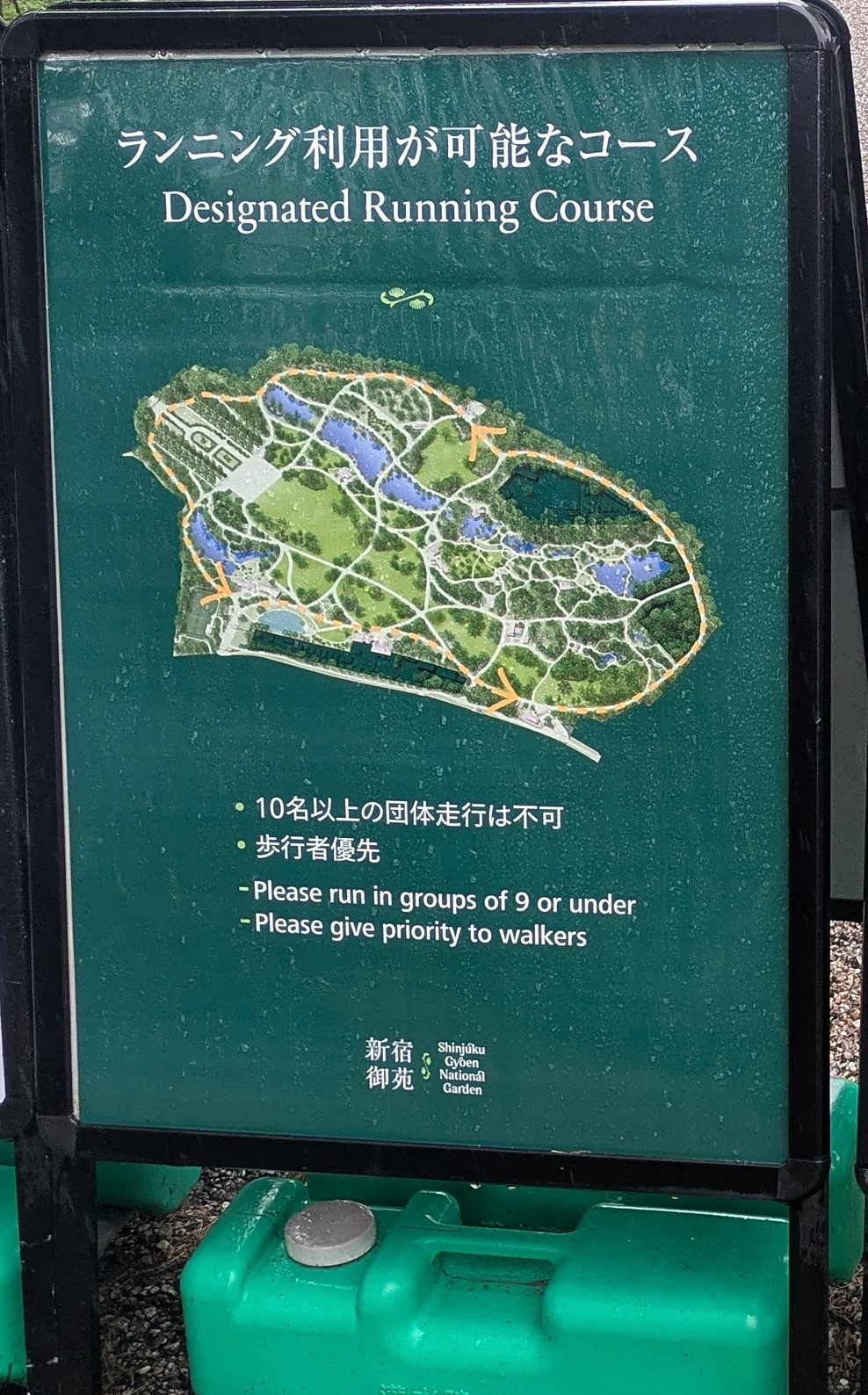
Look at what the board leaves out. It does not mention the spring ban. That rule is on the official site and not on the board you read at the gate. A runner who reads only the board in April will be breaking a rule without knowing it.
Cycling is a separate question with a simpler answer. Bicycles are on the list of things you cannot bring in, along with balance bikes, tricycles, scooters and skateboards. If you arrive by bike, it stays outside.
The rest of the list: relaxing on the grass, yes. Playing on it, no
The rules board at every entrance lists twelve things. Beyond alcohol, the ones that most often catch visitors are these:
- Smoking anywhere in the garden, including e-cigarettes
- Pets (assistance dogs are allowed)
- Drones
- Ball games, badminton, frisbees, kite-flying and skipping ropes
- Bug nets and cages
- Commercial photography or filming without an application
The pattern is simple. Sitting, reading, sleeping and eating on the grass are fine. Anything that turns the lawn into a sports field is not. That is the practical difference from a public park. Children of primary school age have their own exception in the Kids Area, where soft play equipment is allowed.
Paying the 500 yen: a card works, and an IC card skips the machine
The ticket machines at Okido Gate take almost anything. The panel above them reads Cash, Credit card, Contactless, and the logos below cover the major credit cards, Japanese IC cards, and QR payments including PayPay and Alipay+. The screen switches to English, Chinese or Korean with one button.
On this visit a credit card at the machine took well under a minute. It was a public holiday in the rain, there was nobody in front, and the ticket came out straight away.
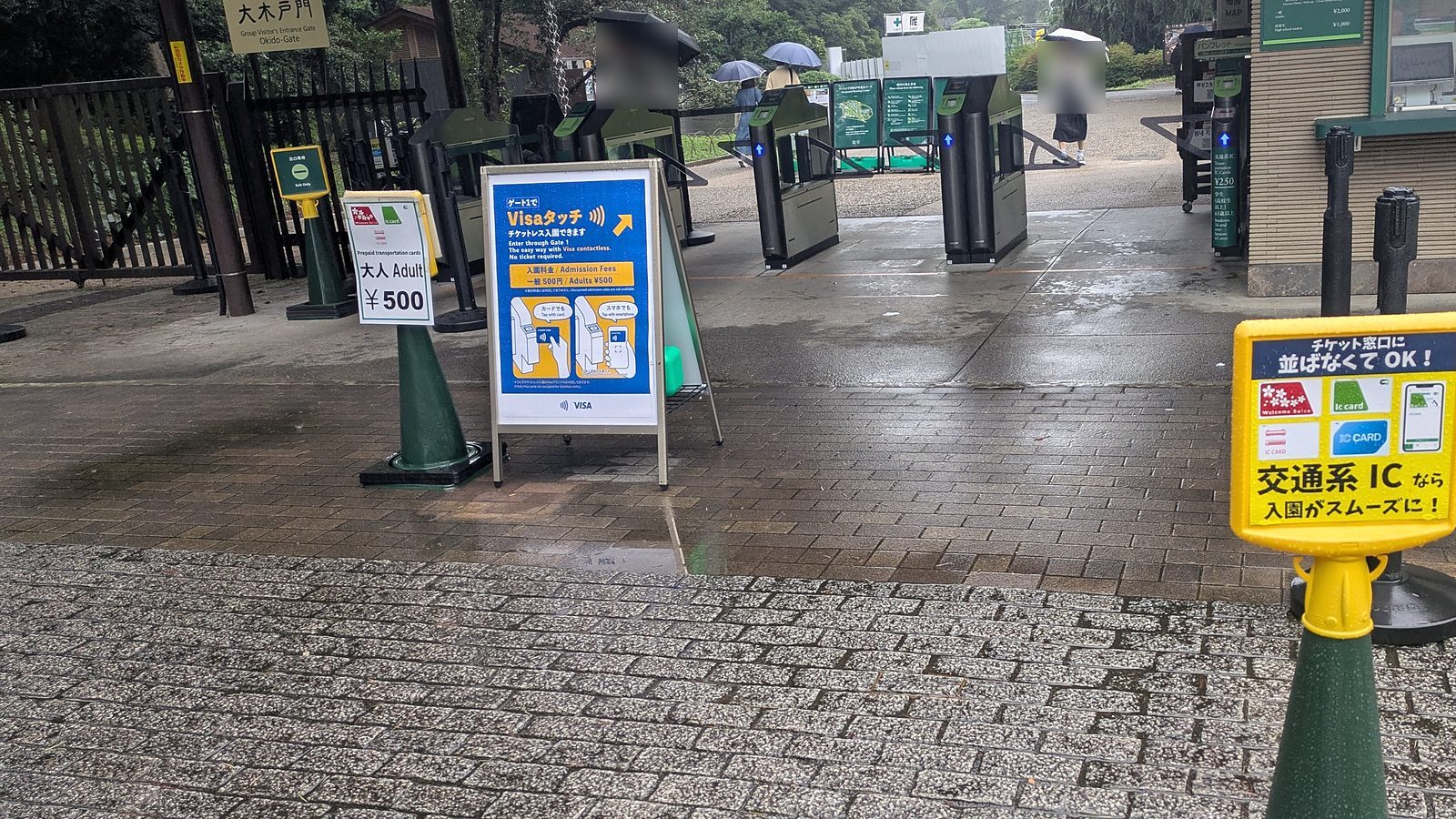
There is a faster way still. If you carry an IC card, a Suica, a Pasmo or a Welcome Suica, you do not need the machine at all. Tap it on the gate and walk through, and the fare is charged there. A yellow sign in front of the gates says so in Japanese, and the official English page says it in English. A second sign said that Visa contactless cards could be tapped at Gate 1 in the same way.
You can also buy an e-ticket in advance. The official site says it lets you skip the line at the ticket counter, and it is valid for six months from purchase.
Three gates, and which one to use
| Gate | Nearest station | On foot |
|---|---|---|
| Shinjuku Gate | Shinjuku Station, south exit / Shinjuku-gyoemmae Station, exit 1 | 10 min / 5 min |
| Okido Gate | Shinjuku-gyoemmae Station, exit 2 | 5 min |
| Sendagaya Gate | Sendagaya Station / Kokuritsu-Kyogijo Station, exit A5 | 5 min / 5 min |
Shinjuku Gate is the one most visitors use, because it is the one closest to the big station. Its ticket building has eight windows and a long row of queue barriers. On this rainy holiday the barriers stood empty.
Okido Gate is the one to choose if the greenhouse is on your list. The greenhouse is a few minutes inside it. Walking from Shinjuku Gate to Okido Gate along the road outside took about eight minutes.
Sendagaya Gate was not visited on this day, so the figures above for it come from the official site only.
An hour and ten minutes, gate to gate
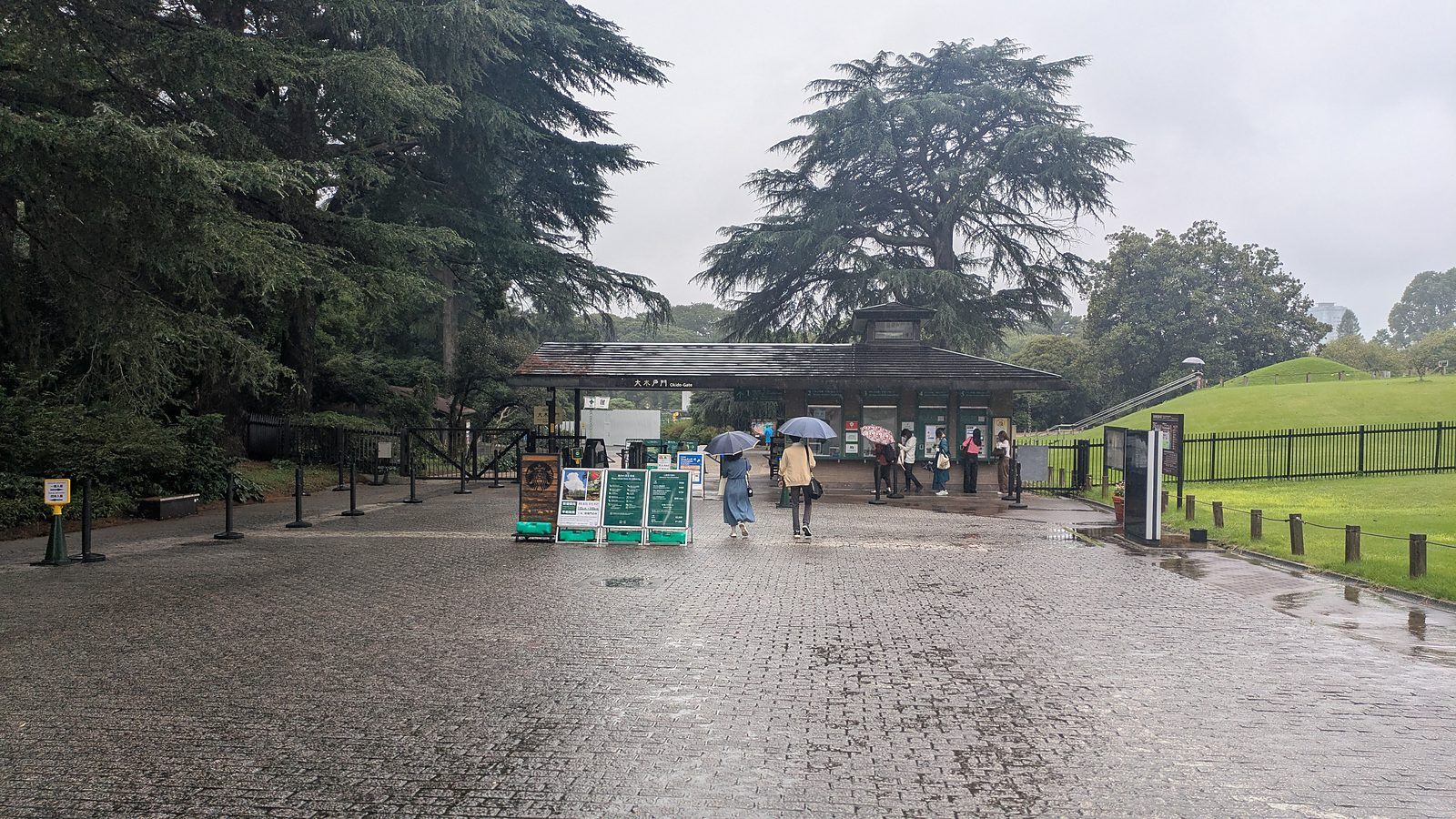
The official English site describes four distinct gardens: a formal garden, a landscape garden, a Japanese traditional garden, and the area around Tamamo Pond. This walk covered the first three, plus the greenhouse and the old rest house, in about 70 minutes at an easy pace in the rain. Tamamo Pond was not on the route.
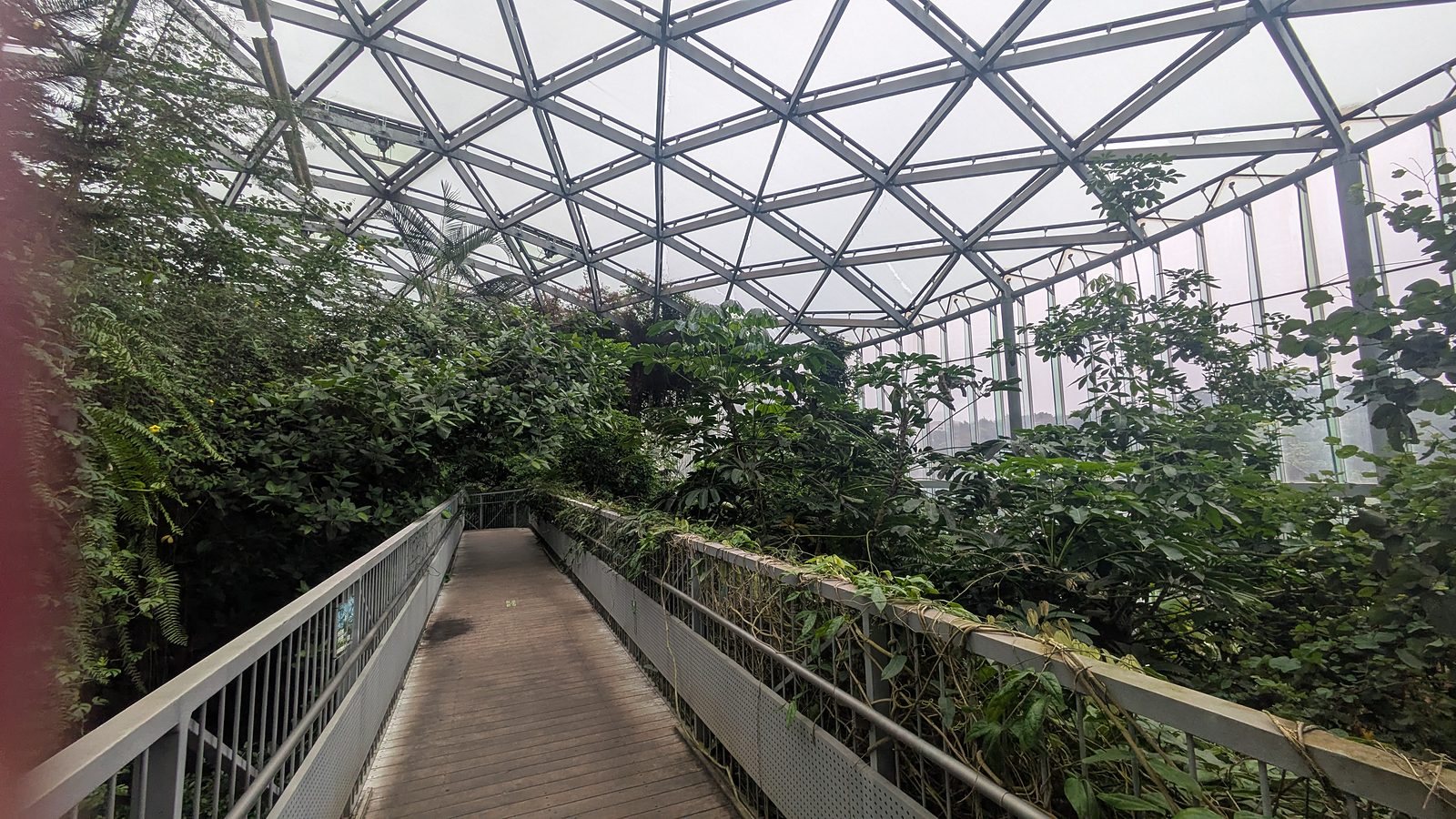
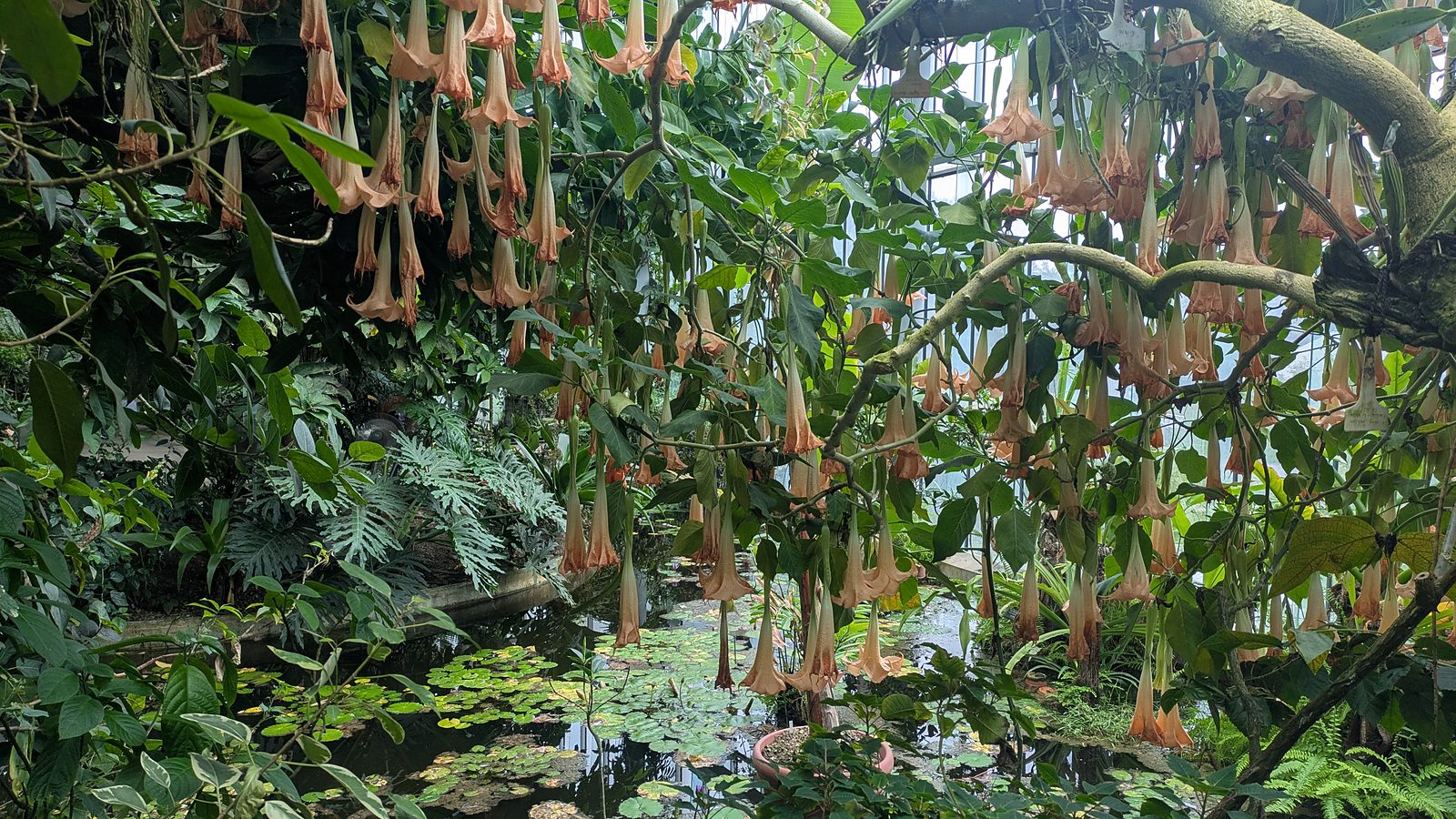
The greenhouse, 13:05. A glass building a few minutes inside Okido Gate, with a raised walkway through tropical planting under a triangulated roof. On the day, anthuriums and angel trumpets were in flower. It keeps its own hours, 09:30 to 17:30 with last entry at 17:00, so it shuts before the garden does.
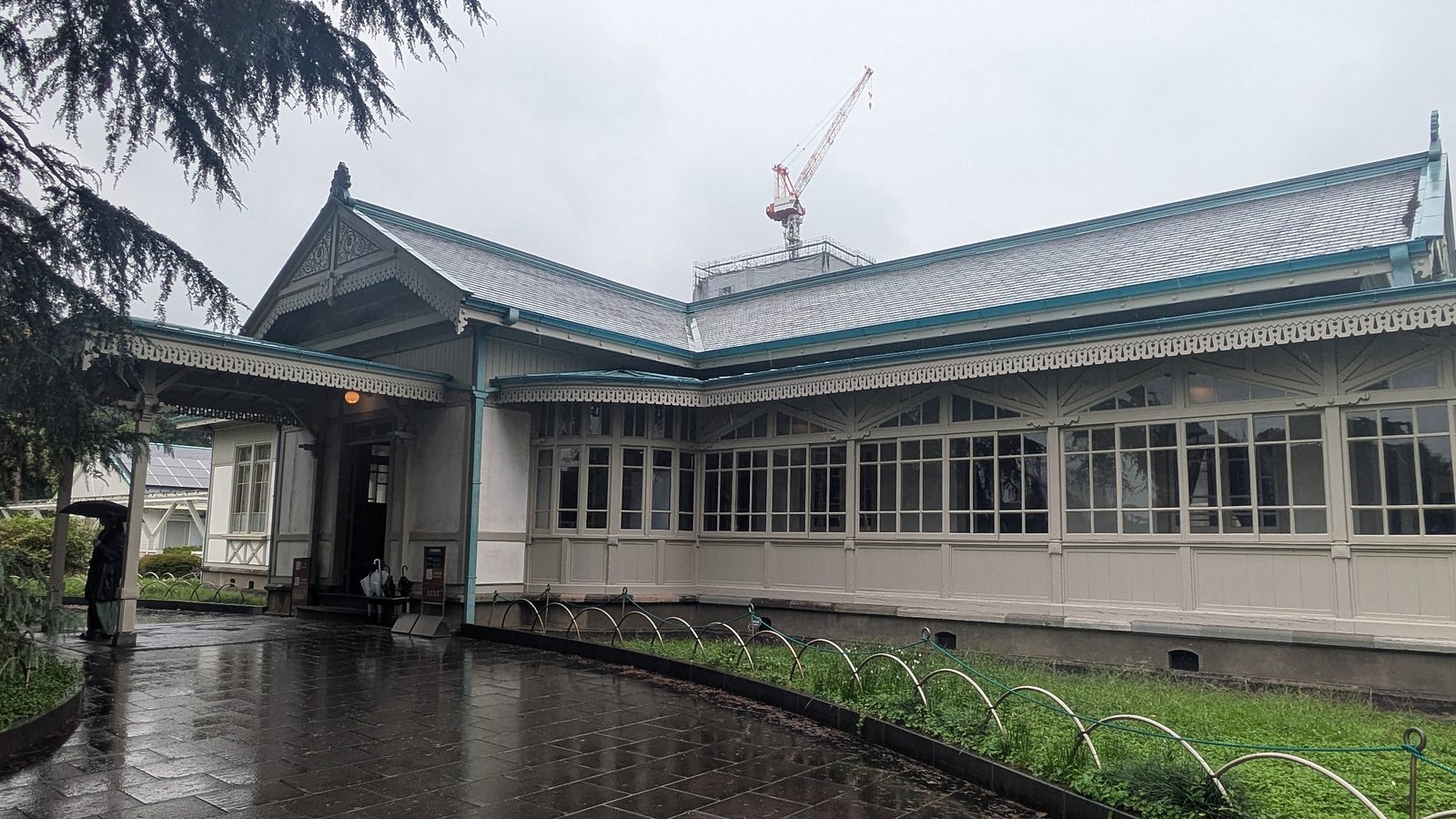
The Old Imperial Rest House, 13:14. A pale wooden building with a green-trimmed roof, one of the few structures in the garden that survived the war. The board beside it gave its hours as 09:00 to 18:00, last entry 17:30.
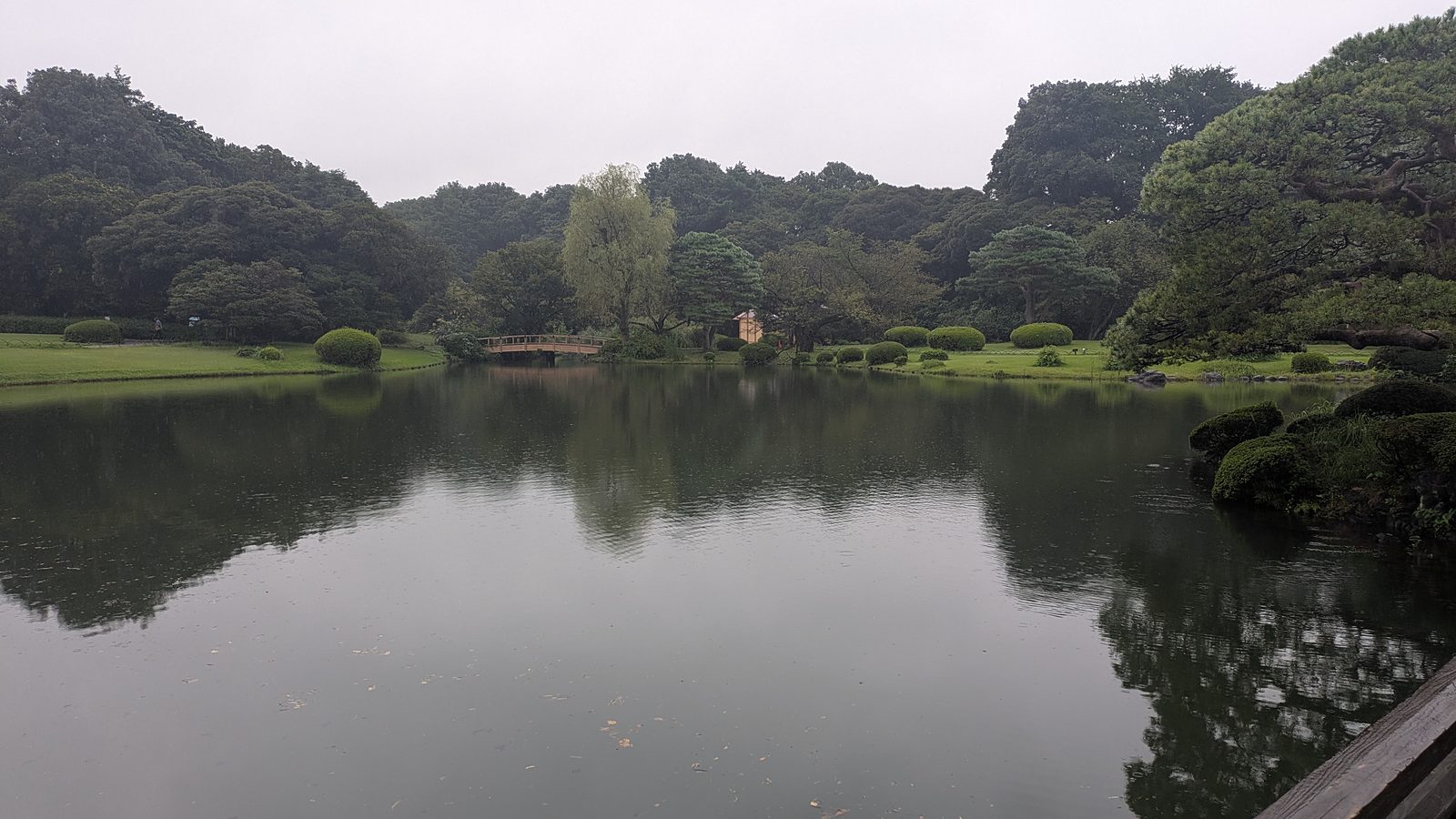
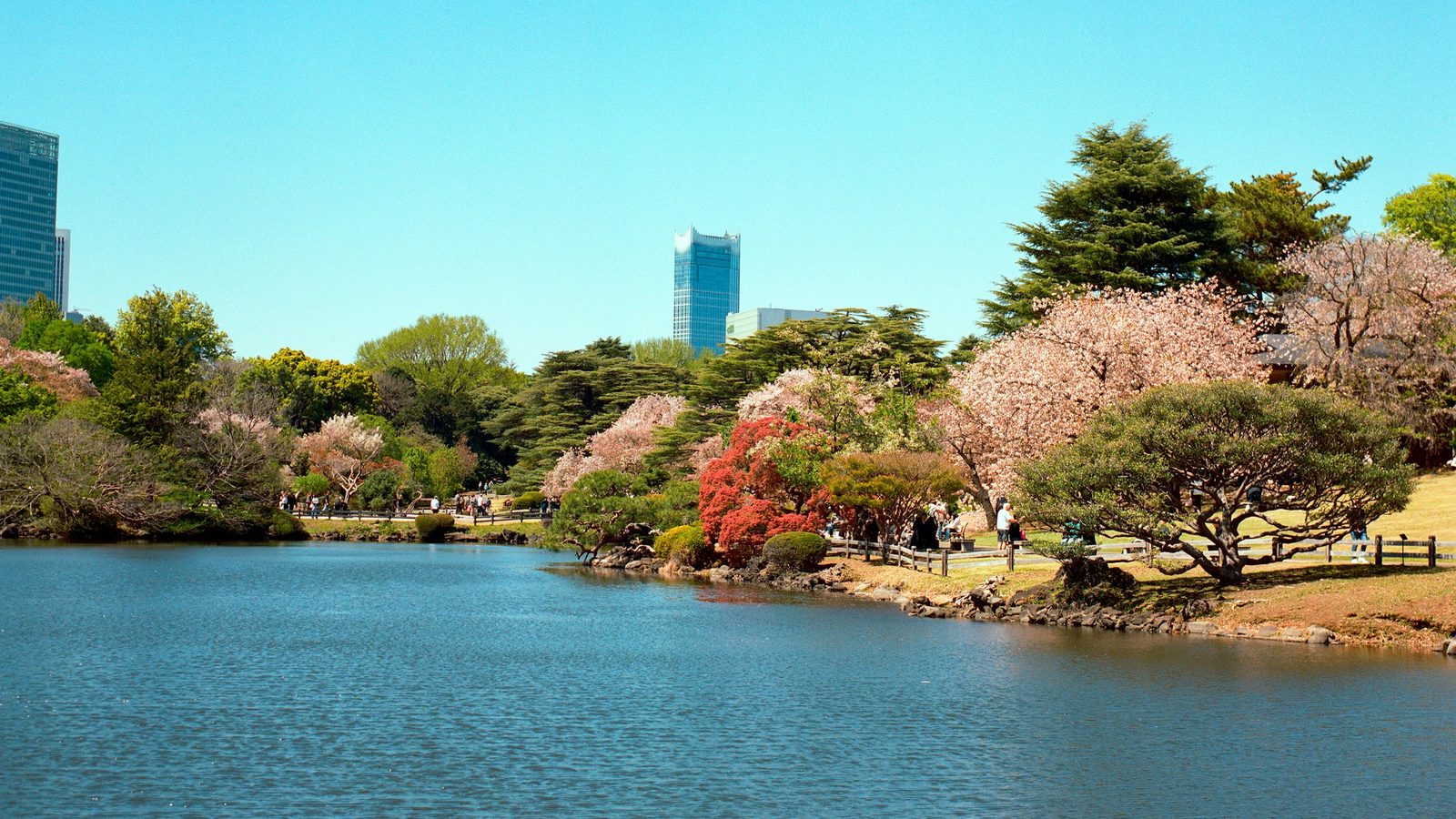
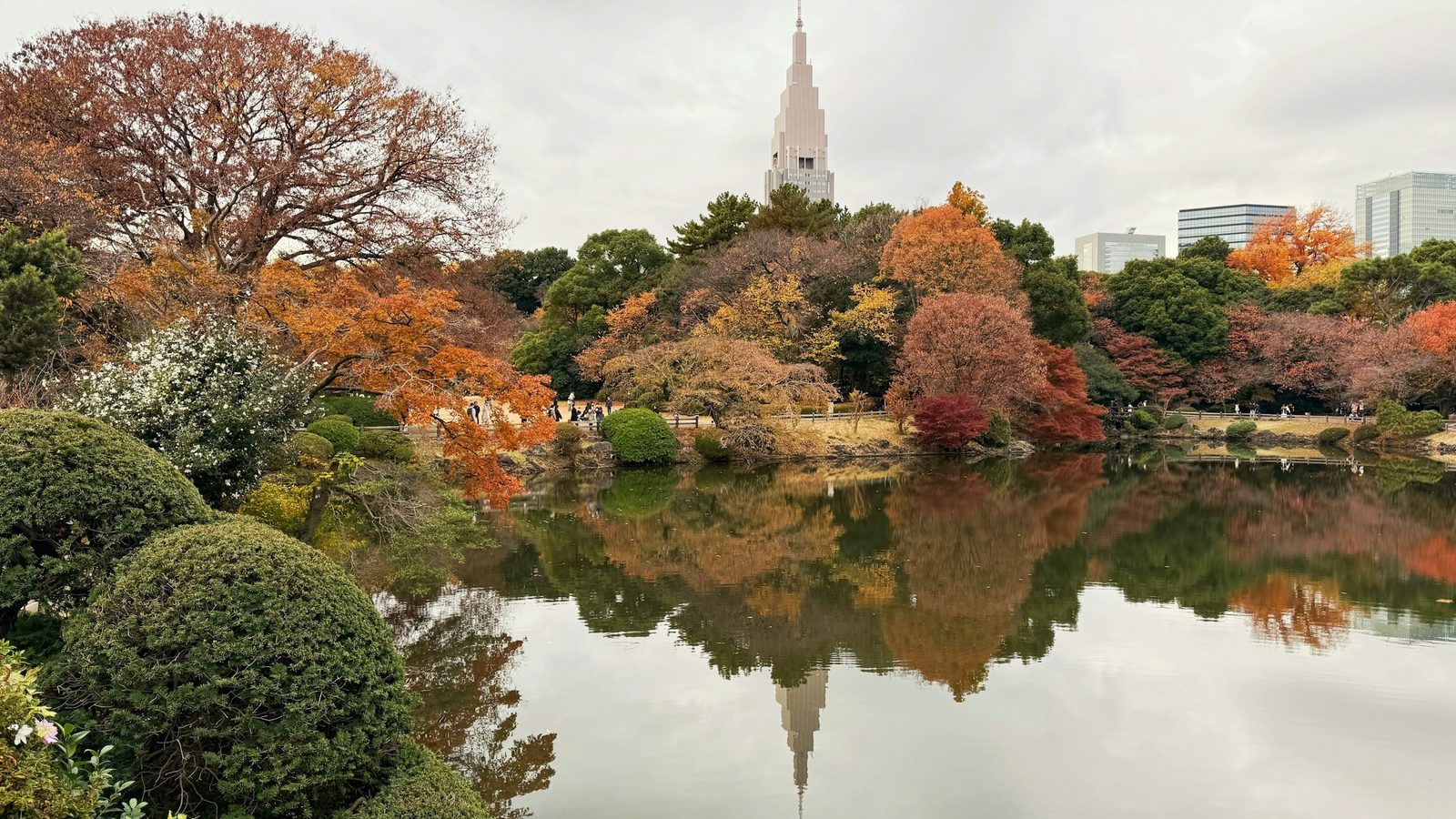
The Japanese garden, 13:26. Ponds, stone lanterns, clipped pines and small wooden bridges, with the Docomo tower rising over the trees. This is the view most photos of the garden use, and even in rain it held up.
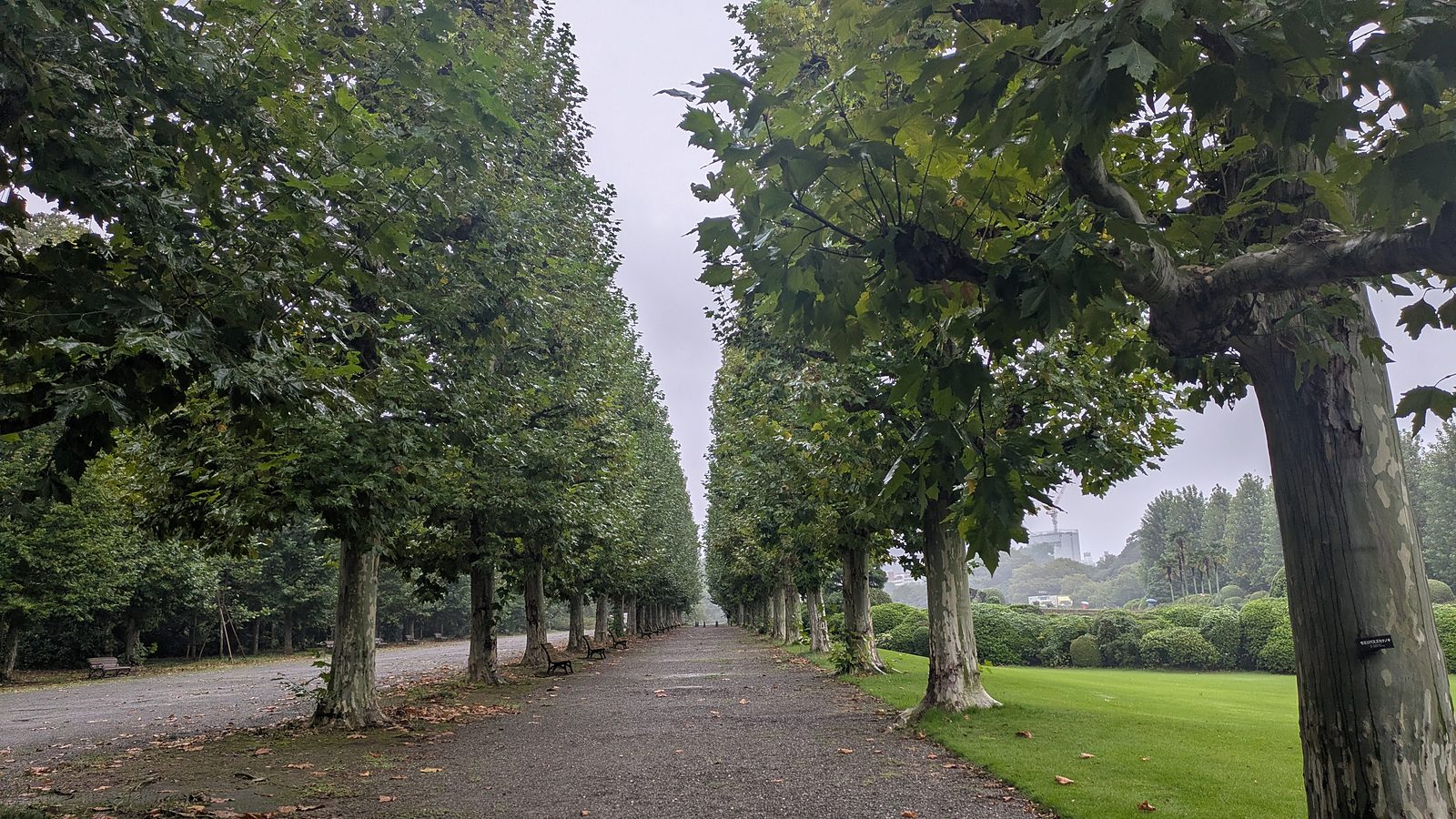
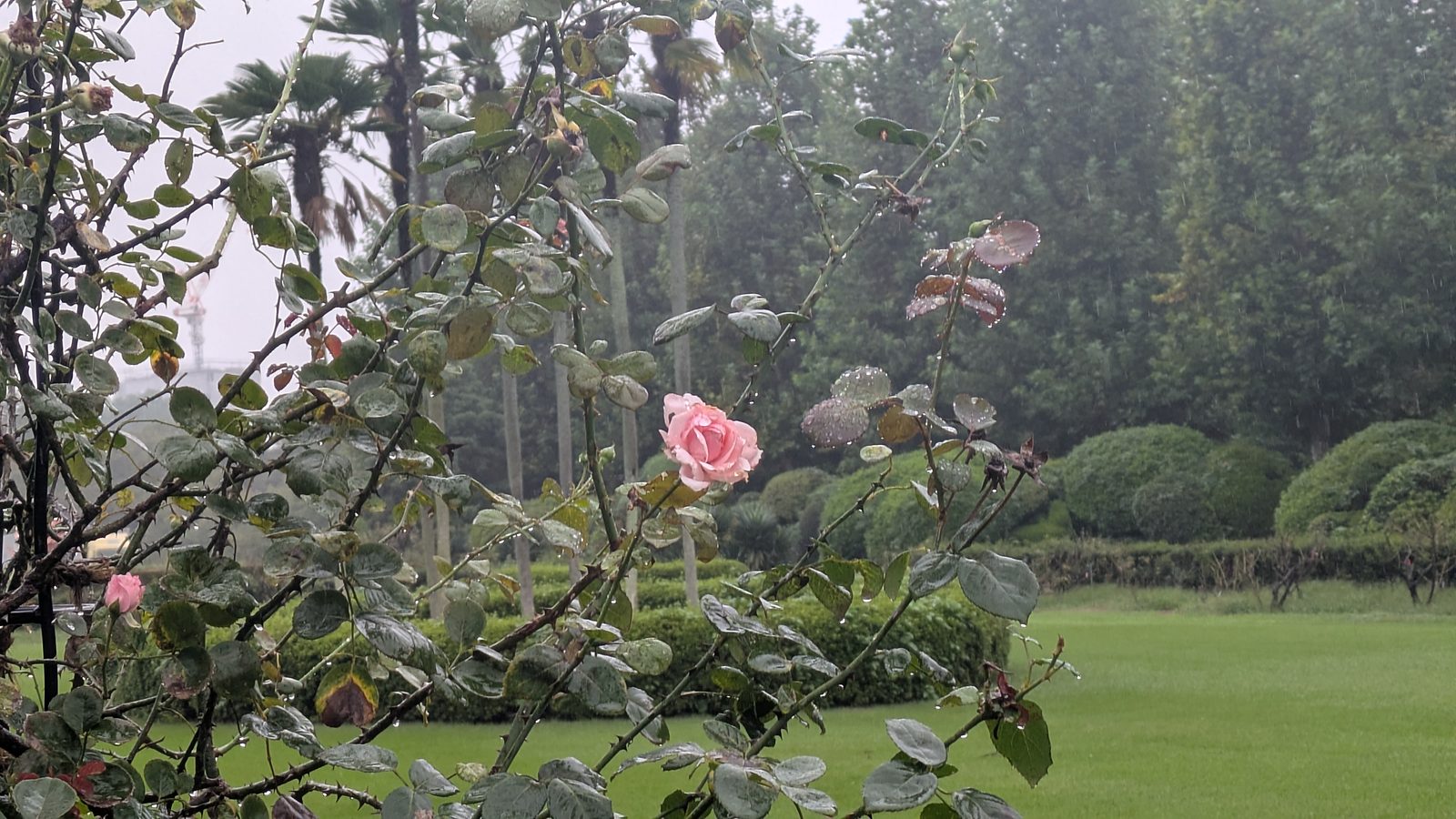
The formal garden, 13:46. Long avenues of plane trees, a round central lawn, and rose beds. In late September a few roses were still out.
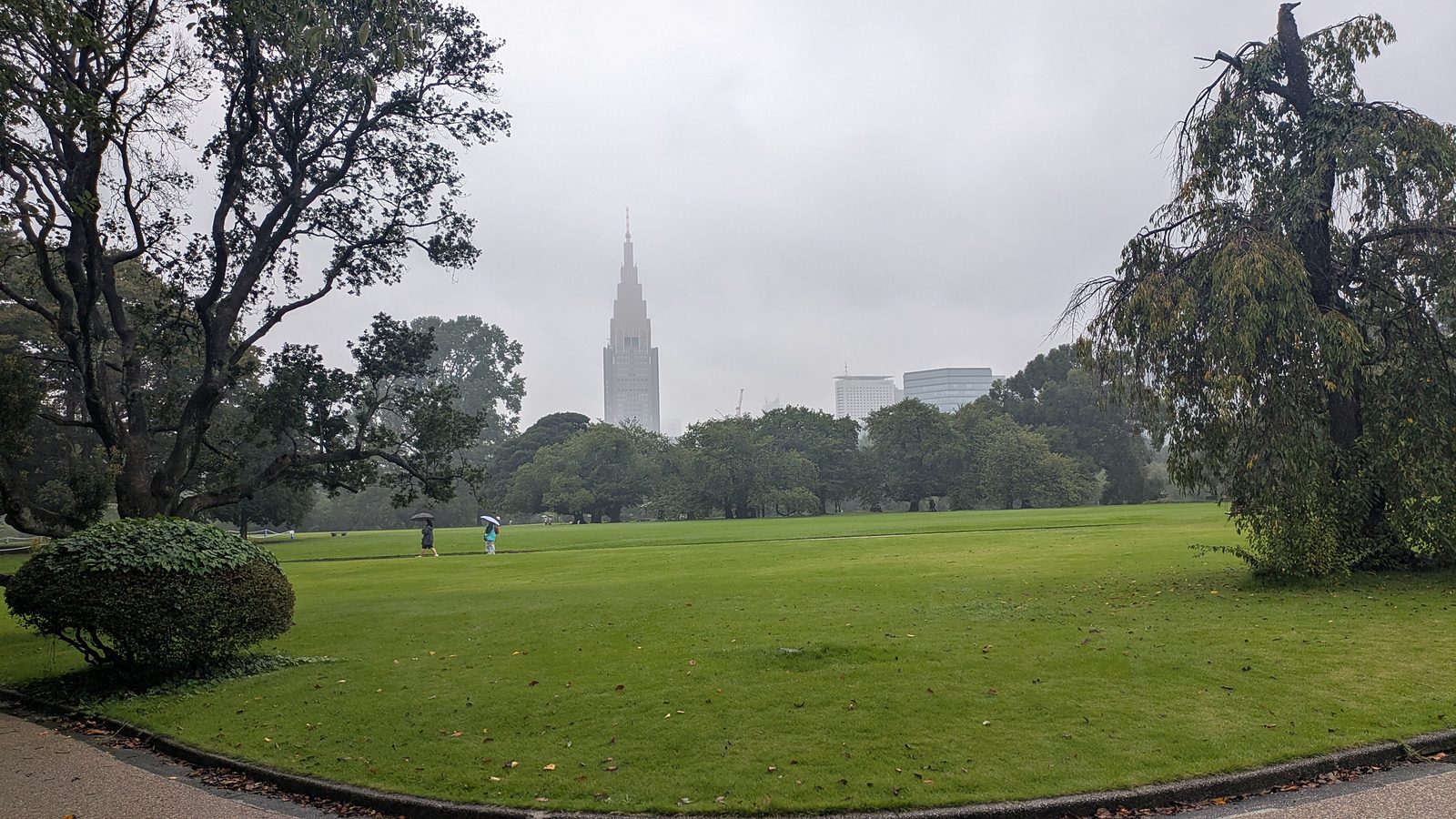
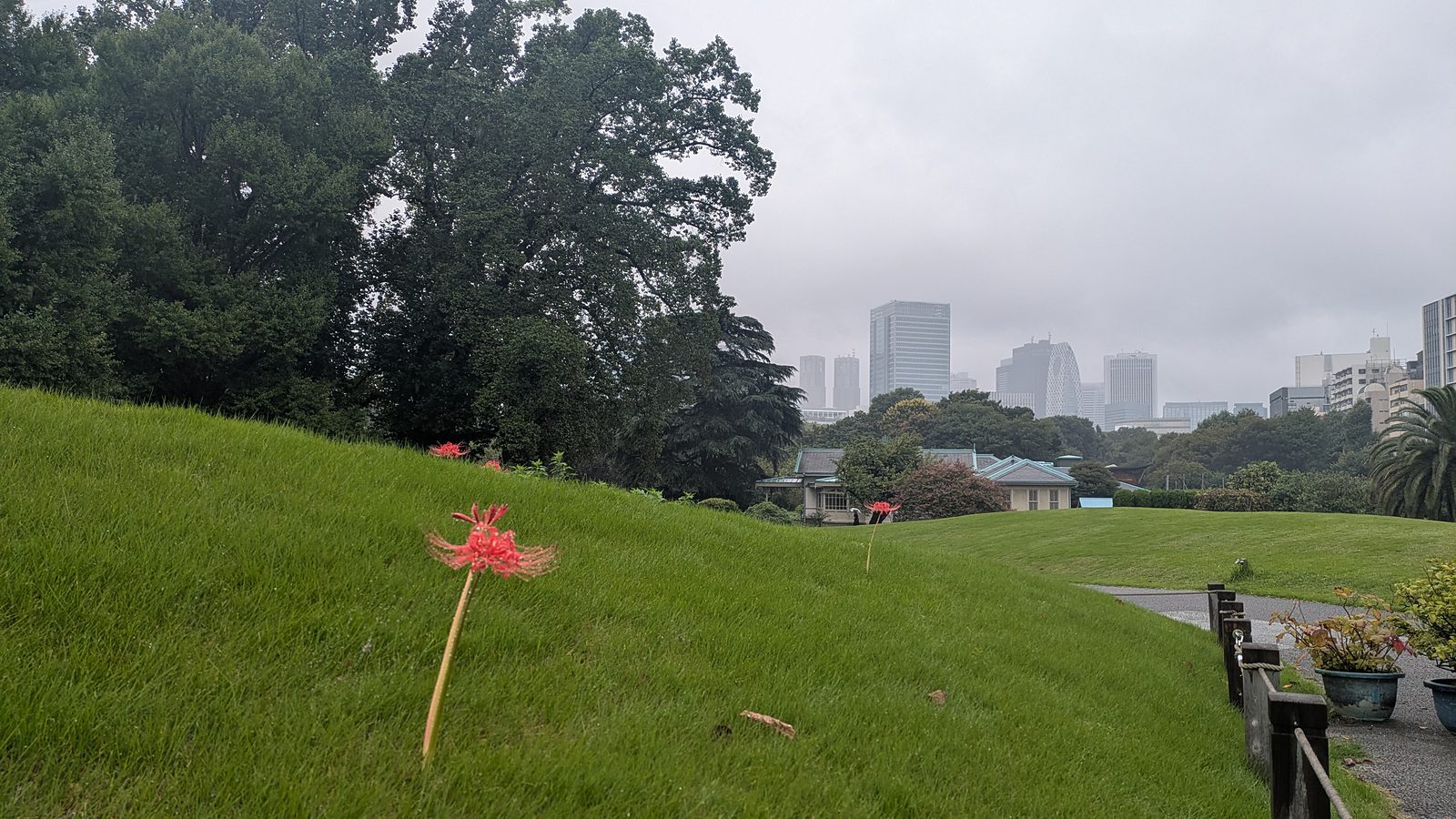
The landscape garden, 14:00. Open lawns with big solitary trees, where people sit in fine weather. In the rain it was nearly empty.
What is in flower depends on when you come
What you see changes a great deal with the month. The official site picks out highlights for each season. These are the ones worth planning around. Treat the months as a guide, because the timing shifts from year to year.
| Season | What to look for |
|---|---|
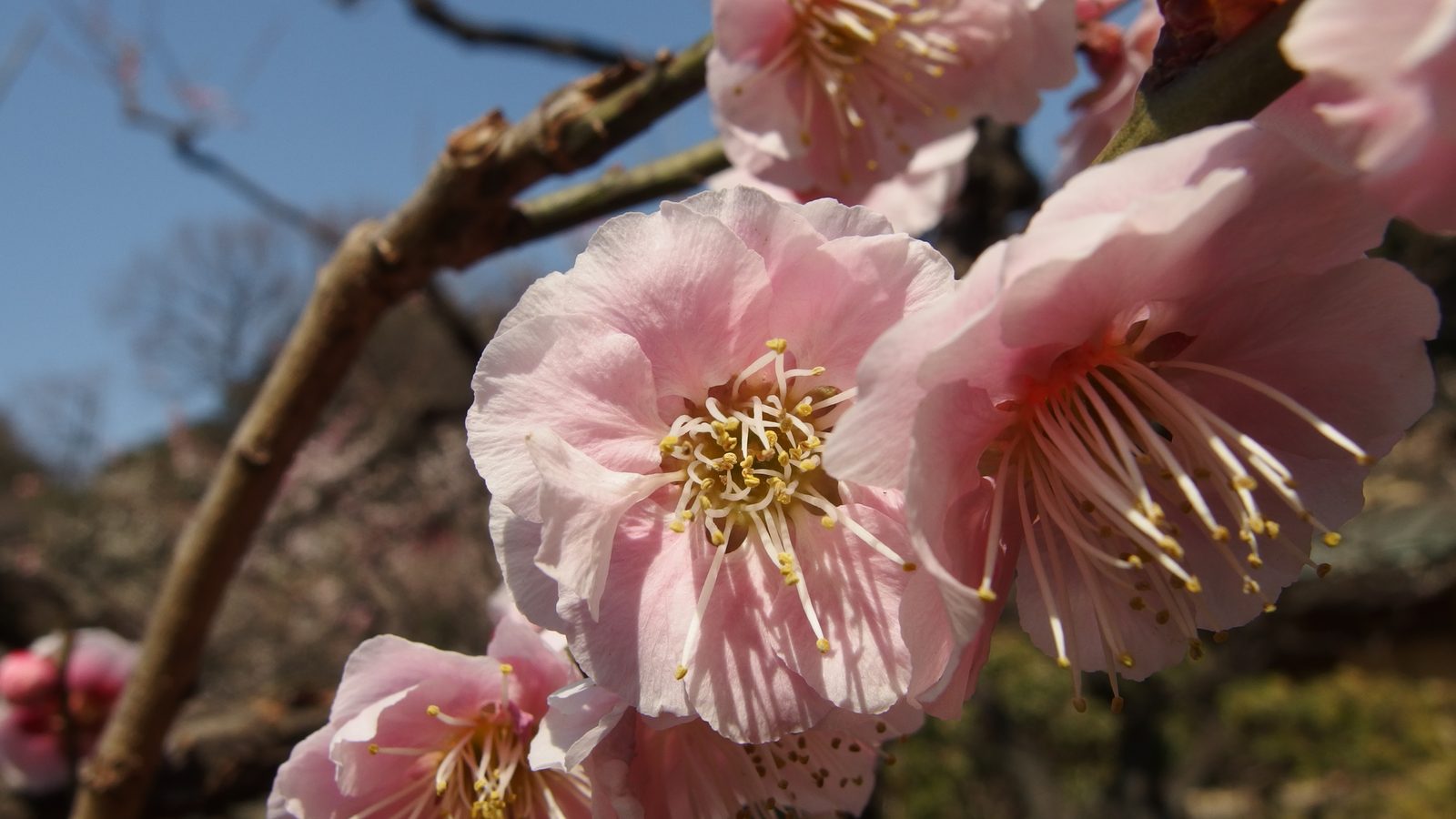
| Spring (March and April) | Cherry blossoms: about 900 trees of around 70 varieties. Early kanzakura from February to early March, Somei Yoshino from late March, double-flowered yaezakura around mid-April |
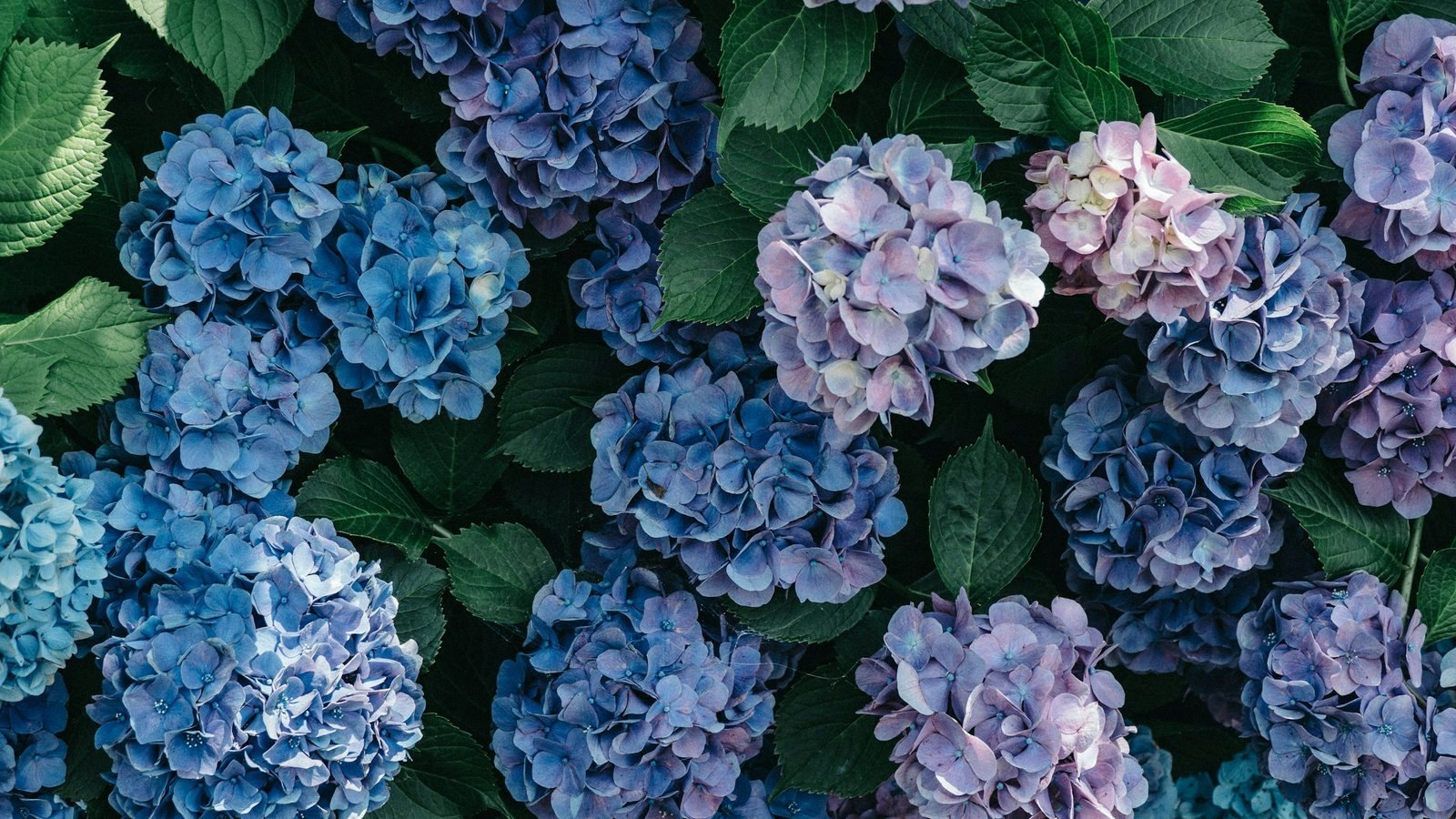
| Summer (June to August) | Hydrangeas in June, crape myrtle in August. From 11 June to 31 July the garden stays open until 19:00. The official site recommends the cool evening hours in summer. |
| Autumn (September to November) | Red spider lilies in September, roses in October, the Chrysanthemum Exhibition from 1 to 15 November, then maples, ginkgo and the gold of the plane trees |
| Winter (December to February) | Japanese apricot (ume) in February, and camellias. The greenhouse stays green all year |
The gate closes to new visitors 30 minutes before the garden does
The closing time is not the time you need to arrive by. Last entry is 30 minutes earlier, all year:
| Period | Open | Last entry |
|---|---|---|
| 15 March to 30 September | 09:00 to 18:00 | 17:30 |
| 11 June to 31 July | 09:00 to 19:00 | 18:30 |
| 1 October to 14 March | 09:00 to 16:30 | 16:00 |
The one that catches people is the change on 1 October. Through September you can still walk in at 17:25. From October the gate stops letting people in at 16:00, which in November is not long after lunch has settled. The greenhouse closes earlier still, with last entry at 17:00 on the day of this visit.
You can decide what time to leave the hotel. You cannot decide what time the gate stops letting people in. Plan backwards from last entry, not from closing.
The English information is accurate. It just does not tell you everything
The official English site for Shinjuku Gyoen is thorough. The rules, the hours, the fees and the closing days are all there, and everything checked for this page matched what was posted at the gate. Three details still took a phone call or a closer look to settle.
The free guided walk is in Japanese. The garden runs a free guided walk on the second and fourth Saturday of each month (not in July and August), at 10:30 and 13:30, about 90 minutes, with no booking. The group meets at the information board just inside Shinjuku Gate on the right. The English page gives every one of those details except the language. The service centre confirmed by phone that the walk is given in Japanese only.
The running board leaves out the spring ban, as covered above. The official rules include it. The board at the gate does not.
The greenhouse tour numbers differ by language. The official English page says the greenhouse tours are limited to the first 20 applicants. The Japanese page gives about 10. If you are planning around one of those tours, call ahead.
None of this is a complaint about the garden. The information is published, in English, and it is correct. But if you want a guide who speaks English, the free walk is not it. Twice a month, in Japanese, the timing is hard to fit into a trip. For an English-language guide on the day that suits you, a paid tour is the realistic option.
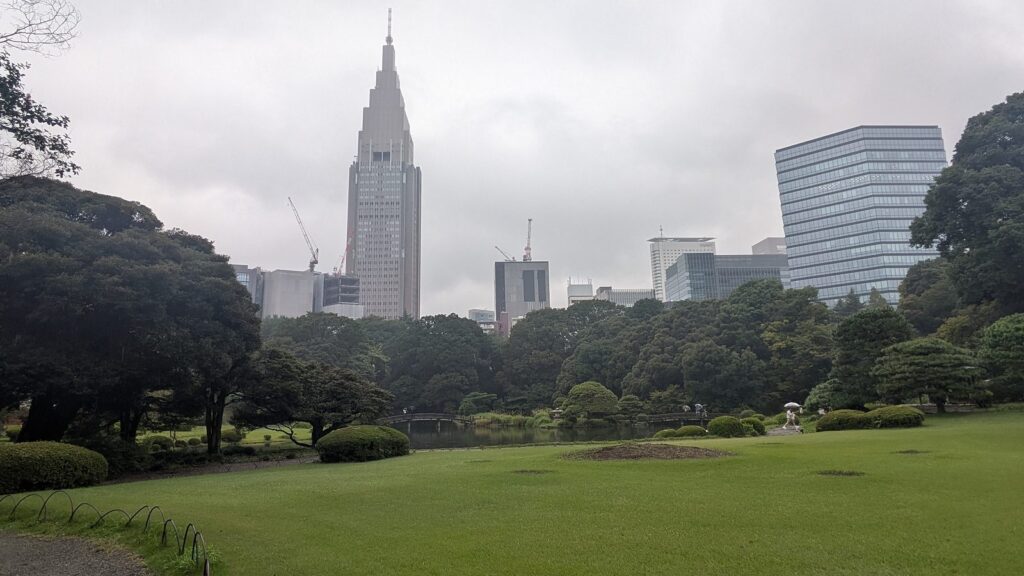
Affiliate link. This site earns a commission if you book through it, at no extra cost to you. Photo from our own walk.
Questions people actually ask
Is Shinjuku Gyoen closed on Mondays? Yes, every Monday, except from 25 March to 24 April and from 1 to 15 November, when it opens every day. When Monday is a public holiday, it opens that day and closes the next weekday.
Is it free? No. Adults pay 500 yen. Children aged 15 and under go in free, and students aged 16 and over and seniors aged 65 and over pay 250 yen.
Is the annual pass worth it? At 2,000 yen against 500 yen a visit, it pays for itself on the fourth visit. It is issued from 09:00 until one hour before closing.
Can I really not drink there? Really. Alcohol cannot be brought in or drunk inside, and the rule is posted in English at the gate. For a drink under the trees, go to Yoyogi Park or Ueno Park.
Can I eat there? Yes. Picnics on the grass are fine. Fires, stoves, tents and parasols are not, and neither is holding the same spot for a long time.
Can I run there? Yes, on the designated course only, in groups of nine or under, and not from 25 March to 24 April.
Can I bring a bike? No. Bicycles, balance bikes, scooters and skateboards are not allowed in.
Can I bring my dog? No. Assistance dogs are the only exception.
Can I take photos, or use a tripod? Photos for your own blog or social media need no permission; the service centre confirmed this by phone. Commercial photography or filming needs an application. Leave the tripod at home unless you have checked first: the official rules restrict camera equipment in the busiest seasons, and the ticket listing sold through GetYourGuide names tripods as not allowed.
Is it open at night? No. The gate stops letting people in 30 minutes before closing, at 16:00 from October. At the time of writing, the service centre had no plans for an illumination event.
Is it good in the rain? Better than you might expect. The greenhouse is under glass, the paths are firm, and the lawns were nearly empty on a wet public holiday.
Is it good with children? Yes. Children aged 15 and under go in free, and the Kids Area allows soft play equipment for children of primary school age.
Where are the toilets? They are marked on the garden map boards at the entrances, in English.
How is it different from Ueno Park or Yoyogi Park? Those are public parks: free, open late, and fine for a drink. Shinjuku Gyoen is a garden with an entry fee, a closing time, and rules that keep it quiet.
Can I pay without cash? Yes. The machines take credit cards, IC cards and QR payments, and you can tap an IC card or a Visa contactless card directly at the gate.
Is it worth it? If you want an hour or two of quiet in the middle of Shinjuku, yes. If you want a party under the trees, it is the wrong place, and that is by design.
If you would rather walk the garden with someone explaining it in English, one two-hour guided walk of Shinjuku Gyoen covers the Japanese, landscape and formal gardens, with admission included. It runs all year, on the days the garden is open.
Affiliate link · About 2 hours · Admission included · Free cancellation up to 24 hours before
What to settle before you go
Three things, in this order:
- Check the day. If it is a Monday, check whether it falls from 25 March to 24 April or from 1 to 15 November. If not, choose another day.
- Leave the alcohol behind. Bring food if you want. Not the beer.
- Bring a card or an IC card. Tap in at the gate, or buy the ticket at the machine in under a minute.
Then plan backwards from last entry, which is 16:00 from October.